
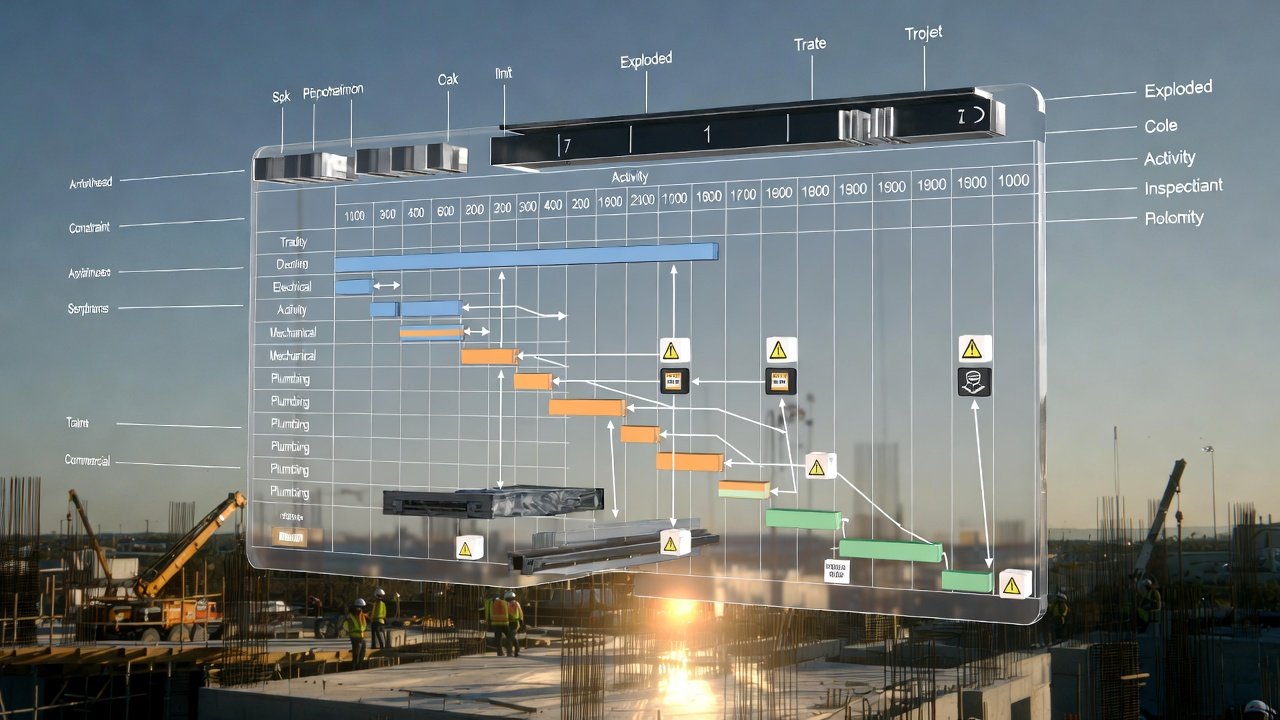
I've seen two kinds of look-ahead schedules on a jobsite. The first is a living document — dog-eared, marked up in the trailer, pulled up on three phones during the Monday coordination meeting, argued over because it actually decides who works where. The second is a beautiful PDF nobody has opened since it was printed. Same tool, same trade, wildly different outcomes. The difference isn't the software or the format. It's whether the person building it understood what a look-ahead is actually for.
A look-ahead schedule is not a shrunk-down copy of your CPM master schedule. The master tells you the contractual finish and the critical path. The look-ahead tells your electrician where to plug in Tuesday morning and whether the wall he needs is even framed yet. Those are different jobs. Get the anatomy right and the thing runs your job. Get it wrong and it becomes wallpaper. Here's what the good ones have in common.
The right level of detail
The most common way to kill a look-ahead is to get the granularity wrong, and people miss in both directions. "Rough-in Building A" is useless — it doesn't tell a foreman what to hang Monday. "Install junction box J-247" is worse; nobody is tracking individual boxes across a three-week window, and the sheer count of lines buries the plan.
The rule of thumb I use: an activity should be roughly one to five crew-days of work, and it should be tied to a location. "Electrical rough-in, Level 2 east, units 201–208" is right. It's big enough to plan around, small enough that you'll actually notice if it slips, and specific enough that two trades reading it know whether they're in each other's way.
When a master-schedule line is too coarse — and it almost always is — break it down for the look-ahead only. You don't need to re-baseline the master to split "MEP rough-in, Level 2" into the four or five real work packages your crews will chew through. The look-ahead is where the master schedule meets the tape measure.
Descriptions a stranger could execute
Every line should be readable by someone who wasn't in the meeting where it was created. That means plain language, not master-schedule codes. "ELEC-2A-203" means nothing to the drywall foreman who's trying to figure out if he's clear to close a wall. "Electrical rough-in, L2 east corridor, complete Thursday" means everything.
Good descriptions answer three questions without making anyone ask: what work, where, and how much. If your activity names pass the test where a new super could walk on site, read the line, and go point at the exact spot the work happens — you're there. If they need a decoder ring and a copy of the master, you're not.
Durations you actually believe
Optimistic durations are how a look-ahead loses its credibility, and once it loses credibility it's done. If the drywall foreman has watched "tape and finish, Level 3" get planned as three days for the fourth time when it's always taken five, he stops reading your dates. Worse, so does everyone downstream of him, because now nobody trusts the sequence.
Realistic durations come from three places: your own historical production on this job, honest input from the trade doing the work, and a clear-eyed look at site conditions. A crew of four hanging board on an open floor plate is not the same production as the same crew working around inspectors, stored material, and a hoist that's tied up half the day. Build the look-ahead around what the site will actually let happen, not what the estimate assumed.
This is also where the weekly commitment loop earns its keep. When you sit down Friday and the foreman commits to next week's dates in his own words, he's stress-testing your durations for you. If he flinches at a date, that's data — the duration is probably wrong, or a constraint is hiding.
Dependencies made visible
Construction is a relay race, not a set of parallel sprints, and the hand-offs are where jobs bleed time. The whole point of trade-flow sequencing is to make those hand-offs impossible to miss. When the drywall crew can see on the plan that their start is chained to electrical rough-in and inspection, they stop showing up to a wall that isn't ready. When the electrician can see that three trades are stacked behind him, he understands why his slip isn't just his problem.
You don't need a full CPM network diagram in the field — that's overkill and nobody reads it. What you need is the local logic visible: this comes before that, this trade hands off to that trade, in this location. A good look-ahead tool draws those trade-flow connections so a foreman can trace the baton from his work to whoever's waiting on it. That single feature converts a schedule from a list of dates into an accountability map, and accountability is what actually pulls a job forward.
Constraints tracked out in the open
Here's the line that separates a real short-interval schedule from a wish list: a good look-ahead shows you not just what's planned, but what could stop it. An activity is not ready to run just because its start date arrived. It's ready when the material is on site, the prerequisite work is signed off, the inspection is booked, the crew is confirmed, and the information — RFI answered, submittal approved — is in hand.
Track those constraints where everyone can see them. The make-ready idea from the Last Planner System is simple and it works: as an activity comes into the window, you walk its constraints and knock them down one at a time before the start date, not on it. My habit is a hard question in the Monday meeting for anything starting in the next two weeks — "what's not ready?" — and I don't let the line go green until someone owns the answer. The activities that quietly aren't ready are the ones that blow up your Thursday.
An owner on every line
Every activity needs a name attached — a person responsible for it actually happening, not just a trade abbreviation. And it's not only the crew doing the work. If the tile can't start until the mud sets and the material clears customs, someone owns that delivery date and someone owns that inspection. Write those owners down.
The failure mode here is the orphaned constraint: the delivery everyone assumed the other guy was tracking, the inspection nobody called in because it wasn't anybody's job. A look-ahead that assigns constraint ownership alongside activity ownership is how you keep things from falling into that gap. A foreman should be able to open the plan and see both the work he's performing and the two deliveries he promised to chase for the crews behind him.
Sequence that's buildable, not just schedulable
Calendar order and construction order are not the same thing, and the gap between them is where good-looking schedules fail in the field. Activities should flow the way crews actually move — by area, by floor, by zone — not in a flat alphabetical or CPM-ID list. A schedule can be perfectly valid on paper and completely unbuildable because it has two trades trying to occupy the same 400 square feet on the same afternoon, or a crew bouncing between three buildings to hit dates that were never sequenced spatially.
Organize the look-ahead by location and you catch these collisions before they happen. When you can see all the work planned in L2 east this week in one block, the double-booking jumps out. Location-based sequencing is also just how superintendents already think — you walk the job by area, so plan it by area. The schedule should read like a walk through the building, one space handing off to the next.
A horizon that fits the job
Three weeks, four weeks, six weeks — the right window depends on the job, not on a template. A fast interior fit-out with short lead times runs fine on a three-week look-ahead; you can see everything you need to make ready and the plan stays honest. A structural or civil job with long-lead steel, precast, or equipment needs six weeks or more just to protect the deliveries that will otherwise ambush you.
Push the horizon too short and you're constantly surprised by material that needed ordering weeks ago. Push it too long and the far weeks turn into fiction — you're planning detail nobody can commit to, and the fiction erodes trust in the near weeks that matter. Match the window to your longest routine lead time plus a little margin, and revisit it if the job's pace changes.
The rolling update that keeps it alive
The best-designed look-ahead is dead the moment you stop updating it, and this is where most of them die. It's a rolling plan: every week you drop the week that just finished, roll a new week onto the far end, record what actually got done, adjust dates, and refresh commitments. The near week — this week — is the commitment zone, where crews have said out loud "yes, we'll do this." The later weeks are planning, still soft.
Keep the update cheap or it won't happen. If refreshing the plan takes two hours in a spreadsheet every Friday, it gets skipped the first busy week and never comes back. This is the honest case for purpose-built tools like LookAheadWall over a hand-maintained grid — when rolling the window, recording actuals, and re-sharing with your subs is a few minutes instead of an afternoon, the discipline actually survives contact with a real jobsite. The tool matters less than the habit, but the tool is what protects the habit.
It has to touch the daily plan
A look-ahead that lives only in the trailer isn't finished. Its job is to feed the weekly work plan and, through that, the decision a foreman makes at 6:45 Monday morning about where to send his crew. That connection is the whole reason the thing exists — planning that never reaches the point of the tool is just paperwork.
When it's working, any crew leader can pull up this week on his phone and know three things cold: what he's supposed to finish, what's happening in the spaces around him, and what he has to get ready for next week. The companion mobile view exists for exactly that moment — the plan in the field, in the hand of the guy swinging the hammer. Get all the pieces above right — honest detail, real durations, visible trade flows, tracked constraints, named owners, buildable sequence, a fitting horizon, and a rolling update that never stops — and the look-ahead stops being a document you maintain. It starts being the thing that runs the job.