
What "Rolling" Actually Means on a Jobsite
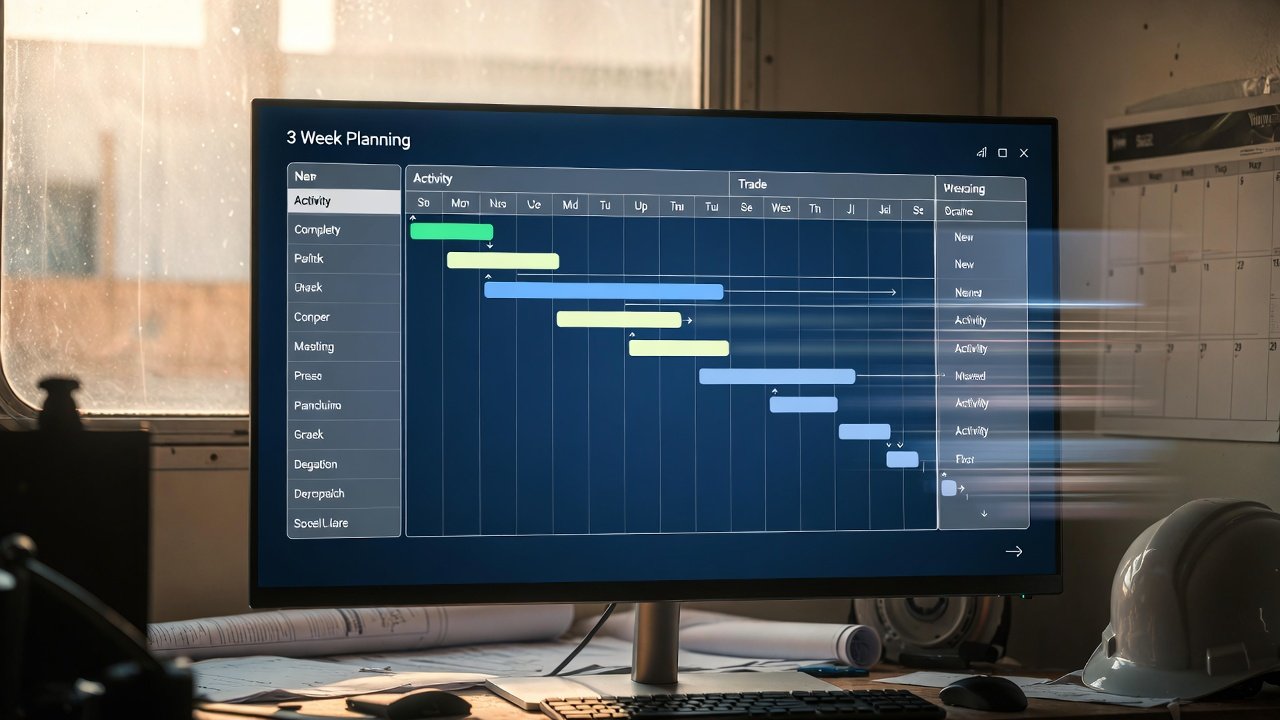
A rolling lookahead is just a planning window that moves with you. Pick a horizon — most crews run three or four weeks — and every week the finished week falls off the back while a fresh week appears on the front. You always see the same distance down the road, whether you're in week 2 of the job or week 40.
That sounds obvious until you watch what happens when a schedule doesn't roll. The classic failure is the schedule that shrinks. A super pulls a six-week lookahead off the master at the start of the job, tapes it to the trailer wall, and works off it. Six weeks becomes five, then four, then two, and by the time anybody notices they're planning a week at a time in reaction mode — ordering material the day it's needed, discovering the fire-caulk inspection has to happen before the drywallers can close up, finding out the elevator guys were never told the shaft was ready. A rolling window is the discipline that keeps that from happening. You're not planning less as the job gets deeper. You're always planning the same amount, forever, until the punch list.
The other thing worth saying up front: the point of a lookahead isn't to predict the future. It's to surface the things that will stop work before they stop it. A good rolling schedule is really a constraint-hunting machine dressed up as a calendar.
Picking Your Horizon
Three weeks is the workhorse. It's long enough to get material ordered, permits pulled, and prerequisite trades lined up, but short enough that the work in the window is real and actionable instead of a guess. If you can only run one horizon, run three.
Go to four weeks when your procurement or your reporting demands it. Long-lead items — switchgear, custom glazing, elevators, anything with an eight-to-twelve-week lead you're releasing in stages — need that extra week of runway so you're confirming deliveries against real dates, not hoping. Four weeks also lines up cleanly with monthly owner reporting and pay apps, which saves you rebuilding the same picture twice.
Six weeks is a specialist tool, not a default. It earns its keep on heavy MEP coordination, phased permit work, or jobs where the critical path runs through a supplier you don't control. The catch is that weeks five and six are soft — the further out you look, the more the plan is fiction — so you spend real effort maintaining detail that keeps changing. Don't run a six-week horizon because longer feels safer. Run it because you have a specific week-five or week-six constraint that will hurt you if you don't see it coming.
A practical rule: your horizon should be a little longer than your longest routine make-ready cycle. If it typically takes you two weeks to clear a constraint — get a submittal approved, get material delivered, get an area released — then a two-week window is useless because everything in it is already locked. You need the constraint to appear while you can still do something about it.
The Weekly Cycle That Makes It Work
The rolling window is worthless without the weekly ritual that drives it. This is the part teams skip when they get busy, and it's exactly the part that can't be skipped. A tight cycle looks like this:
- Score last week honestly. Every task you committed to either got done or it didn't. Mark it. Don't fudge partials into "basically done." If you're tracking Percent Plan Complete — and you should be — this is where the number comes from, and a number you've been massaging is worthless.
- Ask why on every miss. This is the single highest-value thing in the whole process. For every task that didn't complete, write down the reason in plain language: material late, prerequisite trade behind, RFI unanswered, crew pulled to another area, weather, bad duration estimate. These reasons are gold. Six weeks of variance notes will tell you more about what's actually wrong with your job than any dashboard.
- Roll the window and hunt constraints. The new week is now in view. Walk every task in it against the make-ready checklist below. Anything not clear becomes an action with a name and a date on it.
- Get real commitments. The foremen — not you — commit to what their crews will actually do next week, based on what's genuinely ready. A commitment made under pressure that everyone knows is fake poisons the whole system. "Should be ready" is not a commitment.
Done right, this is a 30-to-45-minute meeting, not a half-day. The weekly work plan for the coming week falls straight out of it — it's just the set of tasks that survived the constraint check and got committed to. Tools like LookAheadWall roll the window automatically and carry your notes and refinements forward so the mechanical part takes seconds and the meeting stays focused on the two things that matter: why work missed, and what's genuinely ready to go.
The Make-Ready Check — Run It Every Week
"Make-ready" is the work of removing constraints so a task can actually start on the day you planned it. Before any task graduates from the lookahead into a committed weekly work plan, it should clear a check like this:
- Prerequisite work complete and inspected. Not "the framers are almost done." Done, signed off, and — critically — the buffer inspection is passed. Frame-to-rough-in usually wants a day or two of slack for cleanup, corrections, and the inspector's schedule. Don't stack the electrician on top of framing that hasn't been signed.
- Material on site or confirmed for delivery. A PO is not material. Confirm the delivery date against the day you need it, with a buffer, and physically eyeball long-lead items when they land.
- Information cleared. No open RFI, no unapproved submittal, no unresolved conflict on the drawings for that area.
- Labor and equipment available. The crew size the task needs, plus any lift, pump, or specialty tool, actually reserved for those days — not double-booked in another area.
- Area released. The space is accessible, safe, and not owned by another trade. Layered trades in one room is where schedules quietly die.
- Inspection or hold points scheduled. If the wall closes behind this work, the inspection is booked before you plan the close, not after.
The old carpenter's version of this: megger your runs before you close the wall, and pressure-test the pipe before the drywallers show up. Every trade has its own version of the mistake that's cheap to catch this week and brutal to fix next week. The make-ready check is where you catch them.
Trade-Flow Gotchas the Window Exposes
A rolling lookahead is where sequencing problems become visible while you can still fix them. A few that show up over and over:
- MEP overhead pile-ups. Duct, then major plumbing, then conduit and cable tray, then fire sprinkler, roughly in that order because of who owns the top of the ceiling. When all four try to occupy the same corridor in the same week, someone loses. The window lets you stagger them by area a week ahead instead of refereeing a turf war on the deck.
- Inspection bottlenecks. Rough-in inspections gate insulation and drywall. If you've got twelve units hitting rough-in the same week, your inspector can't cover them all, and you'll have crews standing around waiting on a signature. Spot that cluster three weeks out and spread the finishes.
- The cure-time trades. Concrete, self-leveler, fireproofing, waterproofing, epoxy floors — anything that has to sit. These bite because the delay is invisible on a bar chart. Build the cure time into the sequence as its own line, or the finish trade will show up to a floor that isn't ready to walk on.
- Backfeed dependencies. The trade you forgot needs the area after the one you're focused on. Ceiling grid can't close until the fire alarm devices are in; paint can't finish until the last penetration is fire-caulked. Trade-flow connections in your schedule make these dependencies show themselves instead of ambushing you.
When the Job Speeds Up or Slows Down
No job runs at constant velocity, and the rolling window handles both directions — if you let it tell you the truth.
When you're behind and compressing, more tasks crowd into the same window. The temptation is to commit to all of them and hope. Don't. Compression is only real if the constraints clear and the crews and lifts actually exist. A rolling schedule that shows you five trades needing the same lift in the same week isn't a problem to hide — it's the reason your acceleration plan is aspirational, and better to know now than Thursday afternoon.
When you're slipping, the win of a rolling window is that stuck work doesn't fall off the radar. A task that keeps sliding stays in view, keeps getting a variance reason, and keeps demanding attention until it's actually done. Fixed-milestone schedules let problems disappear between updates. The rolling approach won't let a stuck task hide.
Keeping It Tied to the Master Schedule
The lookahead is not a replacement for the master schedule — it's the high-resolution view of the next few weeks of it. The two have to stay talking. The master typically updates monthly and defines the milestones and the critical path; the lookahead updates weekly and turns the next chunk of that into real, constraint-cleared tasks.
Information flows both ways. When the master moves a milestone, the affected tasks in your window shift with it — but your field refinements and constraint notes shouldn't get wiped in the process. And when your weekly reality shows a stretch of work running faster or slower than the master assumed, that's a signal the master needs updating, not something to quietly absorb. If your lookahead has said "this area is two weeks behind" for a month and the master still shows on-time, one of them is lying, and it's usually the master.
The Discipline Is the Whole Game
None of this is complicated. That's the trap. The rolling lookahead fails for exactly one reason almost every time: the team stops doing the weekly cycle when things get hard. And things always get hard — that's construction. The week you're firefighting a slab pour or a failed inspection is precisely the week the discipline pays off, and precisely the week it's tempting to skip.
Two things build the habit. First, keep the cycle short and boring — same day, same time, same 40 minutes, every week, no exceptions. Predictability is what turns it from a meeting into a reflex. Second, measure it. Track Percent Plan Complete week over week. When foremen see their own commitment reliability as a number, "should be ready" quietly disappears from the conversation and real commitments take its place. Software that automates the rollover, carries your notes forward, and captures variance reasons — LookAheadWall among them — removes the friction, but no tool makes the team show up. That part is leadership.
Run the window honestly for a few months and something else happens: you get smarter. The variance reasons pile up into patterns. You learn that your duration estimates for a particular trade are always optimistic, that a certain supplier is always a week late, that rough-in inspections always bunch up. That accumulated knowledge — not the calendar itself — is the real payoff of rolling lookahead scheduling. The schedule is just the mechanism that forces you to keep learning.