
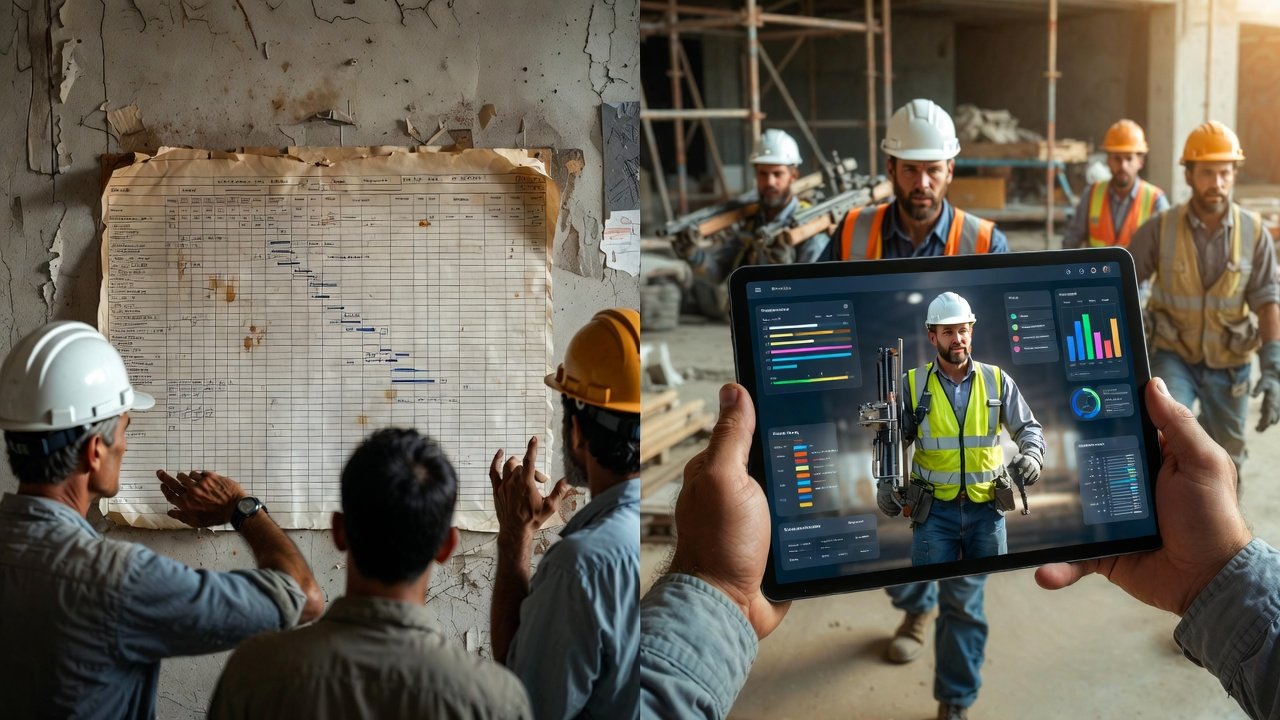
Every job I've ever run started with a beautiful baseline schedule. Somebody in the office built it in the CPM software, printed it forty feet wide, and hung it in the trailer. By the end of the second month, that print was decoration. Nobody looked at it to decide what to do Monday morning, because it no longer described the job we were actually building. That gap — between the plan on the wall and the work in the field — is the whole reason rolling lookahead scheduling exists.
A rolling lookahead isn't a different kind of schedule so much as a different habit. Instead of building a plan once and defending it, you rebuild the near-term window every week off what actually happened. The master CPM still lives above it as the contractual spine. The lookahead is how you drive day to day. Let me walk through why the rolling version wins, and — more useful — how to actually run one without it becoming another meeting nobody respects.
What "static" really costs you
A static plan isn't wrong because the planner was lazy. It's wrong because it was built on the best guesses available on day one, and construction punishes guesses. The concrete sub you assumed had three crews now has one, because they picked up a hospital job across town. The long-lead switchgear that showed a 12-week lead is now at 22. The owner decided to value-engineer the curtain wall in week 9, which quietly moved your dry-in date.
None of those changes announce themselves on a static bar chart. The bars just sit there, confidently wrong. What happens next is predictable: the field stops trusting the schedule, starts running the job out of the superintendent's head and a whiteboard, and now you've got two plans — the official one nobody follows and the real one nobody wrote down. When a delay claim shows up eighteen months later, good luck reconstructing what actually drove the sequence.
The specific failure isn't that the plan gets outdated. It's that a static plan has no mechanism to catch the drift while you can still do something about it. By the time a monthly update reveals you're four weeks behind on rough-in, you've lost the four weeks. A rolling cycle shortens that feedback loop to seven days, and seven days of drift is recoverable.
How the rolling window actually works
The mechanics are simple, which is why they get skipped. Each week you look out three to six weeks (four is the common sweet spot) and you do three things:
- Retire what's done. Activities that finished drop off the front of the window. Be honest here — "80% done" is not done, and calling it done is how you lie to yourself about float you don't have.
- Pull in the next week. A new week enters the far edge of the window at low resolution. It doesn't need to be perfect yet; it needs to be on the radar so you can start clearing its constraints.
- Re-check every remaining activity against reality. Is the predecessor really complete? Is the material on site or still on a truck? Is the crew the sub promised actually coming? Every activity should be able to answer "what's stopping this from starting."
That last point is the engine of the whole thing. A lookahead is not a to-do list — it's a constraint-removal list. The value isn't in drawing the bars; it's in the conversation where a foreman says "I can't set that equipment because the housekeeping pads aren't cured and the electrician hasn't stubbed up," and now you've got two constraints with names and dates attached instead of a surprise on install day.
The graduated horizon: rough in the back, locked in the front
Here's a rule of thumb that separates people who understand lookaheads from people who just make weekly Gantt charts: planning resolution should increase as work approaches.
Work sitting at week four in your window can be rough — a duration, a crew, a rough sequence. That's fine. You've got weeks to sort the details. But by the time an activity is in the one-week column, it should be what the Last Planner folks call "make-ready": every constraint cleared, materials confirmed on site, crew committed by name, access verified, prior inspection signed off. Nothing should enter next week's committed plan carrying an open constraint. If it's got an open constraint, it stays in the two- or three-week column until you knock the constraint down.
Get this discipline right and something almost magical happens to your reliability. When you only commit work that's genuinely ready, your crews stop showing up to blocked work, stalling, and getting demobilized. That's the single biggest productivity leak on most jobsites, and it doesn't show up as a line item anywhere.
Sequencing and buffers you can actually use
Abstract talk about "coordination" is useless. Here's the kind of concrete thinking a rolling lookahead forces, using interior build-out as the example everyone knows:
- Frame to rough-in: don't stack MEP rough-in tight against top-out framing. Give it a 1–2 day buffer per area for framing cleanup, backing installation, and the framing inspection. Trades tripping over each other in a half-framed wall is how you get rework.
- Rough-in sequence: overhead first — the big ductwork owns the ceiling, then plumbing waste (gravity wins, it can't move), then hydronic and domestic water, then electrical and low-voltage, which are the most flexible and can weave around everything else. Fighting that order is fighting physics.
- Before you close a wall: get the rough-in inspections signed, and make the trades verify their own work. Megger the electrical runs and pressure-test the water lines before the drywall goes up, not after. Opening a wall to chase a bad run costs you a day and your credibility.
- Inspection lag: build in the AHJ's actual turnaround, not the fantasy one. If your inspector needs 48 hours' notice and only comes Tuesdays and Thursdays, a Friday inspection request is really a Tuesday inspection. That lag lives in your lookahead or it ambushes you.
A static schedule shows a bar for "rough-in" and moves on. A rolling lookahead makes you confront the handoffs between those bars every single week, which is exactly where jobs are won and lost.
Trade flow: catch the collision on paper
The reason to think in terms of trade flows — the same crew moving through areas in sequence — is that it makes conflicts visible before they happen in three dimensions. When you can see that the drywall crew is flowing into Area C the same week the mechanical crew hasn't finished their overhead in Area C, you've caught a collision on paper. That's a ten-minute conversation in the weekly meeting. The alternative is two foremen and their crews meeting in the same room on Thursday, both convinced they own it, and one of them going home.
Tools like LookAheadWall are built around this location-based, trade-flow view for a reason: when the plan is organized by where the work is and which crew is flowing through, the near-term conflicts jump out at you instead of hiding inside a list of activity IDs. But the tool is secondary to the habit. I ran rolling lookaheads with a whiteboard and sticky notes for years before software made it faster. The software removes the friction — it rolls the dates, flags the incomplete work, and pushes the update to the subs' phones — but the discipline is yours.
Measure PPC, and actually read the variance reasons
If you take one measurement from this article, take this one. At the end of each week, count how many of the activities you committed to actually finished. That's your Percent Plan Complete. Committed and done, divided by committed. Partial credit doesn't count — it either finished or it didn't.
Most teams starting out land around 50%, which feels bad until you realize the static-schedule crowd has no idea what their number even is. The goal isn't a perfect 100% — that just means you're sandbagging your commitments. Somewhere in the 70–85% range is a healthy, honestly-run job.
But the PPC number is only half the value. The other half is the reasons the failed commitments failed. Write them down every week. After a month you'll see a pattern — maybe 40% of your misses trace back to one sub who over-commits, or to submittals coming back late, or to a specific inspection bottleneck. That pattern is a systemic problem you can fix at the root. Static scheduling has no equivalent; a missed bar just becomes a longer bar, and the underlying cause never surfaces.
The predictability paradox
Here's the part that trips people up: a schedule that changes every week produces a more predictable project than one that never changes. It sounds backwards. It isn't.
The static schedule looks stable because it isn't listening. Its stability is denial. The rolling schedule looks turbulent because it's absorbing real information every week — but each near-term week it commits to is accurate, and accurate weeks stack into accurate months. When the near-term plan drifts off target, you see it while you still have moves: resequence, add a crew, pull a delivery forward, work a weekend on the critical path instead of the whole job. Recovery is cheap when you're one week off and brutally expensive when you're two months off and just finding out.
Running it without killing your Monday
The honest downside of rolling lookaheads is that they take real time and real discipline. Here's how to keep that cost sane:
- Same time, every week, no exceptions. The week the job is on fire is the week you most need the meeting, not the week to skip it. If it moves around, it dies.
- Keep it to an hour. Foremen and sub superintendents own their own commitments — you're not building their plan for them, you're de-conflicting the flows and clearing constraints across trades.
- Make the field build it. A lookahead written by the office in a vacuum is just a smaller static schedule. The people making the commitments have to be the people in the room. That's what turns it into their plan instead of one more thing imposed on them.
- Track the constraints between meetings, not just in them. Every constraint gets an owner and a need-by date, and somebody chases them all week. The meeting reviews status; it isn't where the work happens.
The bottom line from the trailer
Static plans fail for one reason: the job doesn't hold still, and the plan does. A rolling lookahead wins because it treats the schedule as a living instrument you re-aim every week toward the work that's actually in front of you. You commit only to work that's genuinely ready, you measure whether you kept your word, and you fix the reasons you didn't.
None of this requires software to be true. What software like LookAheadWall buys you is speed and reach — the weekly roll takes minutes instead of an afternoon, and the subs see the same current picture on their phones that you see in the trailer. But the discipline is the point, and the discipline is free. Start with a four-week window, commit to the weekly cadence, get the field in the room, and track your PPC honestly. Do that for a month and you'll never willingly go back to a plan that just hangs on the wall being confidently wrong.