
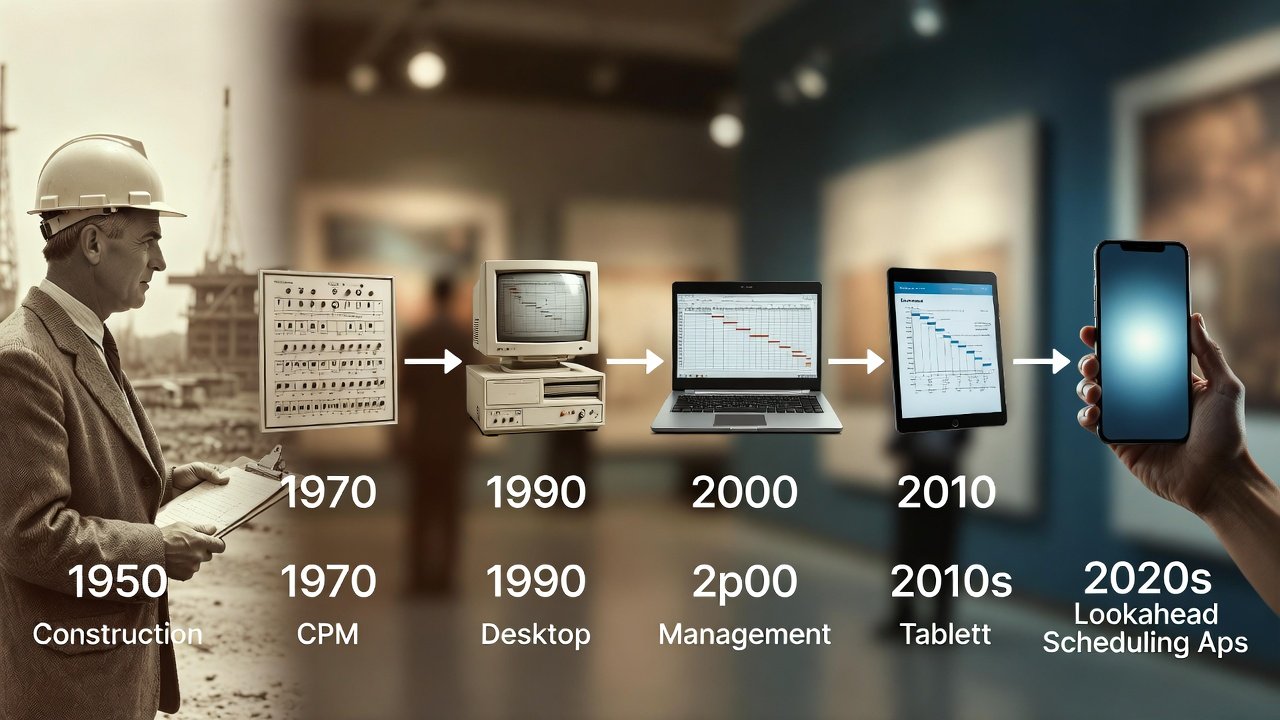
Why a history of look-ahead scheduling is worth your time
Most guys don't care how the look-ahead got invented. Fair enough. But if you understand why each generation of scheduling methods showed up, you understand what each one was actually solving for — and that tells you which parts to keep and which parts are just habit. I've seen crews run a three-week look-ahead they don't believe in because "that's how we've always done it," and I've seen crews get real value out of a whiteboard because they understood the point. The point is the same it's always been: get the right trades in the right place, in the right order, with nothing in their way. Everything below is just the industry getting better and better at doing that reliably.
The superintendent's head was the first schedule
For most of the twentieth century, the look-ahead lived between a superintendent's ears. He knew the job cold — what was framed, what was ready for the electrician, who owed him a submittal — and he coordinated by walking the site and having conversations. On a small job with four or five trades, that actually works. A sharp super carrying the next three weeks in his head can out-plan a lot of software.
The failure mode is obvious once you've lived it: it doesn't scale, and it doesn't survive the super getting hit by a bus (or, more likely, pulled onto another job). All the coordination logic is trapped in one skull. Nobody else can see the plan, question it, or run it if he's out. The moment a job gets big enough to need two supers, or a GC needs subs to plan their own manpower off your sequence, mental scheduling breaks. That's the whole story of what follows — every new method is another attempt to get the plan out of one person's head and into a shared form other people can act on.
The first "real" look-aheads were nothing fancy: somebody printed the next few weeks of the master schedule and handed it out at the sub meeting. Crude, but it did the one thing the mental model couldn't — it gave everyone the same reference point.
CPM: the schedule got smart, and slow
The Critical Path Method came out of the 1950s and it genuinely changed the game. For the first time you could lay out every activity, tie them together with logic, and have a computer tell you which chain of work actually drives the finish date. That's powerful. Knowing your critical path tells you where a one-day slip costs you a day on the end date versus where you've got float to burn.
Here's what old-timers learned about CPM the hard way, though: a beautiful critical-path schedule and the actual jobsite are two different animals, and the gap between them grows every week you don't update it. CPM schedules are big, they need a specialist to maintain, and they get updated monthly at best. By week three the logic on paper no longer matches the mud on the ground. The critical path is a strategic tool — it belongs to the master schedule and the PM fighting over the end date. It was never built for the tactical question a foreman actually has, which is "what do I do Tuesday, and is the wall ready for me?"
So the industry ended up with a split that still exists today, and it's a healthy one: CPM up top for the strategic picture, a short-horizon look-ahead down low for field coordination. The look-ahead is a window cut out of the master schedule and then dragged into reality. If your look-ahead is just a printout of your CPM with nothing added, you're not doing the second job — you're just reformatting the first.
Lean and the Last Planner System: the biggest leap
The 1990s brought manufacturing thinking onto the jobsite, and honestly this is where look-ahead scheduling grew up. Glenn Ballard and Greg Howell's Last Planner System reframed the whole thing. The insight that mattered most: the master schedule tells you what should happen, but the look-ahead's job is to figure out what can happen, and the weekly plan is what you will do. Those are three different questions, and confusing them is why so many schedules are fiction.
A few Last Planner ideas are worth internalizing whether or not you ever call it "lean":
- Make-ready planning. Before an activity is allowed into your commitment window, you screen it for constraints and knock them down — the RFI, the submittal, the material delivery, the preceding trade's sign-off, the inspection. The look-ahead stops being a forecast and becomes a to-do list of blockers to clear. This is the single most valuable thing on this page. An activity that's still got an open constraint has no business being promised for next week.
- Reliable promising. When a foreman says he'll finish an area Thursday, that's a commitment, not a hope. The whole system runs on people only committing to work that's genuinely ready, and then actually doing it.
- Learning from the misses. When something planned doesn't get done, you record why — no material, weather, prior trade late, changed our mind — and you count it. Over time those reasons tell you exactly where your planning leaks.
That last one gave us Percent Plan Complete, PPC — the ratio of tasks you promised to tasks you actually finished. If you track one number off your look-ahead, track that one. A team living around 50% PPC is basically guessing; get consistently into the 80s and your subs start trusting the plan enough to staff to it. And the variance reasons behind a low PPC are gold. If "prior trade not complete" keeps showing up, your problem isn't the plan, it's your buffers or your handoffs.
Why the three, four, and six-week horizons settled where they did
The industry didn't standardize look-ahead horizons by committee — crews just kept landing on the same numbers because they work. A three-week window is the workhorse: it's long enough to clear most constraints (an RFI turnaround, a material lead time on stock items) but short enough that you actually believe week two and week three. Four weeks lines up with how monthly billing and owner reporting run. Six weeks is for jobs with long-pole procurement or heavy trade stacking, where you need more runway to see the pileup coming — but everyone knows the back end of a six-week look-ahead is softer.
The practical rule: match your horizon to your longest routine constraint lead time, not to a number somebody told you. If your typical bottleneck is a two-week submittal-and-fab cycle, a three-week look-ahead gives you exactly one week of reaction time, which is tight. Stretch it. If you're all stock materials and short cycles, a longer horizon just fills up with fiction.
Phones and the cloud: the plan finally reached the crew
Two changes in the last fifteen years mattered more than people give them credit for. First, the schedule got into the foreman's pocket. When the plan lived on a trailer wall or an office printout, the foreman saw it once a week, if that. Put it on a phone and it becomes something he checks the way he checks the weather. That alone tightens the loop between plan and execution.
Second, the cloud killed the version problem. The old nightmare was three subs planning manpower off three different printouts, each a week stale, none of them matching. When the look-ahead lives centrally and everybody's looking at the same live copy, a change you make Tuesday afternoon is a change the drywall foreman sees before he calls in his Wednesday crew. That's the real win — not the technology, but the fact that everyone is finally arguing about the same plan instead of talking past three different ones.
This is also where good scheduling software started earning its keep in a way paper never could. A visual, location-based weekly work plan that a super can drag around in ten minutes and share to every sub's phone does the coordination job the mental model did — except now four other people can see it, question it, and plan off it. Tools like LookAheadWall live right at this handoff between the look-ahead and the crew, which is exactly where paper always fell apart. That's the natural home for it; it doesn't replace your judgment about sequence, it just makes your judgment visible and shareable.
From art to measurable craft
The quiet revolution underneath all the tech is data. When your plans were paper, all that learning about what went wrong got thrown in the dumpster every Friday. Digital plans keep it. Now you can actually answer questions that used to be gut feel: which trade slips its commitments most often, which activity types always run long against your estimate, which constraint category — material, info, prior work, inspection — eats the most days on your jobs.
I'm not talking about drowning in dashboards. A foreman doesn't need analytics; he needs to know if the wall's ready. But over a career, or even over one big job, the pattern data changes how you plan. You stop giving the same trade the benefit of the doubt after the third time their "done Thursday" means "done the following Wednesday." You start baking a real buffer into the handoff that always burns you. Look-ahead scheduling went from something you were either good at or you weren't, to something you can measure and deliberately get better at.
Where it's heading — and what won't change
The next wave is prediction. Weather feeds already flag your exterior work before a bad stretch. It's a short step to software that watches your historical patterns and warns you that a given activity is at risk — this trade, this constraint type, this time of year — before you'd have caught it yourself. Machine learning on enough project history will eventually spot the pileup two weeks out that a human misses. That's genuinely useful, and it's coming.
But don't let the buzzwords fool you about what stays constant. No algorithm is going to walk your site, feel that the concrete guy is behind because his good crew got pulled, and re-sequence three trades over coffee. The technology keeps getting better at the mechanical parts — versioning, distribution, constraint tracking, pattern-spotting — precisely so the superintendent can spend his time on the part that was always the real work: judgment and coordination between human beings who each have their own job to protect.
What to actually take from all this
If you strip a hundred years of evolution down to what belongs in your practice right now, it's a short list:
- Cut your look-ahead as a real window into reality, not a reprint of the CPM. The master schedule says what should happen; your look-ahead's job is to figure out what actually can.
- Screen every activity for constraints before you let it into the commitment window. An open RFI, a missing submittal, or a trade that hasn't signed off means it's not ready — no matter what the bar chart says.
- Pick a horizon that covers your longest routine lead time, and be honest that the far weeks are softer than the near ones.
- Only let people commit to work that's genuinely ready, then track how often those commitments hold. PPC and the reasons behind the misses are how you improve.
- Get the plan off the wall and onto everyone's phone, working from one live copy, so the crew and the subs are all planning off the same reality.
None of that is new, exactly. It's the accumulated hard lessons of a lot of supers who got burned and adjusted. The tools have changed a great deal; the job — right trades, right place, right order, nothing in their way — hasn't moved an inch.