
The schedule isn't the problem
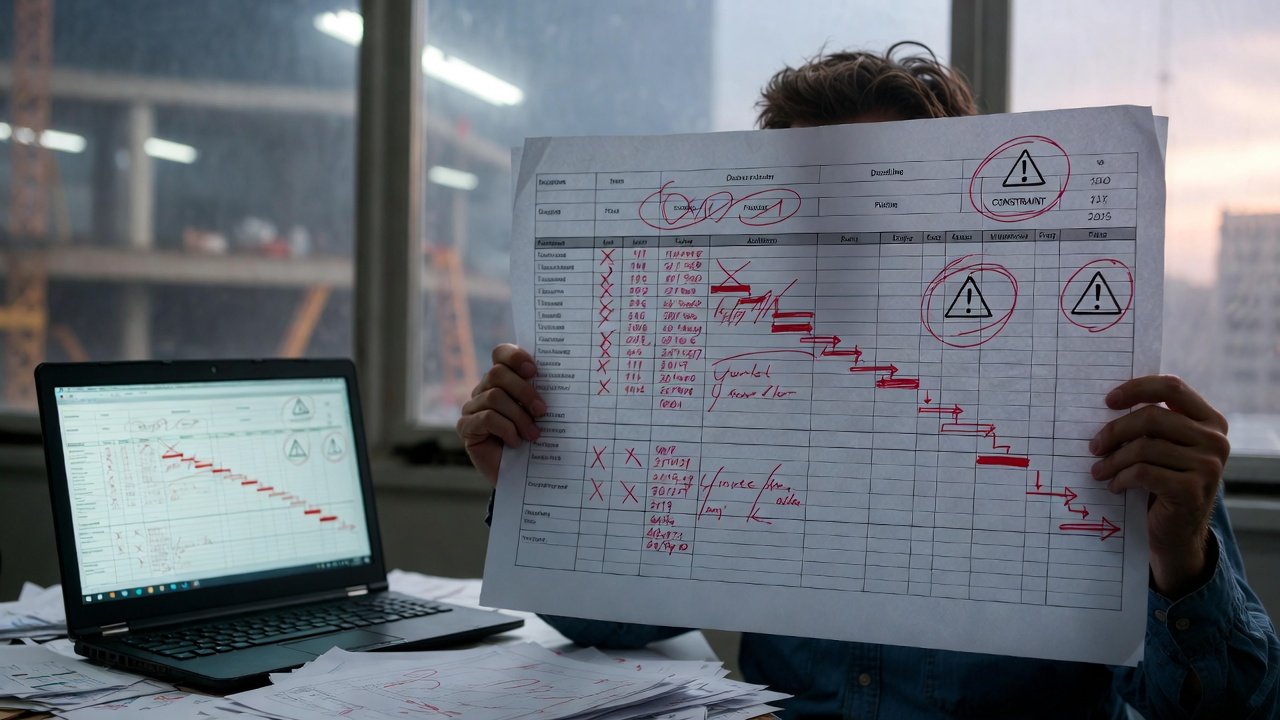
Here's a scene you've probably lived. Monday morning, the four-week look-ahead is printed, color-coded, and taped to the trailer wall. By Thursday it's already wrong. By the next Monday nobody's looking at it, and you're running the job the way you always have — off your gut, your phone, and a running list of fires. The document didn't change anything. It just cost you an hour to make.
When a look-ahead keeps failing, the instinct is to blame the tool or the format. Usually that's not it. A look-ahead is a promise about the near future, and promises fail for a small number of predictable reasons. Below are the ones I see wreck schedules over and over, and what actually fixes them — not "communicate better," but the specific move that closes the gap.
You're planning activities instead of clearing constraints
This is the big one, so it goes first. Most failed look-aheads are just a prettier bar chart: a list of what's supposed to happen and when. That's a projection, not a plan. The whole point of pulling work into a three- or four-week window is that it's close enough to do something about what's in the way.
An activity is only real when it's ready to go. For every task inside your window, walk the standard constraint checklist before you commit to a date:
- Materials — on site or with a confirmed delivery date, not "ordered."
- Prerequisite work — the trade in front of you actually finished the area, not the building.
- Information — approved submittals, an RFI answer, a current drawing revision in hand.
- Labor — the sub has bodies committed to your job that week, not promised to three others.
- Equipment and access — lift availability, a clear path, power where the crew needs it.
- Approvals and inspections — the inspection is scheduled and the prior sign-off is closed.
If any of those is open, the activity doesn't go on the "committed" line — it goes on a constraint log with a name and a date next to it. The look-ahead's real job is to surface those open items two to three weeks out, while there's still time to expedite a shipment or chase an RFI. A schedule that shows dates but hides readiness will fail every single week, because you keep committing crews to work that was never going to happen.
It's built by one person, in a vacuum
If you're the only one touching the schedule, it can only ever be as good as your guess about eleven other trades' durations. And your guesses are optimistic — everyone's are. The drywall foreman knows his hangers can't keep up with two tapers. The electrician knows the gear is six weeks out no matter what the submittal log says. That knowledge lives in their heads, and a superintendent-authored plan leaves it there.
Pull durations and constraints from the people doing the work. The cleanest way is a weekly make-ready conversation where each foreman commits to what they'll actually finish, not what you hope they'll finish. When a foreman says out loud "I'll have the second floor east wing topped out by Thursday," that's a commitment. When you write it for him, it's a wish. This is the core of the Last Planner idea, and you don't need special software to run it — you need the last planners in the room. Good look-ahead tools help by letting each foreman flag their own constraints and update their own progress, so the plan reflects the whole crew's knowledge instead of one person's.
Your durations are fiction and you never check the tape
Optimism compounds. If MEP rough-in "always" takes twenty percent longer than you schedule it, and you never adjust, every four-week window is born broken. The fix is embarrassingly simple and almost nobody does it: track planned versus actual, and read it back.
The metric that matters is Percent Plan Complete — of the tasks you committed to this week, what fraction actually finished as promised? Count it every week. A healthy short-interval plan runs in the 70–85% range. If you're sitting at 50%, your problem isn't effort, it's that you're committing to work that isn't ready (see failure one) or your durations are wishful. Then read the reasons for the misses. When "waiting on inspection" shows up four weeks running, you've learned that inspections in your jurisdiction need a two-day lead you weren't building in. That's a systematic bias you can design out — but only if you write the misses down instead of just moving the bar and pretending.
Wrong altitude — too vague to use, or too fine to maintain
Granularity kills look-aheads from both ends. An activity called "Complete Building A" tells a foreman nothing about what to do Tuesday. It's a milestone wearing a task's clothes. But swing too far the other way — three hundred line items broken to the hour — and maintaining the thing becomes a full-time desk job, so you stop, and it goes stale.
The sweet spot for a work-plan task is roughly one to five days of a single crew's work in a single location. "Rough-in plumbing, Level 2 east" beats both "Complete Building A" and "Set 14 closet flanges." Tie tasks to location, not just trade — location-based sequencing is what lets you see the collisions before they happen (two trades converging on the same room Wednesday) and set up a clean hand-off flow between crews. If a task is bigger than a week, break it by area. If it's smaller than a day, roll it up.
You skip the buffers, so one slip takes down the row
Schedules that are packed nose-to-tail have no shock absorbers. The instant one trade slips a day — and one always does — the delay ripples straight through every activity behind it, because you left no slack to absorb it. Then the whole look-ahead is wrong and everyone downstream loses faith in it.
Build in deliberate buffers at the hand-offs where trades and inspections meet:
- Frame-to-rough-in usually wants a one-to-two-day buffer for punch, cleanup, and rough inspection before the next trade closes in behind it.
- Never schedule cover-up the same day as the inspection that gates it — leave a day for the re-inspection you'll occasionally need.
- Concrete and other cure-dependent work needs real cure time in the plan, not a hopeful next-morning start.
- Anything waiting on an off-site fabrication or a single-source material deserves a week of float, because when it's late it's very late.
Buffers aren't padding you're ashamed of. They're the difference between a plan that flexes and one that shatters on first contact.
Nobody actually uses it
You can build a perfect look-ahead and still fail here. If a foreman can get the answer faster by calling you than by opening the schedule, he'll call you every time — and the plan is dead as a coordination tool. Same with subs who learn about changes through your texts instead of the plan itself.
Make the look-ahead the fastest path to a true answer. That means two things. First, it has to be current — a stale schedule trains people to ignore it, permanently. Second, stop feeding side channels. When a sub texts "are we still on for Wednesday," answer by pointing them to the plan rather than re-litigating it one-on-one. When the plan is genuinely the quickest way to know what's happening, adoption takes care of itself. When it lags reality, no amount of nagging saves it. A mobile view that crew leaders can check from the field — instead of hunting down a printout in the trailer — is often what tips a look-ahead from wall art into a tool people actually pull up.
The coordination meeting is theater
The weekly pull meeting can reinforce the plan or quietly rot it. The failure pattern: it runs long, drifts into detailed problem-solving between two trades while eight others check their phones, and ends with no clear commitments. People leave, and nothing changes.
Run it tight and run it the same way every week. Three jobs, in order:
- Score last week. What did we commit to, what actually got done, and why did the misses miss? Two minutes, no blame, just the number and the reasons.
- Make next week ready. Walk each trade through the upcoming window and confirm constraints are cleared. Anything not ready gets an owner and a due date — it does not get a committed date.
- Get commitments. Each foreman says out loud what they'll finish. That's the promise you'll score next week.
The moment two trades start solving a detailed sequencing problem, park it — "you two, after this" — and keep moving. A meeting that stays at the level of commitments and constraints stays short, and short meetings are the ones people show up to.
Missed commitments carry no weight
The quiet killer. When a trade blows a Wednesday commitment and nothing happens — no conversation, no note, no follow-up — everyone learns the plan is optional. After that, subs commit loosely because loose commitments cost nothing.
Accountability here isn't punishment; it's follow-through. When a commitment misses, you ask why, out loud, the next week. Was it unrealistic when we made it? Was there a constraint we didn't catch? Was it just short-staffed? Most of the time the answer improves the next plan. And when a sub's commitments are tracked and visible week over week — this foreman hits 90%, that one hits 55% — the reliable ones get noticed and the loose ones tighten up on their own. Visibility does most of the work; you rarely have to lean on anyone.
The look-ahead never touches the daily plan
The last failure ties the rest together. If the three- or four-week look-ahead doesn't turn into a concrete weekly work plan, and that plan doesn't drive what crews do Tuesday morning, the whole thing is an administrative exercise. The look-ahead sets up the make-ready — clearing constraints two and three weeks out. The weekly work plan is where those now-ready activities become this week's committed tasks. And the daily huddle is where a foreman says exactly which crew goes to which location to do what.
When those levels connect, the plan drives real decisions: which crews go where, what materials land when, how the trades sequence through each area without colliding. When they don't, you've got a nice document and a job still run off the gut. Every failure mode above is really a break in that chain — an activity that was never ready, a commitment nobody owned, a slip with no buffer to catch it.
Fixing it
You don't fix a broken look-ahead by starting over with a fancier template. You fix it by finding which link in the chain is snapping. Run through the list honestly: are you committing to work that isn't ready? Building it alone? Ignoring the tape on your durations? Skipping buffers? Letting misses slide? Pick the one or two that hurt most on your job and fix those first — habits change slowly, and trying to fix all ten at once fixes none.
The right software makes the disciplined version faster — surfacing constraints, letting foremen update from the field, tracking who hits their commitments — which is exactly where a tool like LookAheadWall earns its keep. But the plan works because committed people run it the same way every week, not because it's pretty on the wall. Get the discipline right and almost any format will do. Skip it, and the best software on earth just produces a nicer-looking schedule that's wrong by Thursday.