
Two documents, two jobs
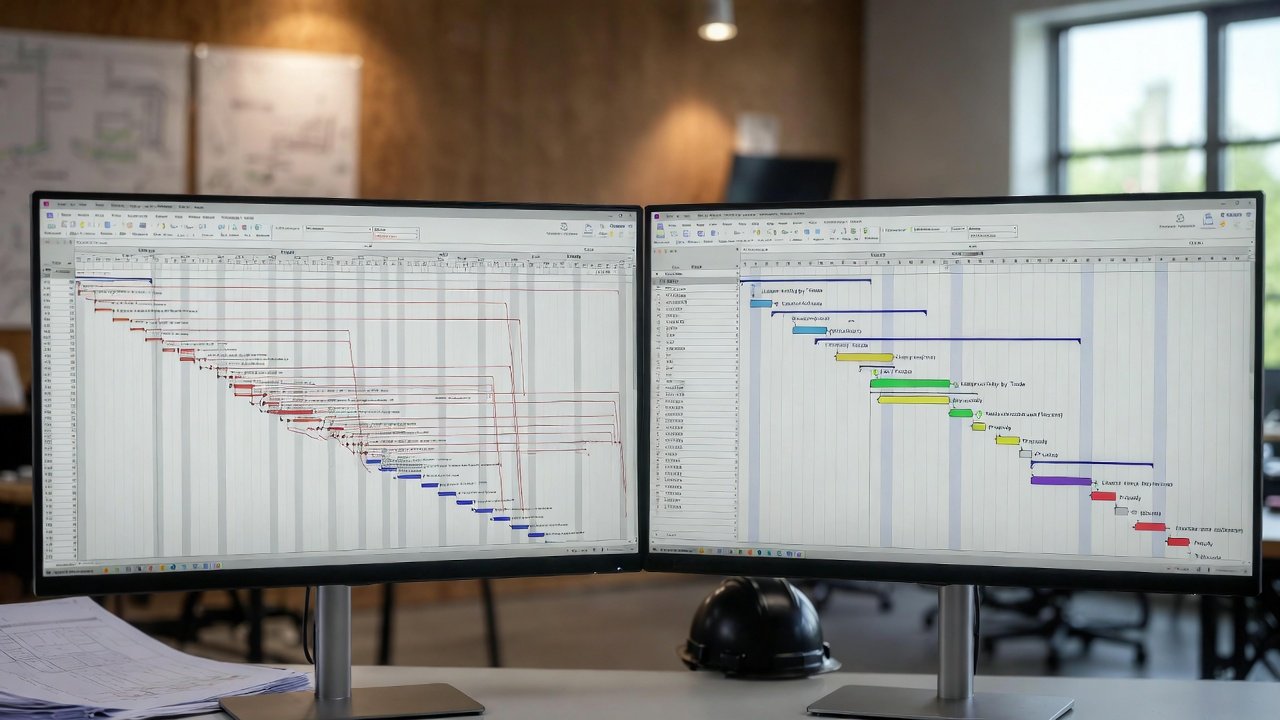
Early in my career I watched a project manager print the full CPM Gantt chart, tape four D-size sheets together on the trailer wall, and tell the framing foreman to "work off that." The foreman looked at it for maybe ten seconds, found his two bars somewhere in the middle of about 1,400 activities, and never looked at it again. He wasn't being difficult. That chart wasn't built for him, and it never would be.
The Gantt chart and the look-ahead are not competing formats. They're two different documents that answer two different questions. The Gantt answers "are we going to finish this job on time and who's on the hook if we don't." The look-ahead answers "can the crews on site this week actually do the work in front of them, and what's going to stop them." Confuse the two and you either bury your foremen in noise or hand your owner a schedule with no defensible logic. Keep them straight and each one gets sharp.
Time horizon is the tell
The fastest way to know which tool you're looking at is the time axis. A Gantt chart runs the whole job — notice-to-proceed on the left, substantial completion on the right, sometimes 18 or 24 months of bars marching across the page. That's the point of it. An owner, a lender, or your own executive team needs to see the entire arc in one view.
A look-ahead deliberately throws most of that away. Three weeks, four weeks, sometimes six on a slower civil job. Everything outside that window is invisible on purpose. The foreman doesn't need to know that the elevator gets its final inspection in March; he needs to know that the shaft walls have to top out before the hoist beam drops next Thursday. Cutting the horizon down to what's actionable is what makes the document usable at the gang box.
A useful rule of thumb: your look-ahead window should be about as long as it takes to clear a constraint. If your average missing-material or missing-inspection problem takes two weeks to resolve, a two-week window is too short to see it coming — you'll be reacting instead of planning. Three weeks is the common sweet spot on building work. Push to four or six when your long-lead constraints (utility connections, controlled inspections, owner decisions) routinely need more runway.
Detail cuts the opposite direction
Here's the part people get backwards. The Gantt chart covers more time but often carries less useful detail at the crew level. A master schedule might show "Level 3 Framing" as a single 12-day bar. Accurate for planning the job — useless for planning Tuesday.
The look-ahead takes that one bar and explodes it into what actually happens on the deck: layout and bottom track Monday, exterior wall panels and shear Tuesday through Wednesday, interior partitions Thursday, in-wall blocking and backing Friday so the trades behind you aren't chasing you for it. That last item — blocking and backing — almost never appears on a CPM schedule, and it's exactly the kind of thing that generates a back-charge when it gets missed. The look-ahead is where that granularity lives because that's where it matters.
Think of it as two different resolutions. The Gantt is the whole coastline seen from an airplane. The look-ahead is the fifty feet of beach you're actually standing on, with the rocks marked.
How often each one moves
A baseline Gantt is a slow, formal instrument. You set it, you get it accepted, and after that you touch it deliberately — a monthly update, a time-impact analysis when a change order or delay hits, a recovery schedule if you've slipped. Changing it carelessly is how you give away your delay claims. There's a reason a scheduler with CPM training usually owns it.
The look-ahead is the opposite animal. It's meant to be marked up. You update it in the weekly subcontractor coordination meeting, and plenty of superintendents adjust it mid-week when a delivery slips or an inspection fails. Nobody needs a scheduling degree to slide an activity two days or flag a constraint. That responsiveness is the entire value — a look-ahead that's a week stale is worse than no look-ahead, because people trust it and get burned. This is where short-interval, weekly planning earns its keep, and where a purpose-built tool like LookAheadWall pays off: dragging a location-based bar and re-sharing it with the subs should take a minute, not an afternoon of fighting formatting.
Logic: rigorous vs. readable
Gantt charts are built to carry real network logic — finish-to-start, start-to-start, finish-to-finish, leads and lags — and to compute a critical path and float from all of it. That machinery is what lets you answer "if the steel slips ten days, where does the roof go, and do we still make dry-in before winter." You genuinely need that for claims, for what-if analysis, and for defending your completion date.
The look-ahead usually shows logic in a much plainer way: what has to be done before I can start, and what I'm handing off to next. That's not a weakness — it's the right altitude for the field. A foreman doesn't care that an activity has 6.2 days of total float; he cares that the deck has to be poured and cured before he can shake out material on it. The good practice is to keep the two consistent: the look-ahead should never sequence work in a way that violates the master schedule's logic, even if it isn't drawing the arrows. When the look-ahead and the CPM start telling different stories, one of them is wrong, and it's usually a sign the master schedule has drifted from reality.
Who's actually reading it
Audience is where these two really separate. A detailed CPM Gantt has a narrow readership — PMs, schedulers, maybe a sophisticated owner's rep. Most people in a hard hat can't read a dense logic-linked bar chart quickly, and honestly they shouldn't have to.
The look-ahead has to work for everybody: the drywall foreman, the labor foreman staging material, the sub's PM three states away, the crew leader checking his phone before he leaves the yard. If understanding your schedule requires a training class, your field won't use it, and a plan nobody reads is just decoration. This is the practical case for keeping the field view simple and mobile — crew leaders live on a phone screen, not in front of a 27-inch monitor, and a companion app that shows a foreman his week and his constraints in the truck before he drives in beats any wall of bars in the trailer.
Constraints: the thing the Gantt quietly ignores
This is the most important difference and the one that separates a real short-interval plan from a colored calendar. A Gantt chart assumes every activity happens as drawn. It shows a tidy future where the material showed up, the RFI came back, the inspector passed you, and the deck below got out of your way. On a real job, that's optimistic fiction about half the time.
A proper look-ahead treats a task as not ready to schedule until its constraints are cleared. Before you commit an activity to next week, you run it against the usual list:
- Design — is the RFI answered, is the ASI in hand, is the shop drawing approved?
- Material — is it on site or confirmed for delivery before you need it, not "ordered"?
- Manpower — does the sub actually have the crew, or is it split across three jobs?
- Equipment — is the lift, the crane pick, the pump scheduled?
- Predecessor work — is the area truly complete and signed off, or 90 percent with a punch?
- Inspection / permit — does the rough need to be signed off before you can cover it?
Anything with an open constraint stays on a make-ready list and does not get promised into the weekly work plan. This is the backbone of Last Planner-style planning: you commit only to work you can actually do, and you track your Percent Plan Complete so you can see whether your commitments are honest. A Gantt chart will never tell you that Friday's overhead rough-in is dead because the fire-caulk inspection isn't scheduled. The constraint log on your look-ahead will. Tools built for this — LookAheadWall included — exist mainly to make that constraint tracking and trade-flow sequencing visible instead of living in one superintendent's head.
A concrete example
Say the master schedule shows "MEP Rough-In, Level 2" as a two-week bar with electrical, plumbing, and HVAC stacked in parallel. Perfectly reasonable at the Gantt level. Now try to run it that way in the field and you'll have three foremen fighting over the same ceiling space above the corridor.
The look-ahead is where you referee that. Overhead sequence usually wants the big-bore first — main duct and the plumbing DWV that has to hold pitch — then fire sprinkler mains, then conduit and low-voltage threading through what's left. You give framing a day or two of buffer ahead of rough-in for cleanup and to let inspection catch the in-wall backing. You megger the branch circuits and you air-test the DWV before anybody hangs a ceiling grid, because opening a closed wall or a hard-lid ceiling to chase a fault is the kind of rework that eats a week. None of that lives on the Gantt. All of it lives on the look-ahead, and getting it right is the difference between a smooth deck and a daily turf war.
Use both, keep them honest
So when do you reach for which? Reach for the Gantt when you need to show the owner the whole timeline, defend a completion date, run a time-impact analysis on a change, set a contractual baseline, or report earned progress against plan. Reach for the look-ahead when you need to coordinate this week's crews, clear near-term constraints, sequence overlapping trades, run your weekly subcontractor meeting, and put a plan in the field's hands that they'll actually open.
The mistake is treating it as either/or. The master schedule feeds the look-ahead — your three-week window should always be a truthful, detailed expansion of the current slice of the CPM. And the look-ahead feeds back: when the field keeps blowing a milestone, that's your early warning that the master schedule has drifted and needs an update before the slip becomes a claim. Keep the strategic view and the tactical view connected and consistent, and you get something neither one gives you alone — an owner who trusts your dates and a field crew that trusts your plan. Let them drift apart, and you've got a beautiful chart on the trailer wall that nobody in a hard hat has looked at since the day it went up.