
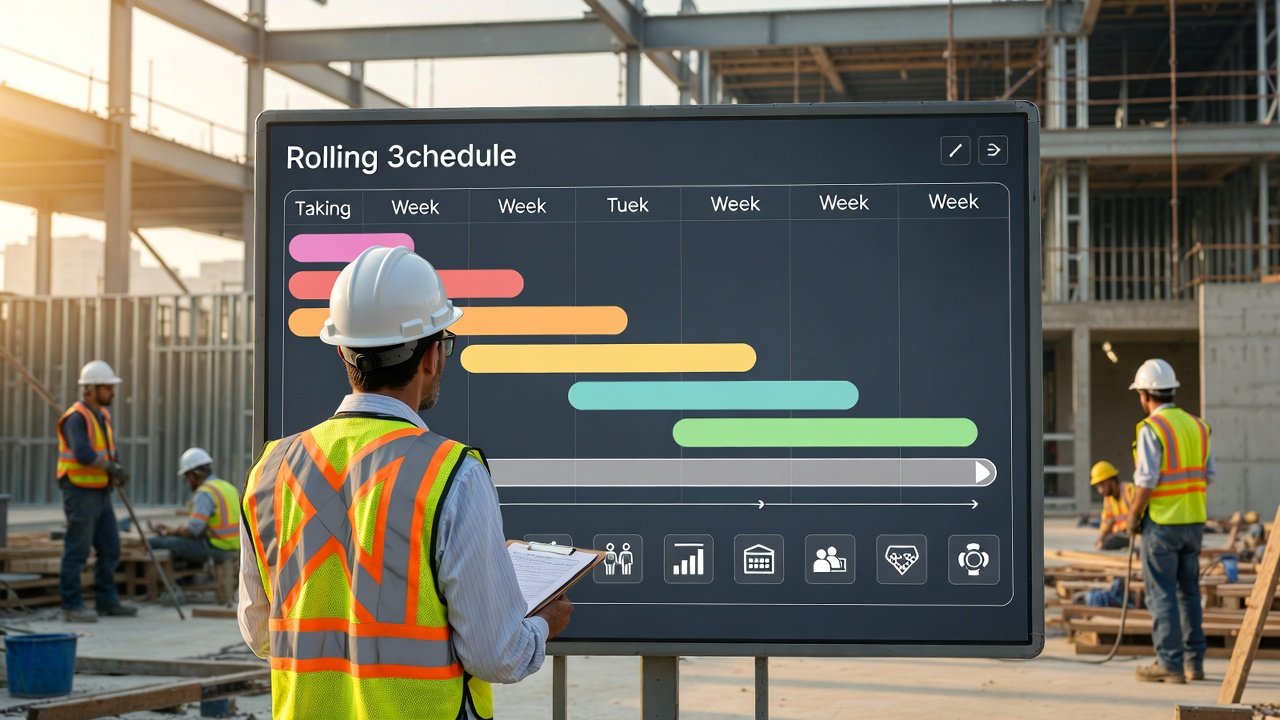
Walk any struggling jobsite at 9:30 in the morning and you'll see the same thing: a drywall crew standing around because the electrician hasn't finished rough-in, an inspector who came and went because nobody pulled the trailer paperwork, and a foreman on the phone chasing a material delivery that was supposed to land yesterday. Nobody's lazy. The work just isn't ready. That gap between "scheduled" and "actually ready to build" is where most jobs bleed hours, and closing it is the whole point of a rolling look-ahead schedule.
The idea behind continuous flow is simple to say and hard to run: work should move through the building without stopping, one trade handing off cleanly to the next, crews staying on tools instead of standing around. A rolling look-ahead is the tool that makes that happen, because it forces you to look far enough ahead to fix problems before they land on the crew's shoulders. This guide walks through how to actually run one, not in theory, but the way it plays out on a real floor.
What "flow" really means on a jobsite
Flow gets talked about like it's a Lean buzzword, but on site it comes down to three concrete things. First, when a crew shows up to an area, the work in front of them is genuinely ready — materials on hand, prior trade complete, inspection signed off, access clear. Second, when that crew finishes, the next trade can walk in behind them without a gap. Third, nobody is standing idle waiting for someone else's mistake to get sorted out.
You measure flow in wait time and rework, not in percent-complete. A schedule can show 92% complete on paper while your framers spent Tuesday afternoon leaning on a wall because the layout wasn't verified. The bar-chart didn't catch it. A look-ahead that's run right does, because it's asking a different question — not "are we on schedule?" but "is next week's work actually buildable?"
Make-ready is the whole game
If you take one thing from this article, take this: the value of a look-ahead lives entirely in the make-ready process, not in the pretty chart. Make-ready is the deliberate work of walking every activity that's coming up and knocking down its constraints before the crew arrives.
The usual constraint categories are worth memorizing because they're the same on every job:
- Prior work — is the preceding trade genuinely complete, or 95% with a punch list that blocks you?
- Materials — are they on site, or do you have a PO number and a prayer?
- Information — RFI answered, submittal approved, layout dimensioned?
- Labor — is the crew sized and available, or did the sub pull two guys to another job?
- Equipment — lift, scaffold, welder, whatever the task actually needs, staged and inspected?
- Access and conditions — is the area dried in, powered, clear of other trades, and can the inspector get there?
The discipline is running that six-item screen against every activity six weeks out, then following each constraint until it's actually resolved — not assumed resolved. There's a real difference between "the ductwork is scheduled to be done Friday" and "I walked it and it's done." A make-ready process that trusts the schedule instead of verifying reality is just optimism with a spreadsheet. Good look-ahead software helps here by letting you tag each activity with its open constraints and track them to closure, so a task literally can't be promised to a crew until its list is clear — but the tool only enforces the discipline you put into it.
Why it has to roll
A static six-week look-ahead printed on Monday is stale by Wednesday. The "rolling" part is what keeps it alive. Every week the window advances one week: last week drops off the back, a new week enters the front, and every activity in between gets re-screened against the six constraints because reality moved.
That cadence matters more than the exact horizon length. Most commercial and multi-family jobs settle on a four-to-six-week window for the look-ahead, with a firm one-week weekly work plan riding at the front. Six weeks is far enough out to fix a submittal or expedite a long-lead item; further than that and you're guessing. Inside that window, the closer an activity is to "now," the more certain it should be. Week six is a rough placeholder. Week one is a commitment you'll be held to.
The rhythm I've seen work: a weekly planning meeting where the whole window rolls forward and every foreman screens their upcoming activities, plus a short daily huddle to catch the things that broke overnight. Miss the weekly and the window goes stale. Skip the daily and you find out about yesterday's blocker at tomorrow's meeting, which is a day too late.
Commit only to work you can actually do
The front week — the weekly work plan — is where flow is won or lost. The rule is simple and gets violated constantly: only put an activity on the weekly plan if every one of its constraints is resolved. This is the reliable-promise principle from the Last Planner System, and it's the difference between a plan crews believe and a plan they've learned to ignore.
When you commit to work that isn't ready, you don't just miss that task — you poison the whole handoff chain behind it, and you teach the crew that the plan is fiction. Track your Percent Plan Complete: of the tasks you promised this week, how many actually got done as planned? A healthy job runs 75–85%. If you're sitting at 50%, you're not committing to ready work — you're committing to hopeful work, and the crews know it.
When a task doesn't complete, log the reason. Over a few weeks those reasons cluster — "prior trade late," "material late," "RFI unanswered" — and that pattern tells you exactly where your make-ready process is leaking. That's the learning loop. It's boring, it's five minutes a week, and it's the single highest-leverage habit in short-interval scheduling.
Backlog: the answer to "what do we do now?"
Flow breaks the moment a crew gets blocked and has nothing else to do. The fix isn't heroics — it's a workable backlog. For every crew, keep a short list of ready, unconstrained work they can slide into when the primary task dies. Punch items, a section of the building that's ahead of sequence, prep work for next week — anything that's genuinely make-ready.
The backlog is what turns a blocked afternoon from four idle hours into four productive ones. Without it, one late delivery cascades into a crew sent home early. Any decent look-ahead tool should let you park and surface that backlog per trade so the foreman isn't inventing busy-work on the spot when things go sideways.
Trade handoffs and trade flow
Continuous flow is really a sequence of clean handoffs. Trade flow — the way each trade moves through the building's areas in sequence — is where a look-ahead earns its keep, because it makes the collisions visible before they happen on the floor.
The classic rough-in sequence tells the story. Frame, then let the wall breathe a day or two for cleanup and framing inspection before rough-in trades pile in. Plumbing top-out and DWV, then HVAC because ductwork is bulky and wants first pick of the ceiling space, then electrical rough because wire is flexible and routes around everything, low-voltage behind it. Get MEP inspected, insulate, then cover. A day or two of buffer between framing and rough-in isn't slack you're wasting — it's the cleanup, layout verification, and inspection window that keeps the whole train from jamming.
A few handoff gotchas that bite crews over and over:
- Don't let anyone close a wall until the in-wall inspections are signed and, on the electrical side, megger the runs before the drywall goes up — finding a nicked conductor after rock is a demo day.
- Fire-caulk and firestopping at penetrations get inspected before cover; schedule it as its own activity or it gets skipped and fails the frame inspection.
- Overhead MEP wants to be complete and inspected before you hang ceiling grid, not after.
- Concrete, mud, and self-leveler need real cure time before the next trade loads them — that's a hard duration, not a place to compress.
Location matters as much as sequence. Flow works best when you visualize trades moving through areas — floor by floor, unit by unit — rather than as one long bar per trade. That's the whole logic behind location-based, visual look-ahead planning: you can see the electrician on level three while the drywall crew works level two behind them, and you can spot the moment two trades are about to fight over the same room. LookAheadWall was built around exactly this — laying out weekly work by location so the trade-flow sequence is something you look at, not something you hold in your head.
Material and information flow feed the work
Two invisible streams have to stay ahead of the crews or flow stops dead. Materials should land just before they're needed — early enough that they're staged and inspected, late enough that they're not cluttering the deck and getting damaged. Tie your long-lead items to the look-ahead so the order date is driven by the install date, not by when someone remembers. Switchgear, elevators, curtain wall, custom AHUs — those get tracked from week six with the ship date on the horizon.
Information is the same. An RFI that takes two weeks to answer needs to be raised the moment the make-ready screen flags it, not the week the crew shows up. The look-ahead is your early-warning radar for the paperwork exactly as much as for the physical work. If your make-ready is surfacing RFIs and submittals six weeks out, the answers arrive before the crew does. If it isn't, you're building the plane in the air.
Takt where it fits
On repetitive work — hotel floors, apartment units, a parking structure — you can push flow further with takt: setting a fixed rhythm so each trade spends the same amount of time in each zone, then follows the trade ahead of it like cars on a train. When it clicks, it's beautiful — a predictable drumbeat where everyone knows exactly where they'll be next Tuesday. It demands balanced crew sizes and honest durations, and it's not for every job, but on repetitive product it's the highest form of flow there is. A location-based look-ahead is the natural place to lay a takt plan out, because the zones and the rhythm are already how you're thinking about the work.
Running it day to day
None of this survives contact with the jobsite unless it's a habit. The weekly meeting rolls the window and screens the make-ready. The daily huddle — fifteen minutes, everyone standing — confirms today's work is still ready and catches what broke overnight. When something does break, the foreman redeploys to the backlog instead of standing the crew down, and end of day is a two-minute check that tomorrow's first task is truly ready to go.
The tooling matters less than the discipline, but it isn't nothing. When the whole team can see the same current plan — foremen in the field, the super in the trailer, the subs on their phones — the coordination that used to take a dozen phone calls happens on its own. A crew leader who can pull up next week's work on a phone and see it's clear doesn't need to call anybody. That shared, current picture is what a good look-ahead app is for; it doesn't run the make-ready for you, but it makes the plan visible enough that everyone's working off the same reality.
The blockers to watch for
Three failures account for most of the flow you'll lose. The first is weak make-ready — activities starting with unresolved constraints because nobody verified. The second is committing to unready work on the weekly plan, which is really the first failure wearing a tie. The third is no backlog, so every blocker becomes idle time instead of redirected time. Fix those three and you've fixed most of what stops crews from staying on tools.
Where to start
Don't try to run the full system on day one. Start with the make-ready screen — take one trade, screen its next four weeks against the six constraints, and just watch how much you catch that would have blindsided you. Add the reliable-promise rule to the weekly plan next, and start tracking Percent Plan Complete and the reasons tasks slip. Once that's a habit, build the per-crew backlog so blocked time turns into productive time.
Continuous flow isn't luck and it isn't a heroic super sprinting between problems all day. It's the quiet result of looking far enough ahead, verifying instead of assuming, and only ever promising crews work that's genuinely ready. Run the rolling look-ahead with that discipline and the standing-around at 9:30 in the morning goes away — not because you got tougher, but because the work was ready when the crew got there.