
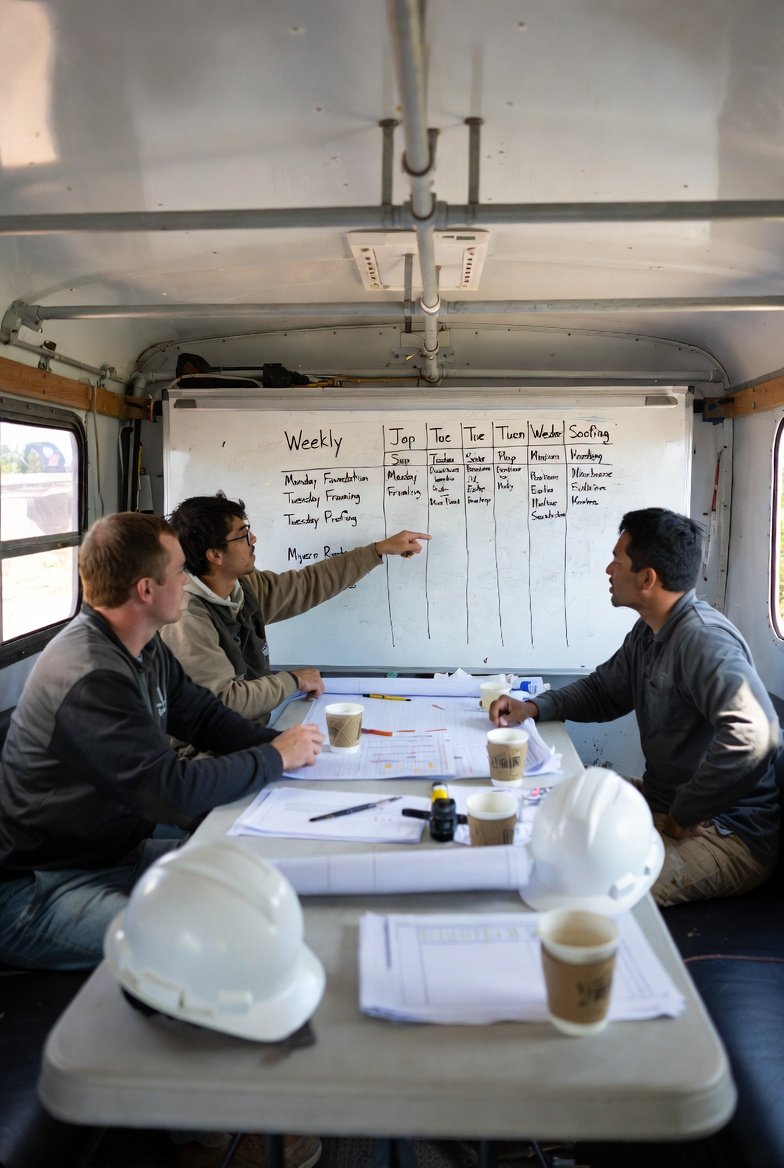
The weekly work plan is where the schedule stops being a wall full of promises and starts being a list of things that will actually happen. Your master schedule says the building finishes in fourteen months. Your look-ahead says these floors get closed up over the next three weeks. But the weekly work plan is the only document on the job that answers the question that matters on Monday morning: what are we going to finish this week, who's going to finish it, and what would stop them?
Get that layer right and the whole job runs quieter. Get it wrong and you spend every day chasing yesterday's mess. After a couple decades of running weekly plans on everything from tilt-up warehouses to four-story wood-frame apartments, here's how I've learned to build one that holds.
A Commitment Is Not a Wish
The single biggest failure I see in weekly planning is treating the plan like a to-do list of hopes. "We're going to try to get the second floor roughed in." That's not a commitment. That's a mood.
A real commitment has four things behind it, and if any one is missing, it doesn't belong on the plan yet:
- The work is clear. "Rough-in the east wing" is too fuzzy. "Set and top-out DWV on units 201-208" is a commitment you can check off or not. No ambiguity about what "done" means.
- The constraints are gone. Materials on site, RFI answered, prior trade complete, inspection passed, area accessible. Not "should be here Tuesday" — here.
- The crew exists. Real bodies, the right count, not borrowed from another commitment across the building.
- The foreman made the promise. Not you assigning it to him. Him looking at it and saying "yeah, we'll have that done Thursday." Ownership changes everything.
The discipline is in what you leave off. A plan with eight rock-solid commitments beats a plan with twenty aspirational ones, because the eight teach your crews that when it goes on the board, it gets done. That reliability is the whole point.
The Plan Comes Out of the Look-Ahead, Not Thin Air
Your weekly work plan should never be the first time an activity gets thought about. It's the last stop on a conveyor belt. The look-ahead schedule — most crews run a rolling three-week window — is where you spot work coming and clear the path in front of it.
Weeks two and three of the look-ahead are your make-ready zone. That's where you're chasing submittals, confirming deliveries, coordinating the trade handoff, booking the inspection. By the time an activity reaches week one, all that spadework is finished. Then and only then is it eligible to become a weekly commitment.
This is the part people skip, and it's why their weekly plans fall apart by Wednesday. If you're clearing constraints the same week you're trying to do the work, you're already late. The look-ahead exists to buy you that lead time. Software that shows the look-ahead and the weekly plan as one connected picture — LookAheadWall was built around exactly this location-based, trade-flow view — makes the handoff obvious, but the principle stands with a whiteboard and sticky notes. The tool doesn't create the discipline. It just makes the discipline harder to ignore.
The Weekly Planning Meeting
You need one real meeting a week, same day, same time, and it should be short. Mine ran 30 to 45 minutes with the foremen who mattered that week in the trailer or standing at the wall. Longer than an hour and people tune out; you're doing coordination that belongs in a smaller huddle.
Run it in this order and it moves:
- Score last week first. Before anybody makes a new promise, we walk last week's commitments. Done or not done — binary, no partial credit. "80% roughed in" is a miss. This sounds harsh; it's actually the kindest thing you can do, because it makes the plan mean something.
- Ask why on every miss. Not to hang anybody — to find the pattern. We'll come back to this.
- Make this week's commitments. Each foreman commits to specific work, out loud, in front of the others. Peer accountability does more than any boss ever could.
- Look at next week. What's coming in week two of the look-ahead, and what constraints do we need to break now so it's ready to commit to next Monday.
Who's in the room: the superintendent running it, the trade foremen doing the work, the key subs, and a project engineer or PM who can go chase the constraints that surface — the RFI, the missing submittal, the delivery date nobody can confirm. If the person who can clear a constraint isn't in the room or on the phone, that constraint doesn't get cleared, it gets deferred, and deferred constraints are how weeks die.
Measure PPC — and Actually Use It
Percent Plan Complete is the one number that tells you whether your planning is real or theater. It's brutally simple:
PPC = commitments completed as promised ÷ total commitments made. If you put twelve things on the board and finished nine the way you said you would, that's 75%.
A few things I've learned about the number. First, it has to be all-or-nothing per commitment — half-done doesn't count, because in the field half-done doesn't let the next trade start. Second, don't be seduced by a suspiciously high score. If you're hitting 100% every single week, you're not planning tight — you're sandbagging, committing to easy stuff you were always going to finish. Good, honest crews live in the 70s and 80s and push. A team that's genuinely at 85% PPC is a machine.
And here's the part nobody likes to hear: PPC is not a report card you file away. The number is worthless unless you read the misses. A low PPC with good variance analysis behind it is more valuable than a high PPC nobody looked at, because the low one is teaching you where the job actually breaks.
Variance Analysis — Where the Real Gold Is
Every missed commitment gets a reason code, and after a month those reason codes tell you the truth about your job that no one would say to your face. Categorize them the same way every week so the pattern shows up:
- Prerequisite work not complete — the trade in front of you didn't finish.
- Materials / equipment not on site.
- Design / RFI / information missing.
- Labor short or reassigned.
- Weather or site conditions.
- Bad plan — we committed to something that was never actually ready. This one's on us, and it's the most useful category on the list.
The magic is in the tally. If half your misses for the month are "materials not on site," you don't have a crew problem — you have a procurement problem, and no amount of yelling at foremen fixes it. If most misses are "prerequisite not complete," your trade sequencing or your make-ready is too loose. The variance data points a finger at the actual constraint on the whole operation. I've watched a job go from the low 60s to the mid 80s in six weeks, not by working harder, but by reading the variance log and killing the same three recurring problems.
Where Weeks Actually Die — Field Realities
A few hard-won specifics that never show up in the textbook version:
Leave buffer between trades. Frame-to-rough-in usually wants a day or two of slack for cleanup, snapping lines, and getting an inspection scheduled — don't stack the plumber on the framer's heels and call it efficiency. That gap isn't waste; it's what keeps a one-day slip from cascading into five.
Protect the inspection. Half the missed weeks I've seen came down to an inspector who couldn't get out for two days. If a commitment depends on passing rough electrical inspection Thursday, that inspection is itself a constraint — call it in early, and megger the runs before you close the wall so you're not tearing rock back off after a fail.
Don't overcommit the crew. A five-man crew has five men. If you've promised work that needs eight, the plan was dead before Monday coffee. Count the labor against the commitment, honestly, every time.
Watch the borrowed-crew trap. The most common way overcommitment hides: two commitments quietly counting on the same three guys. On paper it looks fine. In the field, one of them slips the moment the other runs long.
Track it through the week, not just Monday. The plan is made Monday, but it's alive all week. A five-minute daily huddle at the wall — what's on track, what's wobbling, what do you need — catches the slip on Tuesday when you can still recover, instead of discovering it at Friday's scoring when it's already cost you.
Subs Are Part of the Plan or They're Not
On most commercial and multi-family work, the subs are doing the majority of the labor, which means a weekly plan that only covers your own crews is planning a fraction of the job. Get the trade foremen making commitments in the same meeting, on the same board, scored by the same PPC. When a sub sees his own reliability number tracked next to everyone else's, behavior changes fast — nobody wants to be the trade dragging down the wall. That visibility does more for coordination than any contract clause.
Make It a Habit, Not an Event
None of this works as a one-off. It works because it's the same rhythm every week: same day, same room, same order, same scorecard. The first month feels like overhead. Foremen grumble, the misses are ugly, the variance log is embarrassing. Push through it. Somewhere around week five or six the crews start showing up already knowing their numbers, constraints get chased before the meeting instead of during it, and the plan starts holding on its own.
That's the whole game. The weekly work plan turns the look-ahead's intentions into promises, PPC tells you whether the promises are real, and variance analysis tells you exactly what to fix next. The software — whether it's LookAheadWall showing the location-based flow and rolling up PPC for you, or a disciplined whiteboard — is just there to keep the loop honest. The reliability comes from running the loop, week after week, and refusing to put anything on the wall you don't actually intend to finish.