
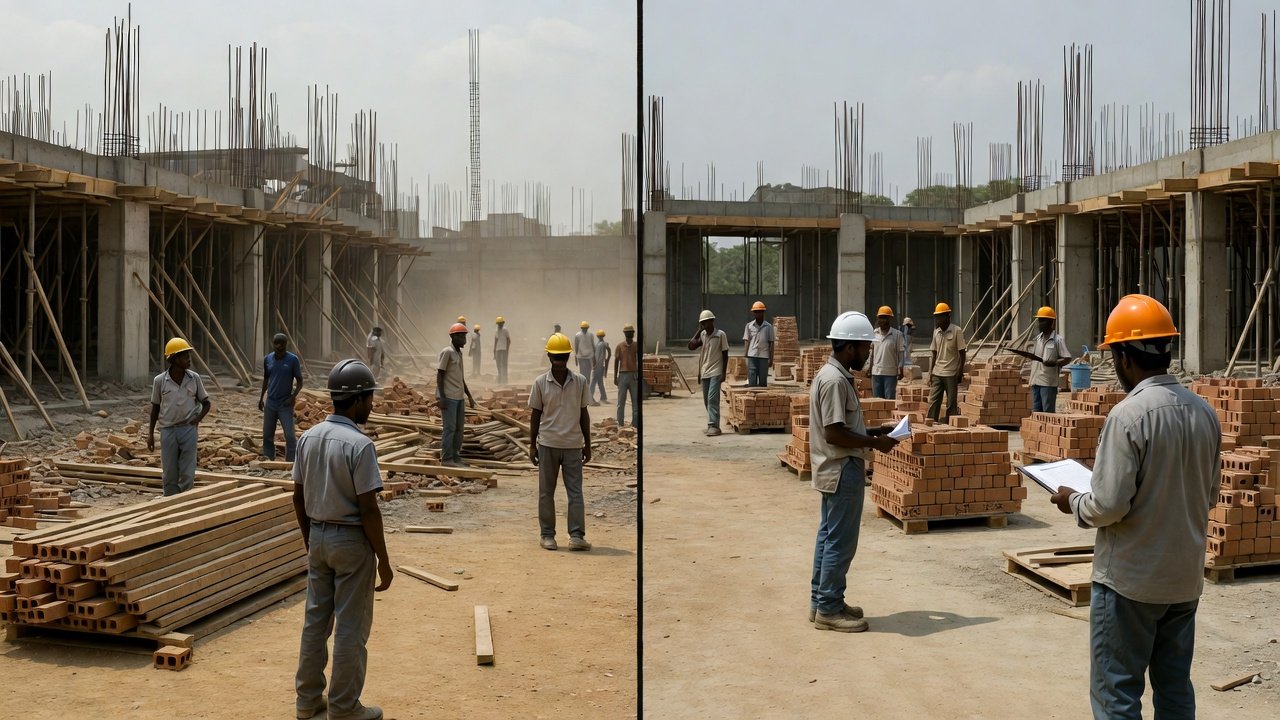
Walk any jobsite at 9:30 in the morning and count the hands actually installing work. Not the guys walking to the gang box for the third time, not the crew standing around a set of prints trying to figure out where the sleeve goes, not the two apprentices waiting on a lift that's tied up on the other side of the building. Just the ones putting material in place. On a lot of jobs that number is embarrassing, and it has almost nothing to do with how hard people are working.
Productivity is construction's oldest problem, and the reflex is always to push the crew harder. But labor doesn't get lost in the eight seconds it takes a guy to pick up his drill. It gets lost in the half-hours: waiting on a predecessor, hunting for material that got staged in the wrong bay, redoing work that was started before the RFI came back. A disciplined weekly work plan attacks exactly those half-hours. It doesn't make anybody swing a hammer faster. It just makes sure that when they show up, the work is actually ready.
Where the hours actually go
If you've never done it, spend one day doing nothing but watching a single crew and writing down what pulls them off the wall. You'll see the same handful of thieves every time:
- Waiting on a predecessor. Drywall shows up to hang and the electrician isn't done with rough-in. Now the hangers are either standing around or hanging around the inspector's back — either way it's a loss.
- Hunting for material. The material's on site, but it's in the wrong stack, or buried, or the delivery got dropped at the gate instead of the floor. A crew of five spending twenty minutes looking is a paid hour and a half gone before a single sheet goes up.
- Waiting on an answer. A dimension doesn't close, a detail's unclear, and instead of installing they're standing at the trailer waiting for the PM to call the architect.
- Rework. The worst one, because you pay for it twice. Somebody framed to the old set, or set the block before the embed layout was confirmed, and now it comes back out.
- Congestion. Two trades stacked in the same 400 square feet, tripping over each other, when a day's separation would have let both run clean.
None of these are effort problems. They're readiness problems. And readiness is decided before the crew ever shows up — which is precisely what a weekly plan is for.
Make-ready is the whole game
The single most valuable habit a look-ahead schedule builds is this: you don't put work on the weekly plan until it's actually ready to build. That's the discipline the Last Planner folks call make-ready, and it's the difference between a plan and a wish list.
Before an activity earns a spot in this week's plan, walk it through a short constraint check. The classic short list is worth memorizing because it catches almost everything:
- Prior work — is the predecessor genuinely done, or just "mostly"? "Mostly" is how you get a crew mobilized to a wall that isn't closed.
- Material — is it on site, in the right place, and released? Not ordered. On site.
- Information — approved submittals, current drawings, closed RFIs. No open questions on the work you're committing to.
- Labor — right crew size and skill, actually assigned.
- Equipment — lift, hoist, pump, whatever it needs, reserved for that window.
- Space and access — the area's clear, safe, and not double-booked with another trade.
- Permits and inspections — the sign-off you need to proceed is in hand.
Anything that fails the check doesn't go on the weekly plan — it goes on the constraint log with a name and a date next to it. That's the part people skip. A constraint you noticed but didn't assign is just a problem you saw coming and let hit you anyway. The look-ahead exists to surface those constraints two and three weeks out, while there's still time to chase the material or get the RFI answered, instead of finding out Monday morning with a crew standing in front of you.
Only promise what's ready — and mean it
Here's the mindset shift that actually moves the productivity needle: the weekly work plan is a set of commitments, not a forecast. Everything on it should be work you're confident can be completed this week because you already knocked down the constraints. That's why crews on a healthy short-interval system stay productive — they're not being handed speculative work that falls apart Wednesday.
The metric that tracks this is Percent Plan Complete: of the tasks you committed to this week, how many actually got done as promised. Don't chase 100 — a plan that hits 100 every week is a plan that's sandbagging. Somewhere in the 80s is a plan that's honest and ambitious at the same time. What matters more than the number is the second question you ask on the tasks that didn't finish: why not? Log the reason every time — waiting on material, prior trade behind, weather, changed our mind, bad estimate. After a month those reason codes stop being anecdotes and start being a map of exactly where your project bleeds hours. Fix the top reason and PPC climbs on its own.
Sequencing and buffers keep the flow going
A productive crew is a crew that never has to stop and ask "what's next?" That continuity is built at the planning table by sequencing work so each trade hands off cleanly to the next, and by leaving deliberate buffers where the hand-off is fussy.
Buffers are where a lot of green planners get burned. They plan trades nose-to-tail — rough-in Friday, inspection and drywall Monday — and then act surprised when the inspector doesn't show, or the framer's punch list isn't cleaned up, and the whole downstream stack slides. A day or two of buffer between rough-in and cover-up isn't slack you're wasting; it's the shock absorber that keeps one late trade from knocking over the next five. Same story from frame to MEP rough: give it that gap for cleanup, layout verification, and the inspection you're going to need anyway. A schedule with zero float between trades isn't aggressive, it's fragile.
And do the boring verification before you close things up, because reopening is the most expensive rework there is. Megger the runs and confirm the low-voltage and blocking are in before the drywall goes on. Pressure-test and get the rough plumbing and mechanical signed off before anybody covers a wall. Photograph the in-wall conditions. Five minutes of checking beats a day of demo every single time.
Coordinate the trades before they collide
Most productivity losses on a busy floor aren't within a trade — they're between trades. Two subs planning in isolation will both, reasonably, pick the same good week to be in the same good area, and then spend that week in each other's way. The weekly plan is where you catch that on paper instead of in the field.
This is exactly what mapping trade flow is for — laying out how each trade moves through the building, area by area, so you can see the collisions and the gaps before they happen. When you can see that framing is finishing zone 3 as the electrician needs to start it, and the electrician wraps zone 3 right as HVAC wants in, you've built a train where every car pulls the next. Tools like LookAheadWall are built around that location-based, trade-flow view precisely because the collisions are obvious when the work is drawn against zones on a wall, and nearly invisible in a bar chart. But the tool only matters because the underlying move — pull the trades into the same weekly conversation and resolve the overlaps out loud — is what actually saves the hours.
Staging, access, and the small stuff that eats mornings
A weekly plan that only lists tasks is half a plan. The other half is the logistics that let those tasks start on time. When you commit an activity for the week, commit the support with it:
- Stage material to the work, not the gate. Say where each trade's material lands, and land it close. A crew that starts the day within arm's reach of its material starts the day, period.
- Book the shared equipment. One hoist, three trades — put it on the plan by half-day windows so nobody mobilizes to a task that needs a lift they can't get.
- Assign the housekeeping. The reason a crew can't start is often that the last trade left the area full of debris. Name who cleans up as part of the hand-off, or you'll pay a productive crew to sweep.
- Confirm access and safety. Barricades, fall protection, a clear path for the material cart. The twenty minutes lost figuring out how to get into the space is twenty minutes at crew rate.
Why accountability lifts the whole thing
There's a softer effect that's easy to underrate. When commitments are made out loud, in front of the other trades, in a plan everyone can see, people plan more carefully and deliver more reliably. Nobody wants to be the trade explaining for the third straight week why they didn't hit what they said they'd hit. That's not about pressure for its own sake — it's that a public commitment forces the foreman to actually think through his week before he makes it, which is when the constraints get caught.
The flip side matters just as much: when a crew consistently gets ready work handed to them, they start to trust the plan, and trust changes behavior. They stop hedging, stop keeping a private list of "real" work to fall back on, and start committing for real. A plan people believe in is a plan people execute.
What it actually adds up to
None of this is about heroics. It's about arithmetic. Cut a crew's daily waiting and hunting from ninety minutes to thirty and you've bought back an hour a day per man — with no new headcount, no overtime, no speeches about hustle. Do it across a floor of trades and the gains compound: fewer collisions, less rework, cleaner hand-offs, a schedule that stops slipping because the work underneath it is finally reliable. Cost follows productivity down, and quality usually follows it up, because work that's properly staged and sequenced simply gets done right the first time.
Good look-ahead and short-interval scheduling — whether you run it on a whiteboard or in something like LookAheadWall — isn't paperwork for the office. It's the mechanism that decides whether your crews spend the day building or spend it waiting. Productivity was never really about working harder. It's about making sure that when a skilled crew shows up ready to work, the work is ready for them. That's the entire job of the weekly plan, and it's why the good ones are worth the hour it takes to build them.