
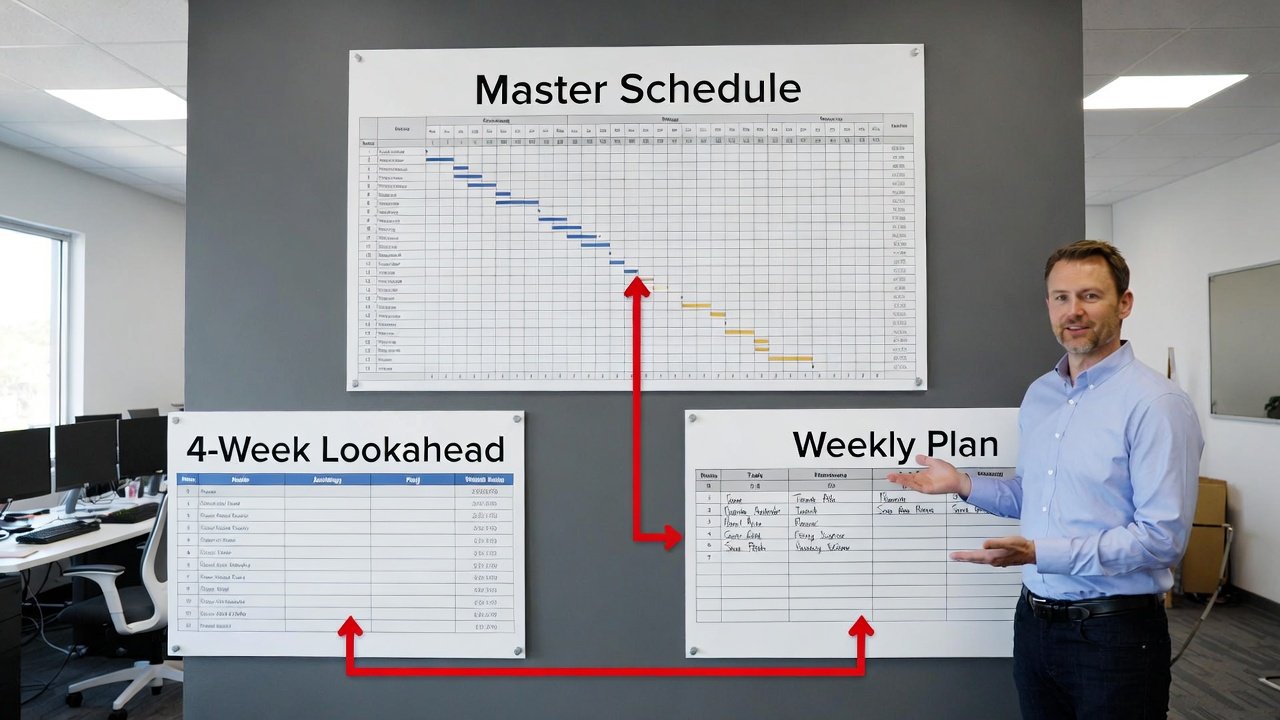
Ask ten superintendents to explain how their weekly plan relates to their lookahead, and you'll get ten shrugs and some version of "the lookahead is the big picture, the weekly is what we're doing this week." True enough, but it misses the machinery that actually connects the two. And when that machinery is missing, you get the job everybody has worked on at least once: a lookahead that lives on the trailer wall gathering dust, and a Monday morning where the foremen just make it up as they go.
The lookahead and the weekly work plan aren't two separate documents. They're one continuous process viewed at two different distances. The lookahead is where you go find out what's coming and knock down everything that could stop it. The weekly plan is where you promise, out loud and in front of the other trades, exactly what will happen in the next five days. If you understand how an activity travels from one to the other, you understand short-interval scheduling. If you don't, you're just filling out forms.
The Four Distances of a Schedule
It helps to think about planning as a set of nested zoom levels, each answering a different question and living on a different clock.
- Master schedule — the contract-level timeline and milestones. Answers "when does the building get done?" You touch it monthly, if that.
- Phase or pull plan — the milestone-to-milestone sequence the trades build backward together in a pull-planning session. Answers "in what order do we hand off between milestones?"
- Lookahead — usually a rolling three-to-six-week window. Answers "what's coming, and what has to be true before we can do it?" You update it every week.
- Weekly work plan — the next five days, task by task, crew by crew. Answers "what are we actually committing to, and who's doing it?" You rebuild it every week and check it every day.
The mistake is treating these as four documents maintained by four different people on four different tools. They're one funnel. Work pours in at the master level and gets refined, constrained, and committed as it flows down. The weekly plan should never contain a task that didn't come out of the lookahead, and the lookahead should never contain a sequence that contradicts the pull plan. When those rules break, the schedule stops meaning anything.
How an Activity Travels from Lookahead to Weekly
Here's the actual journey, using the six-week window as an example. Follow one activity — say, "hang drywall, Level 3 north wing" — through it.
Week 6 out, it enters the window. When drywall on L3 north shows up on the far edge of your lookahead, that's your cue to ask one question: what has to be true before a hanger can pick up a sheet? Framing complete and inspected. In-wall rough-in (electrical, plumbing, low-voltage, fire caulk) signed off. Insulation in and inspected. Material on the deck. Each of those is a constraint, and you write every one of them down now, while you still have five weeks to fix them.
Weeks 5 through 2, you make it ready. This is the part everybody skips and everybody regrets. Making an activity ready means somebody owns each constraint and works it to closed. The in-wall inspection isn't scheduled — get it on the inspector's calendar. The low-voltage sub is three days behind on the north wing — call the foreman, find out why, adjust. This is the real work of look-ahead scheduling. It is not clerical. A make-ready process that just re-lists the same constraints week after week without anyone resolving them is theater.
Week 1, it becomes eligible. An activity is only allowed into the weekly work plan when its constraints are actually resolved — not "should be fine," but verified. This is the single most important handoff in the whole system, and it's where most weekly plans go wrong. Foremen commit to work because it's on the schedule, not because it's ready. Then Tuesday the hangers show up and the fire caulk isn't done, and you've burned a crew-day and made a liar out of the schedule.
The weekly plan, you commit. Now the drywall foreman looks at what's genuinely ready and makes a promise: "L3 north, hang and finish level, Tuesday through Thursday, two hangers plus a finisher Friday." That promise is a commitment, and because the constraints are clear, it's a promise he can actually keep.
Notice what happened. Nothing entered the weekly plan that hadn't spent weeks getting de-risked in the lookahead. The weekly plan isn't where you figure out the work — it's where you cash the check the lookahead already made good.
Make-Ready Is the Bridge, Not a Formality
If there's one idea to take from this, it's that make-ready is the load-bearing wall between the two levels. The lookahead has no value except as a place to run activities through make-ready before you ever ask a crew to commit. Strip out the constraint work and the lookahead is just a Gantt chart shifted three weeks to the right.
A practical rule of thumb: an activity should be constraint-free by the time it's about two weeks out. If you're still resolving constraints in the commitment week itself, you've run out of runway, and you'll either commit to work that isn't ready or scramble to backfill with something that is. Build your make-ready so the answer to "is this ready?" is settled well before Monday, not discovered on it.
And be honest about buffers between trades. Frame-to-rough-in usually wants a day or two of slack for cleanup, punch, and inspection turnaround — don't stack the electrician's rough-in start on the framer's last nail. Same with concrete: nobody's loading a deck the morning after the pour just because the bar chart says so. Those buffers belong in the lookahead sequence, so the weekly plan inherits them instead of colliding with reality.
Information Flows Both Ways
The connection isn't a one-way chute from lookahead to weekly. The return trip matters just as much.
Downhill, the lookahead feeds the weekly plan a menu of ready, de-risked activities to commit to. Uphill, what actually happened in the field last week has to update the lookahead. The drywall crew finished L3 north a day early — great, now L3 south comes forward. The inspector red-tagged the rough-in — that constraint just reopened, and everything behind it slides. If your weekly results don't flow back up and revise the lookahead, the two documents drift apart within a couple of weeks, and by the end of the month your lookahead is fiction.
This is exactly where trying to run the two levels in separate tools falls apart. When the lookahead lives in one program and the weekly plan in another, the update never makes the trip — somebody would have to hand-transcribe last week's results into next month's plan, and nobody ever does. Keeping both views in one connected system, the way LookAheadWall is built to do, is less about slick software and more about making sure the field's reality actually reaches the plan. When an activity finishes on the weekly plan, its status should already be updated in the lookahead — no double entry, no divergence.
Where This Sits in Last Planner
If you've run Last Planner, none of this is new — it's the whole point of the system. Phase planning sets the sequence, the lookahead runs make-ready, the weekly work plan captures commitments, and the daily huddle executes them. The magic isn't any one level; it's the disciplined handoff between them, and the feedback loop that closes at the end of every week.
That feedback loop has a name worth knowing: PPC, or Percent Plan Complete. At the end of each week, you count how many of your weekly commitments you actually finished, divided by how many you promised. A crew hitting 50% isn't lazy — it's a signal that work is entering the weekly plan before it's truly ready, which means your make-ready process upstream is leaking. Chase the reasons for the misses (the "variances"), and nine times out of ten they point back to a constraint that should have been caught weeks earlier in the lookahead. That's the connection working as a diagnostic, not just a plan.
Making the Connection Real in the Weekly Meeting
All of this comes together — or falls apart — in one room, once a week. The weekly work plan meeting should never review only the coming week. Run it in two passes:
- Score last week. Walk the commitments, mark done or not-done, and for every miss, name the reason out loud. No blame, just the reason. Log it.
- Roll the lookahead forward. Advance the window a week, pull the new far-edge activities in, and list their constraints while there's still time to fix them.
- Commit the coming week. Only from the pool of activities whose constraints are verified closed. If a foreman wants to commit to something that isn't ready, that's your cue to say no — and to go fix the constraint instead.
Get the trades' foremen making their own commitments in that room. A commitment somebody makes with their own mouth, in front of the crew that depends on them, holds up a lot better than a task a scheduler assigned to them in an office.
The Failure Modes to Watch For
A few specific ways the connection breaks, so you can catch them early:
- Committing without make-ready. The classic. Work goes on the weekly plan because it's on the schedule, not because it's ready. Symptom: low PPC and crews standing around Tuesday morning.
- Two disconnected tools. Lookahead in one place, weekly plan in another, no link. Symptom: a lookahead that's weeks stale because field results never make it back up.
- Make-ready as a checklist ritual. Constraints get listed but never assigned or closed. Symptom: the same three constraints riding the lookahead for a month.
- No buffers in the sequence. Trades stacked nose-to-tail with no slack for inspection or cleanup. Symptom: every handoff turns into a fire drill.
- Skipping the score. A weekly meeting that only looks forward. Symptom: the same misses repeat because nobody ever traces why they happened.
The Short Version
The lookahead and the weekly work plan are one process at two distances. The lookahead exists to run work through make-ready so that, by the time it reaches the commitment week, every constraint is closed and a foreman can promise it and mean it. The weekly plan exists to capture those promises and, at week's end, feed the results back up so the lookahead stays honest.
Keep that loop tight — constraints identified early, resolved before the commitment week, commitments made by the people doing the work, results scored and rolled back into the lookahead — and the two documents stop being paperwork and start being the same living plan. That's the difference between a schedule that hangs on the trailer wall and one that actually runs the job.