
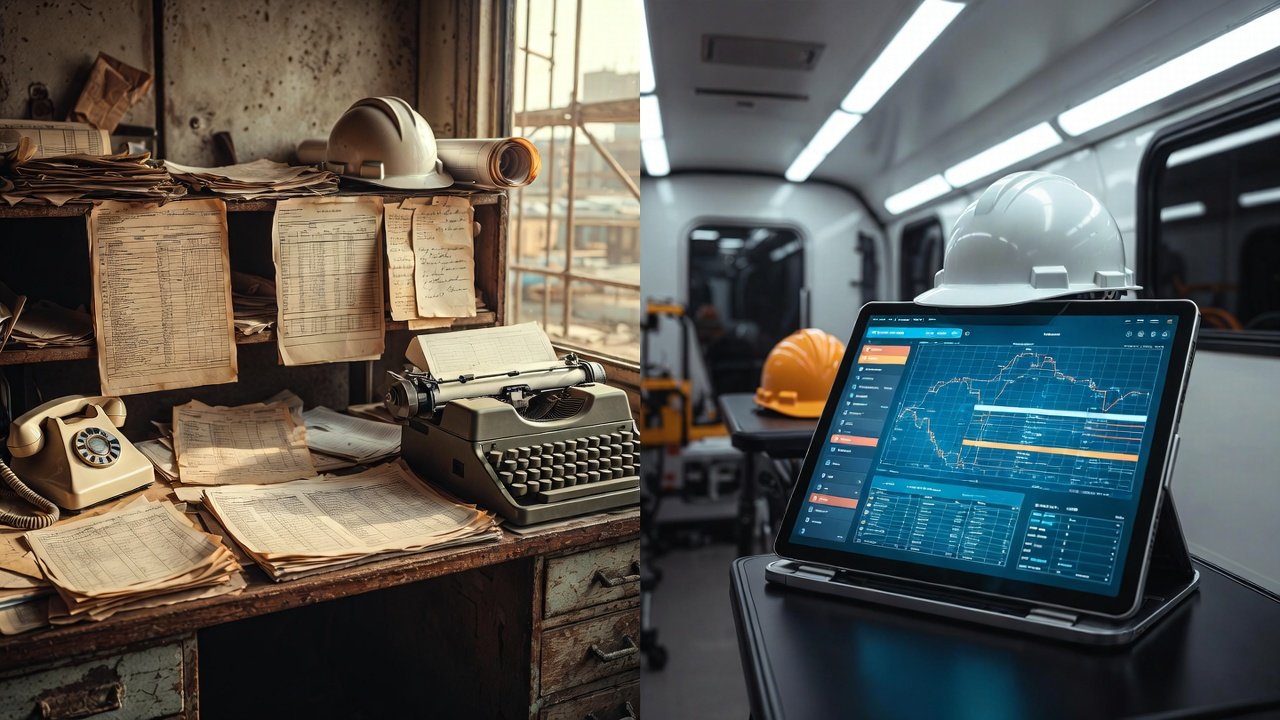
Why the Look-Ahead Exists at All
Every master schedule ever printed has been wrong by the time the ink dried. Not because the scheduler was bad at his job, but because a Gantt chart built in the trailer nine months before you break ground cannot know that the elevator submittal will sit on an engineer's desk for six weeks, or that your drywall sub will get pulled to a bigger job the same week you needed him. The master schedule tells you where the project is supposed to be. It does not tell your crews what to actually do on Tuesday.
That gap — between the big picture and the next handful of days — is the entire reason look-ahead scheduling was invented. Somebody standing in the mud needed a way to reach out three or four weeks, see what was coming, clear the junk out of the way, and hand each foreman a plan he could believe. The tools have changed enormously over seventy years. The problem has not changed at all.
The Clipboard Era
In the postwar building boom, jobs got bigger and more complicated faster than anyone's methods for running them. A good superintendent in the 1950s and 60s kept the schedule the same place he kept everything else: in his head and on a clipboard. The near-term plan was a handwritten list, maybe a marked-up calendar tacked to the trailer wall, updated by memory and by walking the deck every morning.
It worked better than you'd think, because the people doing it were sharp and the job was in their bones. It also fell apart the moment that superintendent got sick, retired, or got promoted to a job across town. Nothing was written down in a way anyone else could pick up. The knowledge lived in one skull, and when the skull left, the coordination left with it. That fragility is worth remembering, because it's the thing every improvement since has been trying to fix: getting the plan out of one person's head and into a form the whole team can see and trust.
The CPM Revolution — and Its Blind Spot
The Critical Path Method arrived in the late 1950s, out of a DuPont plant project, and it genuinely changed the trade. For the first time you could model thousands of activities, their dependencies, and their durations, and the math would tell you which chain of work actually drove the finish date. By the 1970s and 80s, CPM was a contract requirement on nearly every significant public and commercial job.
But CPM had a blind spot that anyone who has run a jobsite feels in their gut. A network with 4,000 activities is a magnificent planning document and a useless field document. You cannot hand a concrete foreman a wall-sized logic diagram and expect him to find his three activities for next week. The critical path answers "will we finish on time?" It does not answer "what does the plumber do on Thursday, and is the wall framed and inspected so he can?"
So superintendents did the obvious thing: they filtered. Every Monday, someone would pull the activities scheduled to start in the next two or three weeks, retype them onto a form, photocopy it, and hand it out at the coordination meeting. That extract — the near-term slice of the CPM — is the direct ancestor of the modern look-ahead. The three-week window became the default not because three is magic, but because it was the longest horizon a person could reliably maintain by hand and the shortest that still gave subs time to mobilize.
The paper version had two chronic failures. First, it was stale on arrival — by the time copies reached a sub's office in the mail, the deck had already moved. Second, it couldn't absorb change. When work accelerated or a delay hit, the printed sheet just sat there being wrong, and a trade would show up Monday to start work on a wall that wasn't ready. Everybody has stood in that argument in a parking lot.
The Idea That Actually Mattered: Last Planner
The biggest leap in look-ahead scheduling wasn't a piece of software. It was an idea. In the early 1990s, Glenn Ballard and Greg Howell formalized the Last Planner System out of the lean construction movement, and it named something the best supers had always done by instinct but couldn't teach.
The insight is simple and it's about honesty. A CPM schedule tells you what should happen based on logic and durations. Last Planner asks what can happen — what work is genuinely ready, with no constraints in the way — and then asks the person who will actually do it to commit to what he will do. The look-ahead sits right in the middle of that. Its real job is not to publish dates. Its real job is to look three to six weeks out, find every constraint, and knock them down before the work is supposed to start.
Constraints are the whole game. Is the material on site? Is the design question answered? Is the inspection scheduled? Is the preceding trade actually done, not "almost done"? Is there a permit, a crane pick, a lay-down area, a crew? A task isn't ready to schedule until every one of those is cleared. Last Planner gave the industry a discipline — make-ready planning — and a scoreboard: Percent Plan Complete, the honest count of how many of last week's commitments you actually hit. PPC is humbling the first time you measure it. Most teams start in the fifties and think they're at ninety.
What matters here is that this reframed the look-ahead from an administrative chore into a management tool. You're not retyping the CPM. You're running a rolling constraint-removal operation, and the near-term schedule is where you keep score.
Going Digital, and the Trap That Came With It
Through the 1990s and 2000s, Primavera and Microsoft Project put real scheduling horsepower on a desk. You could filter the network to a date range, print a clean two- or four-week look-ahead, and email a PDF instead of stuffing envelopes. That was progress. It also created a new trap.
The trap was that these tools were built for schedulers, not superintendents. Producing a decent rolling look-ahead in P6 took real expertise most field guys didn't have and didn't want. So the schedule became something the home-office planner owned and the field received — which is exactly backwards from what Last Planner teaches. The people closest to the work, the "last planners" whose commitments the whole system depends on, were reduced to reading a printout somebody else made. And the printout was still static. The second it left the printer, the deck kept moving and the paper didn't.
The rolling concept did take hold in this era, and it's worth keeping: you maintain the same horizon at all times, always looking, say, four weeks out, dropping completed work off the back and pulling new work in the front every week. A rolling window produces far more reliable flow than planning to fixed milestones, because it forces a fresh constraint check every single week instead of only at the big dates.
Mobile, Cloud, and the Return of the Field
Smartphones changed the physics of the problem. Once a foreman could pull the current plan out of his pocket at the far end of the deck, the whole distribution problem — the copies, the mail, the Monday-morning lag — simply evaporated. A change made at 7 a.m. was visible to every trade before the first coffee.
The cloud finished the job by killing the version problem for good. When the plan lives in one place and everyone reads from it live, you can't have four subs working off three different revisions anymore, which is how a shocking amount of rework used to start. Just as important, information could finally flow the other way. A sub could flag a constraint directly instead of sitting on it until the weekly meeting. Progress from the field could update the plan through the week instead of at a Friday guess-a-thon.
That two-way flow is the quiet revolution. It handed the schedule back to the people doing the work — which is where Last Planner said it belonged all along. Purpose-built look-ahead tools grew up around this, LookAheadWall among them, built around how a super and a foreman actually think: visual, location-based weekly work plans, trade-flow sequences you can see and connect, drag-to-adjust instead of retype, and a mobile view so the crew leader has the current plan without waiting on anyone. The point of the software was never the software. It was to make the honest, boring discipline of clearing constraints cheap enough to do every week without a scheduling degree.
What Hasn't Changed, and Some Rules of Thumb
Here's the part that survives every technology shift, and it's worth more than any tool. A few things I'd hand a young super regardless of what he's using to draw the plan:
- Schedule what's ready, not what's due. If a task still has an open constraint, it does not belong in your commitment for next week. Put it in the look-ahead as a make-ready item and go clear the constraint. Committing to work that can't start is how you train your team to ignore the schedule.
- Leave real buffer between trades. Frame-to-rough-in usually wants a day or two of slack for cleanup, punch, and the framing inspection before the plumber and electrician move in. Butt sequences together with zero buffer and the first slip cascades through everyone behind it.
- Verify "done" with your own eyes. "We're done" from a foreman and "the wall is ready to close" are different statements more often than you'd like. Walk it before you sequence the next trade onto it. Megger the electrical runs and pressure-test the plumbing before anyone hangs board — reopening a closed wall is the most expensive mistake on the list.
- Measure PPC and don't lie to yourself. Count the commitments you actually hit. When you miss, ask why — a constraint you didn't clear, a bad duration, a trade that no-showed — and fix the cause, not the number.
- Keep the horizon rolling. Same window, every week, forever. The weekly ritual of re-checking constraints is the whole value. A look-ahead you update once and forget is just a worse master schedule.
People love to talk about where this goes next — predictive models flagging constraints before a human spots them, schedules that nudge themselves based on how your crews really perform. Some of that is coming and some of it is genuinely useful. But don't let the shine distract you. From a clipboard on a trailer wall to a live plan on a phone, look-ahead scheduling has always been about one unglamorous thing: looking a few weeks down the road, finding what's going to stop the work, and clearing it out of the way before the crew shows up. Master that habit and the tool almost doesn't matter. Skip it, and no software on earth will save your finish date.