
What a Lookahead Schedule Actually Is
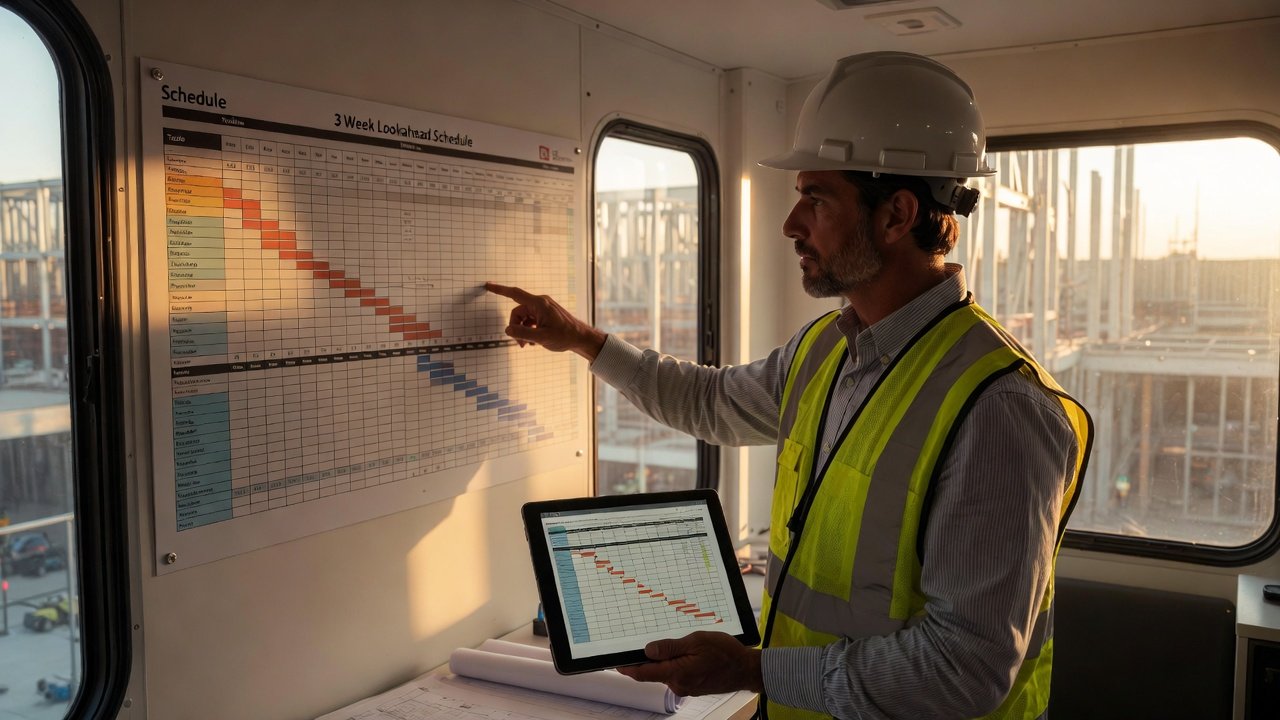
A lookahead schedule is the plan for the next three to six weeks of work, broken down to the level of detail a foreman can actually build from. The master schedule tells you the concrete pour on Level 3 happens sometime in March. The lookahead tells you it happens Wednesday the 12th, that the pump truck is booked, the inspector is scheduled for Tuesday afternoon, and the embeds got delivered last Thursday. One is a promise to the owner. The other is a promise you can keep.
The master schedule and the daily huddle live at two different altitudes, and there's a gap between them where projects quietly fall apart. The lookahead fills that gap. It's the working document where you stop asking "are we on schedule?" and start asking "is this specific activity actually ready to go, and if not, who fixes what by when?"
I've watched superintendents run billion-dollar jobs off a whiteboard and a roll of blue tape. The tool matters less than the discipline. But the discipline is where most GCs come up short, and that's what this is really about.
Why the Master Schedule Isn't Enough
Every project starts with a CPM schedule — a few thousand activities, logic ties, a critical path glowing red. It's a legal document, a billing reference, and a beautiful piece of fiction. It assumes every predecessor finishes clean, every submittal comes back approved, and every crew shows up at full strength. None of that is true for more than about a week at a stretch.
The master schedule is also too coarse to build from. "Interior rough-in — 15 days" means nothing to the electrician standing in the corridor Monday morning. Which rooms? In what order? Is the framing inspection signed off so he can close walls, or is he going to hang wire in a wall the inspector is going to make him open back up?
The lookahead exists to answer exactly those questions, and to answer them far enough in advance that a "no" is still fixable. A missed material delivery three weeks out is a phone call. The same missed delivery discovered Monday morning is a crew standing around on your dime while the super scrambles.
The Real Job: Removing Constraints Before They Bite
Here's the part the glossy definitions skip. A lookahead schedule is worthless as a status report. Its entire value is as a constraint-removal engine. Every activity you pull into the window gets interrogated against the same short list before you'll call it "ready":
- Prerequisite work — is the predecessor genuinely complete, or 90% done with a punch list that'll block the follow-on trade?
- Materials — on site, or confirmed with a delivery date that lands before the crew does? "It's ordered" is not a yes.
- Approvals and submittals — shop drawings approved, product data in hand. You can't set a fixture that's still stuck in submittal review.
- Inspections — is the sign-off scheduled, and does the prior inspection actually pass before this trade covers it up?
- Labor — did the sub commit the headcount, or did he promise eight guys he's also promised to two other jobs?
- Equipment and access — lift available, area handed over, safe to work. A scissor lift booked for two crews in the same corridor is a fistfight waiting to happen.
- Preceding information — RFIs answered, no open design questions sitting on the activity.
Run every activity through that filter three or four weeks before it's supposed to start and you've bought yourself the one thing a jobsite never has enough of: time to react. That's the whole game. The Last Planner System calls these "make-ready" tasks and tracks them formally; you don't need the full methodology to get the benefit, but you do need to actually walk the list activity by activity instead of just admiring the bar chart.
How Long Should the Window Be?
Three, four, or six weeks — the arguments for each are practical, not philosophical.
A three-week window is tight and honest. Everything in it is close enough that the information is real, and it forces the team to deal with the near term instead of hiding behind activities that are still going to shift. It's my default for fast-moving interiors and repetitive work where the sequence is well understood.
A four-week window buys a little more runway for material lead times and inspection coordination, and it lines up neatly with monthly billing and owner meetings. For most commercial work, four weeks is the sweet spot — far enough out to catch a long-lead item, close enough that people take it seriously.
Six weeks earns its keep when lead times and coordination are genuinely long — healthcare, labs, data centers, anything with heavy MEP and specialty equipment. The trade-off is that the far end of a six-week window is soft. Weeks five and six are for staging make-ready work and flagging long leads, not for making firm daily commitments you'll just have to redraw.
Whatever you pick, keep it rolling. As this week drops off the back, a new week comes on the front, and the horizon stays constant. A lookahead that gets rebuilt from scratch every month isn't a lookahead — it's a monthly report with delusions of grandeur.
Building One That People Actually Use
The trap every new super falls into is treating the lookahead as a document to publish rather than a conversation to run. Nobody coordinates a project by reading a printout. They coordinate it by arguing over the sequence in a room, then holding each other to what got decided.
So the rhythm matters more than the format. A workable weekly cycle looks like this:
- Before the meeting, you roll the schedule forward and flag the constraints you already know about — the delivery that slipped, the inspection you can't get on the calendar.
- In the weekly coordination meeting, you walk the window with every foreman in the room. Each trade confirms readiness or raises a flag. Constraints get an owner and a due date, not a shrug.
- The current week becomes each foreman's weekly work plan — the specific daily commitments their crew will actually make and hit.
- Through the week, the plan feeds back: what got done, what slipped, what surprised you. That reality updates next week's roll-forward.
That feedback loop is what separates a living lookahead from wall art. Track your Percent Plan Complete if you want a number — of the tasks the team committed to this week, how many actually finished. Crews new to this land around 50%. Mature teams run 80% and up. The number matters less than the conversation it forces: why did the other 30% miss? Chase the reasons and the whole operation gets tighter month over month.
Where Trade Sequencing Lives or Dies
The lookahead is also where you catch the collisions the master schedule is too blurry to show. A few that have bitten me and everyone I know:
- Overhead MEP order. In a congested ceiling, gravity wins — big duct and plumbing waste before conduit and cable tray, sprinkler drops threading in around them. Let three trades hit the same corridor the same week with no sequence and you'll be paying for rework by Friday.
- Inspect before you cover. Frame-to-rough-in wants a day or two of buffer for cleanup, backing, and the framing inspection before drywall closes the wall. Megger the electrical runs and pressure-test the plumbing before anyone hangs a sheet of rock. The cost of opening a finished wall is roughly ten times the cost of waiting one day.
- Concrete cure and follow-on. You can strip forms early, but layout and anchor work want the slab to actually cure. Rushing the follow-on trade onto green concrete is how you get cracked anchors and a bad day with the structural engineer.
- Handoff cleanliness. A predecessor at 90% with a trailing punch list is not a finished predecessor. Build the punch-out and cleanup into the sequence as its own line, or the next trade inherits your mess and your schedule.
Mapping the trade flow — who hands off to whom, in what order, with what buffer — is exactly the kind of thing a purpose-built tool like LookAheadWall makes visible, because you're laying out work by location and connecting the sequences instead of squinting at a list of activities and hoping the logic holds. But the thinking has to come first. Software that draws a bad sequence faster is not an improvement.
Getting Your Subs to Buy In
A lookahead only works if the people doing the work believe in it, and subs have been burned by GC schedules that were pure wishful thinking. The way you earn that trust is by making commitments two-way. If a foreman commits his crew to a date, you owe him that the area is ready, clean, and accessible when he shows up. Break that promise a few times and he'll pad every estimate and stop telling you the truth — and a lookahead full of padding and polite lies is worse than none.
Visibility helps enormously here. When a sub can see the plan for himself — what's coming, when his window opens, what he's waiting on — you replace a dozen phone calls a week with a shared reference everyone's reading off the same. That's where sharing the schedule digitally, whether through LookAheadWall or whatever platform your team already lives in, does real work: not because software is magic, but because a plan nobody can see isn't a plan, it's a secret.
The Bottom Line for GCs
Short-interval scheduling isn't a nice-to-have you graduate into once the job is big enough. It's the difference between running the job and letting the job run you. The master schedule tells you where you're supposed to be. The lookahead is how you actually get there — by looking three or four weeks down the road, finding every reason a crew might get stopped, and clearing those reasons while there's still time to clear them.
Start small. One project, a three-week window, one honest coordination meeting a week where you walk the constraints instead of reciting the plan. Do that consistently for a month and you'll feel the difference — fewer fire drills, fewer crews standing around, fewer angry calls from subs who mobilized into work that wasn't ready. The projects that finish on time aren't the ones with the prettiest CPM schedule. They're the ones where somebody was looking ahead, out loud, every single week.