
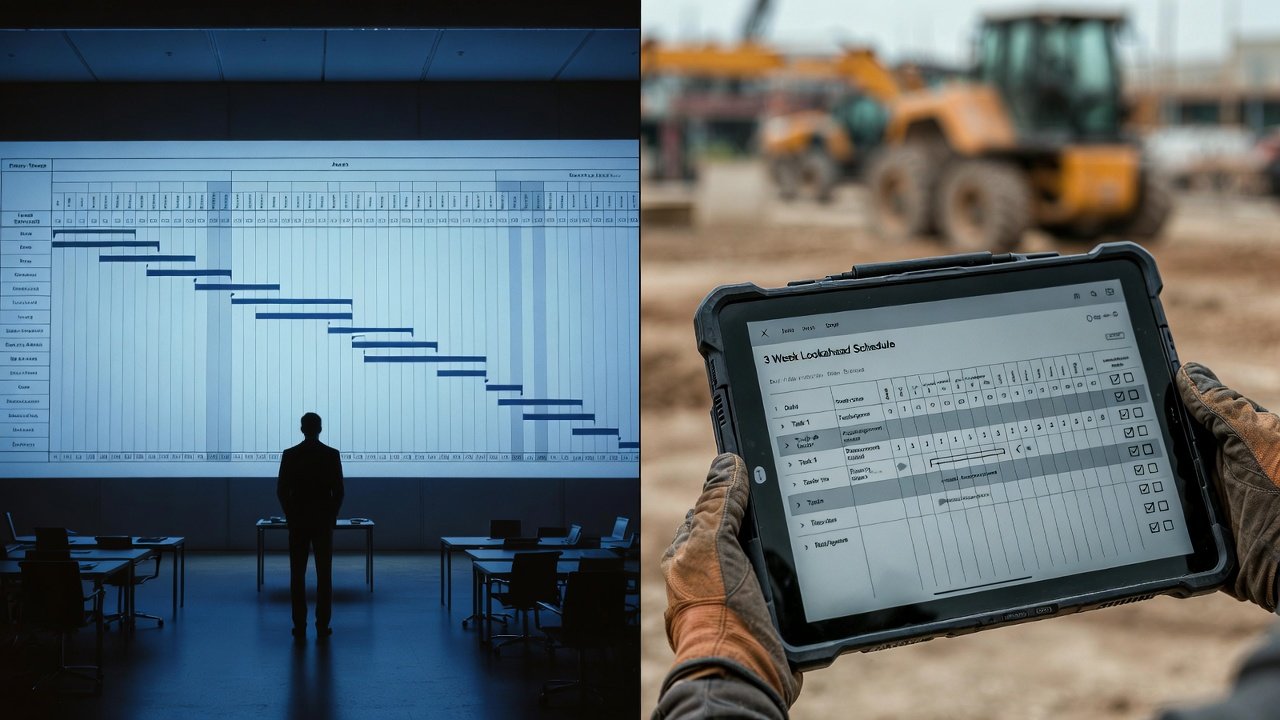
Two schedules, two jobs
Walk into any decent-sized commercial or multi-family project and you'll find two schedules living side by side, whether anyone calls them that or not. There's the master schedule — the big Gantt chart the scheduler built in P6 or MS Project, hanging in the trailer or living on somebody's laptop. And there's the plan for what actually happens next week, which usually lives in the super's head, on a whiteboard, or in a spreadsheet he rebuilds every Thursday afternoon.
They are not the same tool, and confusing them is where a lot of jobs quietly go sideways. The master schedule tells you whether you'll finish on time. The look-ahead tells you whether Tuesday's going to work. You need both, and you need to understand exactly what each one is for, because the failure mode is always the same: somebody tries to run the field off the master schedule, or somebody runs the look-ahead with no eye on the master, and either way the project pays for it.
Time horizon: the whole job vs. the next three weeks
The master schedule covers the entire project — notice to proceed through substantial completion, sometimes a couple of years of work with a thousand-plus activities and a critical path snaking through all of it. Its whole reason to exist is the long view: milestone dates, the baseline you measure against, and the answer to the owner's favorite question, "are we still going to make the date?"
A look-ahead schedule — usually a three- or six-week window — deliberately throws away the long view to gain detail. Instead of a bar that says "Rough Framing — 15 days," you get the real plan: interior partitions on grids 4–7 Monday and Tuesday, grids 7–11 Wednesday through Friday, second floor starting the following Monday once the deck's clear. The master schedule shows you the forest. The look-ahead is where you count the trees, because the trees are what actually trip your crews.
That compression is the point. You can plan three weeks at a level of detail that would be insane to maintain across two years. Nobody's going to keep a live, day-by-day plan of a slab pour that's fourteen months out — conditions will have changed a dozen times before you get there. So you don't. You let the master schedule hold the place, and you sharpen the detail only as the work rolls into the window.
Level of detail: where coordination actually lives
Here's the thing the master schedule can't show you, and it's the thing that gets crews standing around. Take a line that reads "Install HVAC Ductwork — Building A, Level 2." Perfectly fine at the master level. But the work is really a sequence: sheet metal delivery, hang the main trunk, run branch ducts to the VAV boxes, then tie flex to the diffusers. And buried in that sequence is a coordination trap — the trunk lines have to go up before the electrician can pull his home runs through that same ceiling space above the corridor. On the master schedule, HVAC and electrical rough-in are two bars that overlap, and the overlap looks harmless. It isn't. In the field it's two foremen wanting the same overhead at the same time, and one of them loses a day.
That kind of dependency is invisible at the master level and glaringly obvious at the look-ahead level, because the look-ahead is built at the resolution coordination happens. Ceilings, corridors, specific rooms, specific grid lines. If your short-interval plan isn't detailed enough to expose which trade needs which space on which day, it isn't detailed enough to prevent the collision — it's just a prettier version of the master schedule.
Who builds it, and who it's for
The master schedule is usually the scheduler's baby, built from historical durations, standard sequences, and CPM logic. Its audience is small and technical: PM, scheduler, ownership. Reading it correctly — floats, constraints, driving relationships — takes training. Hand a raw CPM printout to a drywall foreman and you've handed him nothing useful.
The look-ahead flips that. It has to be legible to everyone who touches the work — every sub, every foreman, every crew lead. When your plumber shows up Monday morning, he needs to see his tasks and the trades around him at a glance, not wade through a network diagram. That's a big reason the look-ahead earns its keep as a visual, location-based plan rather than a spreadsheet of activity codes. Tools like LookAheadWall exist for exactly this — they let you filter the plan so each sub sees their own work in context without drowning in the full schedule, and give crew leaders a mobile view of what's on for the week. The format matters as much as the content; a plan nobody can read is a plan nobody follows.
Update frequency: monthly vs. constantly
Master schedules get updated on a formal cycle — usually monthly, sometimes at milestones. You status the progress, slide the future dates, recalculate the critical path, and issue the update. It's deliberate work, and it should be, because owners and the schedule of values ride on it.
The look-ahead moves at a completely different tempo. It's a living document that changes when the job changes. A pour slips two days on the weather and the whole downstream sequence shifts that afternoon, not at the end of the month. This is why you don't run the field off the master schedule — by the time a monthly update catches a two-day slip, your crews have already made three bad decisions off stale information. The look-ahead absorbs the day-to-day chaos so the master schedule doesn't have to twitch every time it rains.
Update the look-ahead the day reality changes, not on a calendar. The moment your short-interval plan is stale, it stops being a plan and becomes a rumor.
The part that separates good supers from the rest: constraints
This is where I'll spend a minute, because it's the whole game. A master schedule assumes the world behaves — that every activity can start when the logic says it can. The field knows better. Work doesn't happen because material's on a truck in Ohio, because the deck above isn't shored yet, because the inspector can't come until Thursday, because the shop drawings are still in review, or because the crew that's supposed to be here is finishing another job across town.
Running a real look-ahead means walking that three-week window activity by activity and asking one blunt question of each: is there any reason this can't happen when I've got it planned? Material on site. Prior work complete and inspected. Approved submittals in hand. Access, permits, equipment, manpower. Anything that isn't a clean "yes" is a constraint, and a constraint with no name attached and no date to clear it is a delay that hasn't shown up on your report yet.
The discipline that formalizes this — make-ready planning, out of the Last Planner System — is simply this: you look far enough ahead to see the constraint, assign a person to clear it, and give it a need-by date. Only activities that are actually clear get committed for the coming week. Here's the rule of thumb worth tattooing somewhere: never let a task onto next week's committed plan until every constraint on it is removed. A schedule full of activities that can't actually start isn't optimism, it's fiction, and crews learn fast to stop trusting a plan that lies to them.
A couple of practical buffers that live in the look-ahead and never on the master: leave a day, sometimes two, between framing complete and the start of rough-in — you'll want it for cleanup, layout verification, and getting the framing inspection signed off before anybody closes anything. Don't schedule drywall hang tight against MEP rough-in completion in the same room; give it a beat so the rough-in inspection can actually pass first. And megger your electrical runs before the board goes up — chasing a bad run after the wall's closed is a day and a hole you didn't budget for. None of these show up on a master schedule. All of them show up in your Friday plan if you're doing it right.
How the two connect — and why the connection has to be live
For all their differences, these schedules can't run in separate universes. Information has to flow both ways. When the master schedule shifts a milestone, the affected work in your look-ahead window has to move with it. And when your look-ahead reveals the field is running ahead or behind — which it will, weeks before the monthly update would catch it — that reality needs to feed back up so the scheduler isn't statusing off a fantasy.
The clean workflow looks like this. The master schedule sets when each work package is supposed to land. As a package rolls into the three- or six-week window, it gets pulled into the look-ahead and broken down to real, buildable tasks. The supers and foremen refine the sequence and timing in the weekly work plan meeting — the one where foremen actually commit to specific work and name their constraints out loud. Daily progress gets captured against that plan. And periodically, that accumulated field truth rolls back up to inform the next master schedule update.
When those two levels are disconnected, you get the classic split: a master schedule that says everything's fine and a field that knows it isn't, discovered a month too late to do anything cheap about it. When they're connected — and modern look-ahead scheduling tools are built to keep them linked, so a milestone move ripples into the field plan and field progress rolls back up — the schedule stops being a document you defend in a meeting and starts being a tool you actually run the job with.
Use each for what it's good at
Simple way to keep it straight. For strategic questions — will we hit the date, what does this change order do to the end of the job, what do I tell the owner — the master schedule is your authority. Its comprehensive logic is exactly what those conversations need.
For tactical questions — what's crew doing Tuesday, does the tile guy have a clean substrate, who needs that corridor first — the look-ahead is the tool, every time. Its detail, its readability, and its constant updating are what keep the field flowing.
Teams that try to run the field off the master schedule alone spend their days firefighting collisions the master could never have shown them. Teams that live in the look-ahead with no line back to the master hit their weekly targets and still blow the milestone, because nobody was watching the forest. Keep both. Keep them talking to each other. And be honest about which one answers the question in front of you — because on a live jobsite, asking the master schedule what to build Tuesday is how you end up with two foremen and one ceiling.