
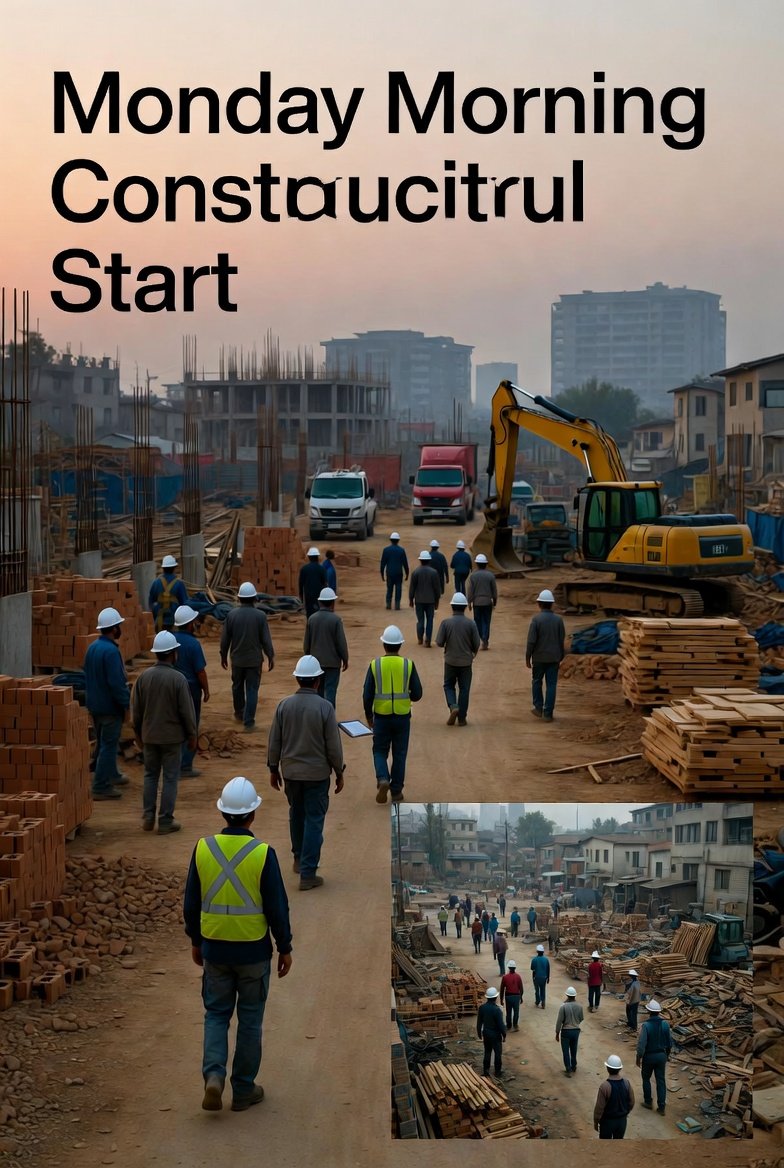
You know the picture. It's 6:55 in the morning, the gate's open, and forty guys are standing around the gang boxes with coffee, waiting on somebody to tell them where to go. The foremen are huddled near the trailer trying to sort out who's got the east stair and whether the deck is even ready to pour. Twenty minutes later people finally start moving. Multiply that across a crew and you've burned the best, coolest, most focused hour of the day before a single tool came out of the box.
Morning confusion isn't a personality problem or a motivation problem. It's a planning problem, and it's one of the most fixable things on a jobsite. The fix isn't a pep talk at the tailgate. It's making sure every crew already knows where they're going and what they're doing before they clock in — and that work starts the afternoon before, not at 7 a.m.
What a Confused Morning Actually Costs You
Do the arithmetic honestly and it stings. Say you've got 40 tradesmen and the average guy loses 25 minutes to milling around, walking the wrong way, or waiting on a foreman to free up. That's roughly 16 to 17 labor-hours gone before lunch — every single day it happens. On a loaded rate, you're bleeding real money for nothing, and you're doing it during the hours when people are freshest.
The bigger cost is the ripple. A late start compresses everything downstream. The crew that was supposed to be off the fifth floor by ten so the mechanical guys could get in is now behind, so the mechanical crew stacks up, so the inspector shows up to a work area that isn't ready. One sloppy morning quietly turns into three trades stepping on each other by afternoon. And crews notice. Nobody respects a job where the plan changes at the gate every day — you lose your best people to the contractor down the road who runs a tight ship.
Why Mornings Go Sideways in the First Place
Almost every confused morning traces back to one of three things:
- The assignment was never actually made. "The drywall crew is on three" is not an assignment. Which apartments? Hanging or finishing? Who's the lead? If the foreman is inventing the answer at 6:55, you've already lost.
- Something changed overnight and nobody carried the message to the field. The GC moved an inspection, the concrete got pushed, a material delivery slipped. The office knew by 4 p.m. The crew found out at the gate.
- The foreman doesn't have what he needs to direct people. No current drawing, no confirmed access, no clear answer on whether the area's been released. He can't lead a crew he can't answer questions for.
Notice that none of these are solved by starting the morning meeting five minutes earlier. They're all solved the day before.
Win the Morning the Afternoon Before
The single highest-leverage habit I've ever run on a job is a short day-before huddle, usually somewhere around 2 to 3 in the afternoon. It's fifteen minutes with the foremen, and its whole purpose is to confirm that tomorrow's work is real. Not hoped-for. Real.
For each crew you're walking three questions: Is the area ready and released? Are the materials staged where the work is? Is the crew assigned by name? If any answer is "no" or "not sure," you've just found a problem while there's still daylight to fix it — call the GC, chase the delivery, move a crew to the backup task. That's the entire game. You're not trying to build a perfect plan in that huddle. You're trying to catch the one thing that would've blown up your morning, twelve hours before it could.
This is exactly what a short-interval schedule is for. The weekly work plan tells you the intent for the week; the day-before confirmation checks the intent against reality before you commit crews to it. If you're running your look-ahead in a tool like LookAheadWall, this is where you're clearing constraints and confirming the next day's activities as "made ready" rather than just penciled in — the same make-ready discipline the Last Planner folks talk about, just done every afternoon instead of once a week.
A Real Assignment Answers Four Questions
When you hand a crew their work, it isn't clear until it answers who, what, where, and when. Miss one and you've reintroduced the confusion you were trying to kill.
- Who — named lead and the crew, not "the framers." Somebody owns it.
- What — the specific task, scoped tight enough that there's no argument. "Hang rock, units 301–308, walls and ceilings" beats "drywall on three."
- Where — the exact location. Floor, zone, grid line, unit number. On a big deck, "the northeast quadrant between column lines 4 and 7" saves ten minutes of wandering.
- When — only if it's off the normal start. If a crew's got a 6 a.m. start for a crane pick or a night pour, that has to be dead obvious, not buried.
Location-based planning is the quiet hero here. When your plan is organized by where the work happens instead of just a list of activities, the "where" answers itself and two trades don't show up expecting the same room. That's the whole idea behind building a weekly plan visually against the actual floor plate — the geography does half the coordination for you.
Stage Materials and Tools the Day Before
A shocking amount of "morning confusion" is really just searching. A crew shows up ready and then spends 40 minutes hunting for the right box of anchors, dragging a welder across the building, or waiting on a forklift that's already committed somewhere else.
Stage it the afternoon before. Get the material to the work location, not just onto the site. Confirm the gang box on that floor has what the day's task needs. Sort out the equipment that's shared between crews before two foremen both need the same lift at 7:15. None of this is glamorous, and all of it buys you a clean start. Walk your staging at the end of the day the same way you'd walk it in the morning — because the version you walk in the morning is the one you're stuck with.
The Tailgate Talk Confirms; It Doesn't Plan
The morning meeting still matters, but its job is narrow. It's where you confirm the plan everyone already got, pair it with the safety talk for the day's actual work, and answer the last questions before people spread out. It is not where you figure out the plan. If your toolbox talk is the first time a crew hears what they're doing today, you're already behind — the talk should be reminding them, not informing them.
Tie the safety message to the real work. "We've got overhead activity on four today, so anybody below is in a hard-hat-and-look-up zone" lands a lot harder than a generic slide about PPE. When the safety talk and the assignment come from the same plan, crews take both more seriously.
Foremen Have to Arrive With Answers
A foreman who walks in cold can't run a smooth morning no matter how good the plan is. The good ones review tomorrow the night before — they know the sequence, they know what's ahead of them and behind them, and critically, they've got a backup in their pocket. If the pour slips or the area isn't released, what does the crew do instead? A foreman who can pivot to a real alternate task keeps twelve people productive; one who can't sends them to stand around while he makes phone calls.
That contingency habit is worth training deliberately. Every crew, every day, should have a plan A and a rough plan B. Weather, access, and deliveries fall through often enough that "we'll figure it out" is a guarantee of a wasted morning a couple times a week.
More Trades, More Ways to Collide
Morning confusion compounds with every subcontractor on site. Two crews showing up to the same corridor, one trade blocking another's access, a specialty contractor arriving to find the area still full of the previous trade's material — these are coordination failures that show up at the gate but were baked in days earlier.
The antidote is shared visibility. When every trade can see the same look-ahead and knows which zones they own on which days, the collisions surface in planning instead of in person. This is where a schedule you can actually share with your subs earns its keep — a plan that lives in the super's head or a spreadsheet on his laptop coordinates nobody. Trade-flow sequencing helps here too: when the plan makes the hand-off explicit — frame, then rough-in, then close the wall — each trade knows not just their work but who's ahead of them and who's waiting on them.
Adjust for the Conditions You've Actually Got
A few situations deserve extra clarity because they magnify confusion:
- Dark winter mornings. When crews are starting before sunrise, "go find the work" doesn't cut it. Assignments and temporary lighting at the work location both need to be nailed down the day before.
- Multiple shifts. The shift hand-off is a classic confusion point. Whatever the outgoing shift didn't finish, the incoming shift needs in writing — not as a rumor passed at the gate.
- Weather uncertainty. If tomorrow's outdoor work is 50/50 on the forecast, decide the trigger and the alternate tonight. "If it's raining at 6, the concrete crew moves inside to X." Deciding that in advance turns a chaotic morning into a two-minute call.
Give Crews the Whole Information Package
A crew can't start clean if they have to go hunting for the basics. Before they hit the work area they should have the current drawing for that scope — current, not last month's revision — the relevant spec detail, the safety requirements for that specific area, and a name to call when something doesn't match the field. That last one matters more than people think: the fastest way to stall a crew is to leave them with a question and nobody to ask.
Measure It, or It Drifts Back
What you don't track slides back to chaos within a month. Keep it simple. Note when actual productive work truly begins each day and watch whether that time creeps earlier. When a morning does go sideways, jot down why — you'll see the same two or three root causes over and over, and now you know exactly what to fix. And ask the crews. They'll tell you straight whether the assignments are landing clearly or whether they're still guessing at the gate.
The Bottom Line
Morning confusion feels like it's just the nature of the work. It isn't. It's the visible symptom of planning that stopped at the whiteboard and never made it to the field. Confirm tomorrow's work the afternoon before, hand every crew a real assignment that answers who-what-where-when, stage the materials where the work is, and make sure your foremen show up with answers and a backup. Do that consistently and the gate stops being a bottleneck. Crews walk in, know where they're going, and go — and you get back the best hour of the day, every day.