
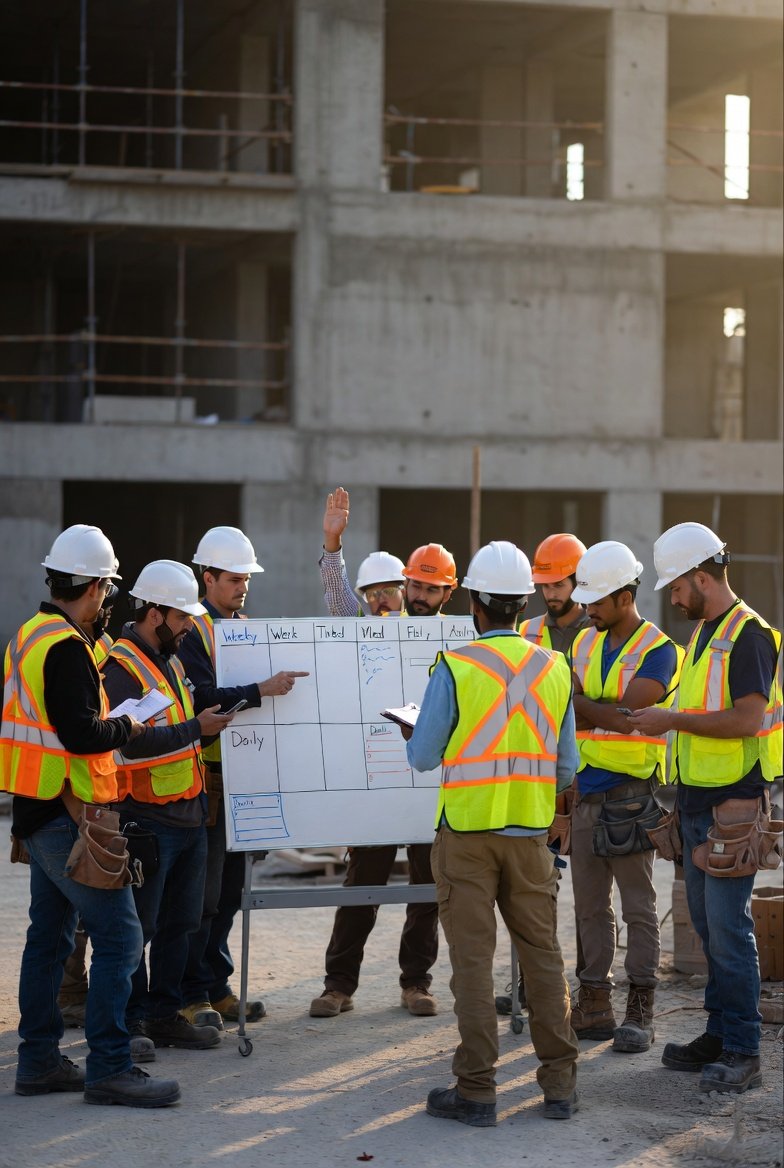
The weekly work plan is a promise. It says: this week, these crews will finish this work in these locations, in this order. The daily huddle is where you find out whether that promise is going to hold up by Friday, or quietly fall apart on Tuesday morning while everyone nods and heads to their trucks.
I've run huddles that took twelve minutes and saved a day of rework. I've also sat through "morning meetings" that dragged to forty-five minutes, turned into a gripe session about the port-a-johns, and ended with nobody any clearer on what actually had to happen. The difference isn't the people. It's the discipline. A good huddle is a tight, standing, same-time-every-day check against the plan you already made. It is not the meeting where you make the plan. If you're building your week at 6:45 AM with the crews standing around, you're already behind.
What the huddle is actually for
A daily huddle does three jobs, and it should do them fast.
First, it confirms today's commitments. Your weekly work plan already says the electricians are rough-ing in the east corridor and the drywall crew is hanging the north classrooms. The huddle is where each foreman looks you in the eye and says "yes, we're good to go" or "no, we've got a problem." That verbal commitment matters more than people give it credit for. A foreman who said out loud in front of his peers that he'd have the corridor closed by noon works differently than one who just read it off a printout.
Second, it surfaces constraints before the day burns. The whole point of look-ahead scheduling is to spot what's not ready two, three, four weeks out and clear it. But some things only show up the morning of: the lift didn't get delivered, a guy called in sick, the inspector pushed to tomorrow, the slab isn't cured enough to load. The huddle catches those while there's still time to shuffle crews instead of sending them home.
Third, it checks the handoffs. Most jobsite delays don't happen inside one trade's work. They happen at the seams, where one crew's finish is another crew's start. The huddle is where the framer and the electrician stand three feet apart and agree that walls two through six will be ready for rough-in by 10 AM, not "sometime today."
Notice what's not on that list: solving problems. The single fastest way to blow a huddle is to let it become a problem-solving session. Surface the issue, name who owns it, and move on. The two people who need to sort out the crane pick can do it after everyone else is working.
Who stands in the circle
Keep it lean. The superintendent runs it and owns the plan. Every trade foreman working that day is there, because they're the ones making and keeping the commitments. Bring in the sub's field lead or PM only when that trade has a critical handoff that day, and let them go when they don't. There is no faster way to teach subcontractors that your huddle is a waste of time than to make an idle plumber stand around for ten minutes listening to painting coordination that has nothing to do with him.
Rotate the sub attendance based on who's actually on the critical path today. A visual weekly plan makes this obvious at a glance, which is half the reason to run one — you can see which trades are stacked in which locations and who genuinely needs to be in the circle.
Timing, place, and posture
Run it at the start of the day, before crews deploy — typically somewhere in the 6:30 to 7:00 window depending on your call time. Do it on site, near the work, not in the trailer with everyone in chairs. And everybody stands. This isn't a gimmick. Chairs invite tangents; standing keeps you honest about time. When your feet start to hurt, the meeting ends. That's the design.
If you can put the week's plan up on a tablet or a screen at the huddle spot, do it. When the plan is visible, the conversation anchors to it instead of drifting into whatever's top of mind. This is exactly where a shared look-ahead board earns its keep — the same weekly plan everyone committed to is right there, and today's row is the only thing you're talking about.
A fifteen-minute agenda that holds
Structure keeps a huddle from wandering. Here's a shape that works, and fifteen minutes is the hard ceiling:
- Yesterday, quick (2 min): Did yesterday's committed work finish? Yes or no, trade by trade. You're not asking for a story. A "no" gets flagged for the constraint round, not debated now. This is also your real Percent Plan Complete data — track it, because a crew that consistently misses its commitments is telling you something about how you're planning, not just how they're working.
- Today, by trade (5 min): Walk today's committed activities. Each foreman confirms he's ready — crew, material, equipment, access, and predecessor work all in place. "Ready" is a real word here. If the drywall guy needs the walls closed and they're not, he's not ready, and you'd rather hear it now.
- Constraints (5 min): What's blocking work today or tomorrow? Deliveries, inspections, RFIs, weather, manpower, access. Every constraint that comes up gets a name attached — someone owns clearing it before you break the circle.
- Tomorrow, a peek (3 min): Glance at tomorrow's plan and make-ready. Is anything on tomorrow's list not going to be ready? Better to know today. This is the difference between look-ahead scheduling and firefighting — you're always looking one move past the one you're making.
The round-robin, and why it works
A lot of good construction huddles borrow the stand-up format from software teams and adapt it: each person answers three questions in sixty to ninety seconds. What did we finish yesterday? What are we doing today? What's in our way? Go around the circle fast. The detail lives in the schedule; the huddle is just the pulse check.
The time box on each person matters more than it looks. When everyone knows they get ninety seconds, they come prepared and they cut the fluff. When there's no limit, one talkative foreman can eat the whole meeting and the quiet trades — often the ones with the real problem — never get their turn.
Where the huddle goes wrong
After enough years you see the same failure modes over and over:
- It runs long. A huddle that regularly hits thirty-plus minutes has stopped being a huddle. Usually it means you're solving problems in the circle. Park them.
- Problem-solving creep. The most common killer. Two guys start hashing out a detail and fourteen other people go quiet and start checking their phones. Cut it: "Good — you two, after this. Next."
- Attendance rots. The day you let it slide, it's dead. If the superintendent skips a huddle, everyone learns it's optional. Leadership presence is the whole reason it holds.
- It becomes a lecture. If you're doing all the talking, you're not running a huddle, you're giving a briefing. The value is in what the foremen tell you, not what you tell them.
- No follow-through on constraints. If issues get raised every morning and never cleared, people stop raising them. The huddle is only as good as the follow-up.
Following up, because surfacing isn't fixing
The huddle's output is a short list of constraints, each with an owner and a target — usually same day. That list is the real deliverable. Capture it somewhere the whole team can see, not on a scrap in your back pocket. Tomorrow's huddle opens by verifying yesterday's constraints got cleared. When a constraint keeps showing up on that list day after day, you've found a real problem worth pulling out of the circle and running down separately.
This is also where the daily huddle plugs back into the weekly rhythm. The weekly work plan sets the commitments. The daily huddle tracks and protects them. And the pattern of what got committed versus what got completed — your PPC and the reasons behind every miss — is exactly the data that makes next week's plan better. A crew that keeps missing because material shows up late doesn't have a crew problem; it has a procurement problem, and only the huddle-to-weekly feedback loop makes that visible.
Fold in safety and the phase you're in
Give thirty seconds to a safety moment tied to today's actual work — not a generic canned topic, but the real hazard in front of the crews. If three trades are stacked in the same mechanical room today, that's your safety moment. If someone's doing hot work near the framing, coordinate the watch and the extinguisher right there in the circle.
The huddle's focus should also shift with the job. Early on, it's site logistics, laydown, and access — who's got the gate, where's the crane, how are we sequencing the underground. During peak, it's trade stacking and manpower — keeping four crews out of each other's way in the same footprint. At closeout, it's punch, inspections, and the last few handoffs that stand between you and turnover. Same fifteen-minute format, different pressure points.
The habit is the whole thing
None of this works as an occasional practice. The huddle has to be non-negotiable, same time, same spot, every single day the crews are on site. That consistency is what turns it from another meeting into the heartbeat of how the job runs. The crews learn that this is when the day gets set, and they show up ready for it.
Keep it short. Keep it standing. Anchor it to the plan you already built, surface problems without solving them in the circle, and chase down every constraint before the next morning. Do that, and the week you committed to on Monday is still standing on Friday. Skip it, and drift takes over quietly — one unready handoff, one missed delivery, one "I thought you had it" at a time, until you're wondering on Thursday why a plan that looked so clean on Monday fell apart.