
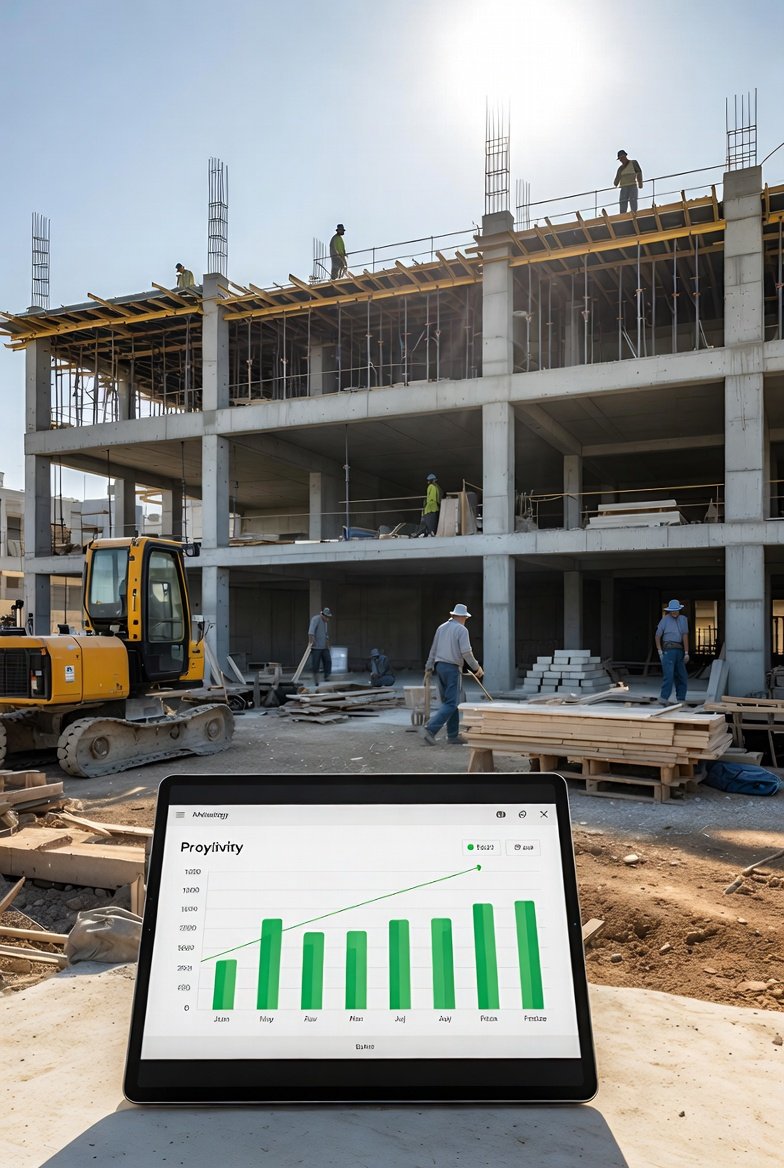
Labor is the one line item you can actually move. Material prices are set by the mill, your fuel is set by the pump, and your equipment rental is a phone call away at a rate you don't control. But the hours your crews burn on site are yours to win or lose, and most of them are lost quietly, in ten-minute chunks, before you ever notice. A carpenter who spends forty minutes hunting for the right fasteners didn't cost you forty minutes. He cost you forty minutes times the crew that was waiting on his layout, times the inspector who showed up to nothing ready, times the trade behind him who now slides a day. That's the real math of productivity, and almost all of it traces back to the schedule.
Let's talk about how crew scheduling actually drives labor productivity — not in slogans, but in the specific ways a good weekly plan puts a wrench in a hand and a bad one leaves it in a pouch.
What "Productivity" Actually Means on a Jobsite
Forget the textbook definition for a second. On a real job, productivity is wrench time — the share of a paid hour a worker spends doing installed work versus waiting, walking, searching, or setting up. Industry studies have kicked around numbers for decades, and the honest range most supers will recognize is somewhere between 40 and 60 percent wrench time on a typical job. The rest evaporates. That means on a ten-man crew, you might be paying for ten bodies and getting five people's worth of installed work.
The mistake is thinking the fix is to make people work faster. It isn't. Your journeyman already knows how to hang a stud fast. The fix is to remove the reasons he stops. And the reasons he stops are almost always upstream of him — decisions made (or not made) in last week's schedule, not this morning's effort.
Where the Hours Actually Go
If you stand in a work area for an hour with a clipboard and just watch — really watch — you'll see the same five thieves every time:
- Waiting. For a decision, for material, for the trade ahead to finish, for the area to get released, for the answer to an RFI that's been open three weeks.
- Traveling. Back to the gang box for a tool, down four floors to the conex for more material, across the building to ask the foreman a question.
- Making ready. Doing the layout, the housekeeping, the staging that should have been handled by someone else before the crew arrived.
- Rework. Tearing out and redoing because two trades hit the same chase, or because the work went in before the inspection that would have caught it.
- Stacking. Three trades crammed into one room, tripping over each other, nobody able to get a clean run at their scope.
Notice that none of those are laziness. Every one of them is a coordination failure, and coordination is what a schedule is for. This is why the connection between crew scheduling and labor productivity isn't a soft correlation — it's mechanical. The schedule either eliminates these thieves or it feeds them.
The Cost of a Slow Morning
Here's a scene every superintendent has lived. It's 6:45, crews are on site, and the foremen are standing in a loose circle trying to figure out who's doing what today because the plan changed and nobody told them until now. By the time assignments shake out, tools get grabbed, and everyone walks to their area, it's 7:30. You just lost 45 productive minutes across the whole job — and you'll lose them again tomorrow.
Run that out. Forty-five minutes a day, across a 40-man site, is 30 man-hours a day. Over a month that's roughly 600 hours — call it fifteen weeks of one worker's time, gone, every month, to nothing but a fuzzy morning. And it never shows up as a line item. There's no "confused morning" cost code. It hides inside your labor overrun and you blame it on the estimate.
The cure is boring and it works: the day's assignments are locked and communicated the day before. When a crew leader walks on site already knowing exactly which area, which scope, and what "done" looks like, the morning huddle becomes a confirmation instead of a negotiation. A short-interval schedule that's genuinely current — the kind a foreman scheduling app can push to the field the evening before — is worth more in recovered morning hours than most tooling upgrades you'll ever buy.
Make-Ready: The Real Job of Look-Ahead Scheduling
The single biggest lever in the whole system is make-ready planning, and it lives in your look-ahead window. The idea from the Last Planner System is simple and unforgiving: an activity shouldn't hit the weekly work plan until its constraints are cleared. Material on site. Prior work complete and inspected. Access available. Approved drawings in hand. Equipment lined up. Manpower committed.
The look-ahead — your three, four, or six week window — exists to screen work against those constraints and knock them down before the week arrives. When a foreman pulls activities from a rolling look-ahead into the current week, every one of them should already be "ready." If you're clearing constraints on Monday morning for Monday's work, you're not scheduling, you're firefighting, and your crews are paying for it in wrench time.
A practical rule I'd push on any team: nothing enters the weekly work plan with an open constraint. If material is "supposed to be here Thursday," it is not ready — it's a hope. Sequence around it. This one discipline does more for productivity than any pep talk, because it attacks waiting and make-ready at the same time, and those are two of your biggest thieves.
Sequence and Trade Flow: Keep the Parade Moving
Productivity isn't just about keeping one crew busy — it's about keeping the whole parade of trades moving through the building without collisions. This is where trade-flow thinking earns its keep. Think of each trade as a crew moving through zones in a repeating pattern: framing leads, then rough-in stacks in behind, then insulation, then board, and so on, each following the last through the same sequence of areas.
When that flow is planned and visible, three good things happen. Crews stay in a rhythm and stop jumping randomly around the building (which crushes the learning curve and triples the travel time). Trades stop stacking, because everyone can see who's ahead and who's behind them in a given zone. And handoffs get clean — the guy finishing knows exactly what the next guy needs, because the sequence is explicit, not tribal knowledge.
A couple of hard-won buffer rules worth building into the sequence:
- Leave a 1–2 day buffer between frame and rough-in in any zone for cleanup, punch, and inspection. Slam them together and your electricians are working over sawdust and around a framing crew still fixing bad backing.
- Don't schedule the trade that closes the wall until the trades inside it have signed off. Megger the electrical runs and pressure-test the plumbing before the drywall goes up, not after — the rework cost of opening a finished wall is brutal and entirely avoidable.
- Give inspections their own slot in the sequence, not a "we'll squeeze it in" assumption. A failed or missed inspection stalls every trade queued behind it.
Sizing the Work: One-Day Chunks Beat Vague Weeks
How you package the work matters as much as when you schedule it. Vague, week-long activities ("MEP rough-in, third floor") hide problems until Friday. Break work into chunks a crew can start and finish inside a day or two, with a clear location and a clear definition of done. "Rough-in unit 312, walls and ceilings, ready for inspection by Wednesday" is a commitment you can actually track. "Third floor rough-in" is a place for a week to disappear into.
The location piece is the part people skip. Telling a crew what without telling them where guarantees a slow start and a travel penalty. A good weekly work plan is location-based first — it says which unit, which zone, which floor — because that's how work actually gets released and how you spot two trades about to collide in the same room.
Measure It, or You're Guessing
You can't manage what you won't count. You don't need a data science team — you need two or three honest numbers tracked consistently:
- PPC (Percent Plan Complete): of the tasks you committed to this week, what percentage actually finished as planned? A team living at 50% PPC is planning work that isn't really ready. Teams that push PPC up toward 80% almost always see labor productivity climb alongside it, because the same discipline that makes a plan reliable is the discipline that clears constraints.
- Reasons for variance: every task that didn't complete gets a one-word reason — material, prior work, access, weather, manpower, change. After a month, the pattern jumps off the page and tells you exactly which upstream failure is bleeding your labor.
- First productive start time: when did installed work actually begin this morning? If it's consistently 7:30 instead of 7:00, you've found thirty minutes a day per worker hiding in plain sight.
Track those before and after you tighten up your planning process and the productivity story tells itself. This is exactly the kind of tracking a look-ahead scheduling tool like LookAheadWall is built to make painless — logging commitments, flagging variance reasons, and showing PPC trend over the weeks so you're improving the process, not just documenting the damage.
The Foreman Is the Multiplier
All of this dies on the vine without the foreman. A schedule is a plan; the foreman turns it into ten specific assignments and clears the small obstacles the office never sees. The best thing you can do for field productivity is give your foremen a plan that's current, specific, and in their hands — on the wall and on their phone — so they spend their morning directing work instead of reconstructing the plan. When a crew leader can pull up the day's assignments and the week's flow on a mobile device standing in the work area, the whole feedback loop tightens.
The Bottom Line
Labor productivity isn't won at the tool. It's won in the plan — in the constraints you cleared last week, the sequence you protected, the make-ready you did so the crew hits a ready work area with a full material stage and a clear definition of done. Do that consistently and wrench time climbs on its own, without anyone working a minute harder.
Get the schedule right and productivity follows. Get it wrong and no amount of pushing on site will buy it back, because you're not fighting slow workers — you're fighting the thirty small stops you built into their day before they ever picked up a tool.