
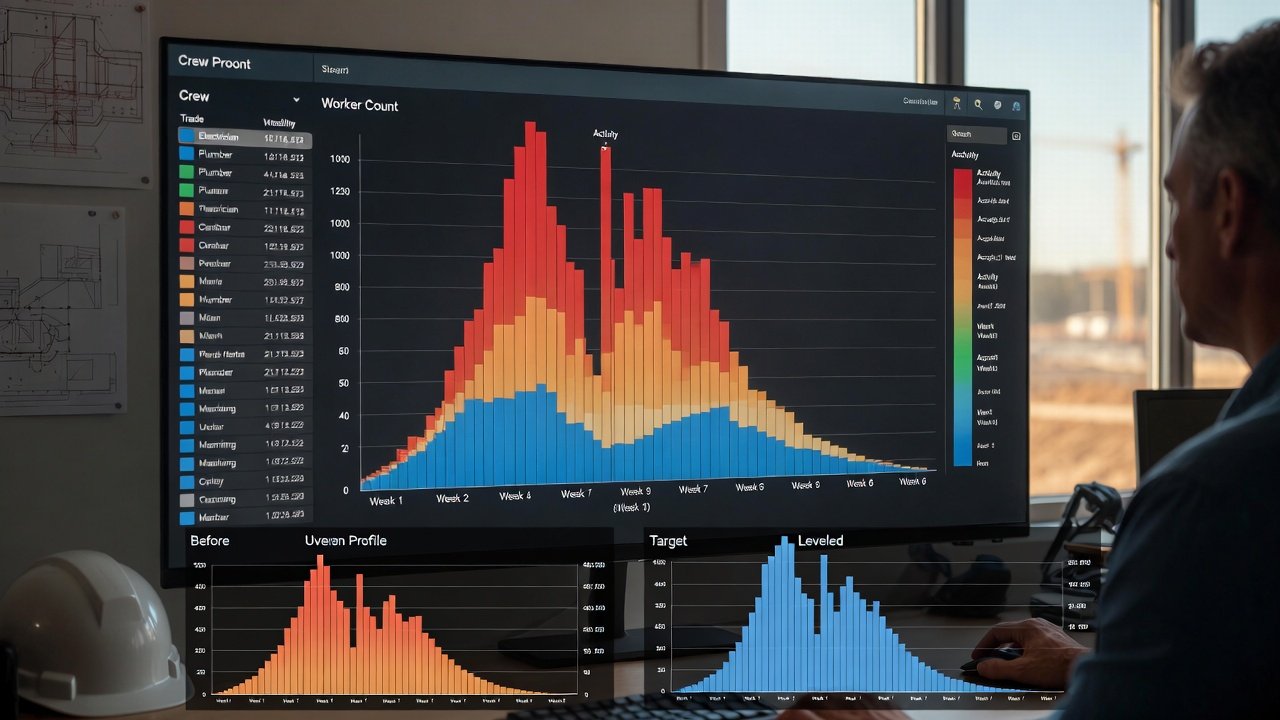
Every superintendent has lived some version of this Tuesday: three activities all need the same drywall crew, the same 60-foot boom lift shows up on two areas at once, and you're on the phone at 6 a.m. trying to talk a foreman into pulling four guys off one wing to cover another. Meanwhile, two weeks from now that same crew has half a day of work and nowhere to go. That's a resource-leveling problem, and it almost never announces itself. It creeps up on you one week at a time until it lands as a fire drill.
Resource leveling is just smoothing out the demand for your crews, equipment, and shared space so you're not slammed one week and idle the next. The reason a rolling look-ahead is the right tool for it is simple: leveling only works if you can see the collision before you're standing in it. A three-to-six-week forward view gives you the runway to move work while you still have options. On the near-term stuff, you've got none.
Why the collisions stay invisible until it's too late
The master CPM schedule won't save you here. It tells you an activity has, say, twelve days of float, but it says nothing about the fact that the same eight-man crew is booked on three activities in the same week. Float lives in the bar; the crew lives in your head, or worse, in three different foremen's heads. The look-ahead is where those two worlds finally meet on one page.
The three classic failure modes:
- Peaks you can't staff. Five areas hit the same trade in the same week and there simply aren't enough bodies. Something slips, or you eat overtime to force it.
- Valleys that bleed money. A crew or a piece of rented equipment sits idle. You're paying for it and getting nothing. Idle time is quieter than an overload, which is exactly why it's more expensive over a job.
- Boom-and-bust. The whipsaw between frantic weeks and dead weeks is where quality goes to die. Rushed work during a peak generates punch list; the idle valley is where your best hands start looking at other jobs.
The forward view is the whole ballgame
Here's the practical difference between a two-week and a four-to-six-week horizon. A conflict you spot next week has maybe two moves available: throw overtime at it, or slip it and take the hit. A conflict you spot five weeks out has ten moves — resequence, shift a floated activity, phase the deliveries differently, pull a crew in from another area, split the work across two weeks, adjust the pour schedule so the finishers aren't stacked. Time is optionality. That's the entire argument for looking ahead.
This is why the leveling conversation belongs inside your weekly work plan, not in a separate spreadsheet nobody opens. When resource loading is visible in the same look-ahead your foremen already work off of, it becomes part of the plan instead of a side project.
Level labor first — it's the one that hurts
Of everything you level, labor is usually the tightest and the most expensive to get wrong. Work it in this order:
- Tag every activity with a crew and a headcount. Not "drywall" — "Crew B, 6 hangers." Until the number is attached to the activity, you can't add anything up, and everything downstream is guesswork.
- Load each week and read the totals. Sum the heads by trade, week by week. Any week where the demand for a crew exceeds what you actually have on site is a peak. Write it down. This ten-minute exercise catches most of the fire drills before they start.
- Spend your float on the peaks. Take a non-critical activity sitting on a peak week and slide it into an adjacent valley. You've smoothed the labor curve without moving the finish date one day. This is the cleanest leveling move there is and it costs you nothing.
- Plan the overtime you can't smooth away. Some peaks are real and won't move — a hard inspection date, a pour that has to happen. Fine. Planned overtime with the crew warned a week out is a different animal than a Friday-afternoon scramble. Same premium dollars, a fraction of the chaos and mistakes.
One rule of thumb from the field: a labor curve that swings more than roughly 30 percent week to week for a given trade is usually a leveling opportunity, not a fact of nature. Before you accept a spike, ask what would have to move to shave it.
Equipment: the rental clock never stops
Major equipment deserves the same week-by-week loading, for a different reason — it's metered. A lift, a crane, a pump is costing you whether it's turning or parked. Two things to watch:
- Don't double-book the shared iron. The 60-foot lift can't be in two areas at once. Put its assignments on the look-ahead the same way you do crews and the conflict shows up before the operator does.
- Line up continuous use, then cut it loose. The goal is one clean window — equipment mobilizes when the work is genuinely ready and demobilizes the day it's done, not "sometime." Every gap in the middle where it sits idle is rent you're paying for nothing, and every extra mobilization is a delivery fee and a lost half-day. Sequencing the dependent activities back-to-back so the machine runs straight through is where the real rental savings live.
Space is a resource too
This is the one that isn't on any histogram and burns the most GCs. You can have enough bodies and enough equipment and still create a mess by stacking four trades in the same 1,200 square feet. There's a real limit to how many crews can productively work an area before they're tripping over each other, blocking each other's material, and arguing over the same power drop.
Leveling means watching crew count per zone, not just crew count on site. A location-based look-ahead — where the plan is drawn against actual areas of the building rather than a flat activity list — makes over-stacking obvious in a way a bar chart never will. If three colored bars are all sitting in the west wing on the same day, you don't need a report to tell you Thursday is going to be ugly. This is exactly the kind of spatial collision LookAheadWall is built to surface, because it plans by location instead of hiding the crews inside abstract bars.
A weekly leveling routine that actually sticks
Make this part of the same sit-down where you update the look-ahead. It shouldn't take more than fifteen or twenty minutes once it's habit:
- Load the resources. For each of the next four to six weeks, tally crews by trade, major equipment, and any long-lead material that gates the work.
- Flag the peaks and valleys. Compare demand to what you've actually got. Circle every week where they don't match — in either direction.
- List the moves for each one. Shift a floated activity, resequence, add or borrow a crew, plan overtime, re-time a delivery. Force yourself to name at least two options per peak.
- Weigh the cost of each move. Every fix trades against schedule, dollars, or coordination load. Pick the one that hurts least. Sometimes accepting a small peak is genuinely cheaper than the resequence that avoids it — that's a real answer, not a failure.
- Update the plan and tell people. A leveling decision that lives only in your notebook didn't happen. Push it into the look-ahead so foremen and subs are working off the leveled version.
Use float — but don't spend it all
Float is the fuel for leveling. Non-critical activities can slide inside their window to dodge a peak without touching the completion date, and that's the move you'll reach for most. But the discipline that separates good superintendents from lucky ones is this: never consume all of an activity's float just to smooth a curve. That float is also your shock absorber for the delivery that shows up short, the inspector who reschedules, the weather day. Leave a cushion. A perfectly leveled schedule with zero float is a schedule that shatters the first time reality touches it.
Where perfect leveling isn't in the cards
Be honest about the limits so you spend your energy where it pays:
- Critical-path work won't move. Zero float means zero leveling room without pushing the finish. Don't fight it — level around it.
- Hard dependencies are hard. You can't shift the finishers earlier because the drywall isn't up. Logic ties come first; leveling works in whatever slack is left over.
- Subs have their own book. Your ideal crew curve and the sub's manpower reality are two different things. You can share the forward view and ask, but a trade partner running four other jobs may not staff to your perfect line. The earlier they see the peak coming, the better your odds.
- Garbage in, garbage out. Every leveling call rides on the resource numbers being right. If the headcounts in the plan are fiction, you'll level a schedule that doesn't exist. Keep the loading honest.
What smoothing the curve actually buys you
The payoff isn't abstract. Steady crews stay — predictable hours beat boom-and-bust for retention every time, and the good hands are the first to walk when a job runs hot-and-cold. Equipment that runs continuous returns its rental instead of bleeding it. Work done at a steady pace generates less punch than work rammed through a peak, so your quality and your schedule improve together. And you quietly kill the three biggest silent cost leaks on a job: overtime premiums, rush procurement, and the pure inefficiency of a crew stacked on top of another crew.
You don't need to level everything to get most of this. Start with your two or three most constrained resources — the trade you're always short on, the one lift everybody fights over — and level those well. Build the habit into the weekly look-ahead, share the forward view with your subs, and track one number over a couple of months: overtime hours. If it drops while the schedule holds, the leveling is working. In this trade, that's a return you can take to the owner.