
Most jobsite fights aren't really about personalities. Two grown men aren't yelling in a mechanical room because one of them woke up mean. They're yelling because the drywaller closed in a wall the plumber still needed open, and now somebody's eating a day of demo and rework, and nobody wants to be the one who eats it. The conflict is the symptom. The coordination failure is the disease.
I've spent enough years on commercial and multi-family jobs to tell you that the vast majority of trade conflict is manufactured upstream, in the two or three weeks before the work hits the field. Get those weeks right and the field goes quiet. That's the whole promise of look-ahead scheduling: you move the argument out of the hallway and into a planning meeting where it costs nothing to lose.
Where the real conflicts come from
If you strip away the drama, jobsite disputes almost always trace back to one of a handful of root causes. Naming them precisely helps, because each one has a different fix.
- Two trades wanting the same square footage at the same time. The classic. Overhead MEP all trying to get in the ceiling during the same week, or the tile setter and the electrician both needing a small bathroom on Thursday.
- Out-of-sequence work. Nobody's fighting over space, but the drywall went up before the in-wall blocking, or the slab got poured before the under-slab plumbing was inspected. Now someone's opening finished work.
- Shared resources that don't stretch. One man-lift, one crane pick window, one loading dock, one hoist. Three trades, one resource, no plan.
- Missing information. A crew starts, hits an unanswered RFI or an unapproved submittal, and stops cold. The stoppage itself breeds blame.
- Undocumented promises. "You told me framing would be done by the 12th." "I never said that." Two weeks later it's a change-order argument, and there's no paper.
Notice that only the first of those is genuinely about physical space. The rest are timing and information problems — which means most of your conflict is solvable with sequence and communication, not with a bigger building.
Make the sequence visible before anyone shows up
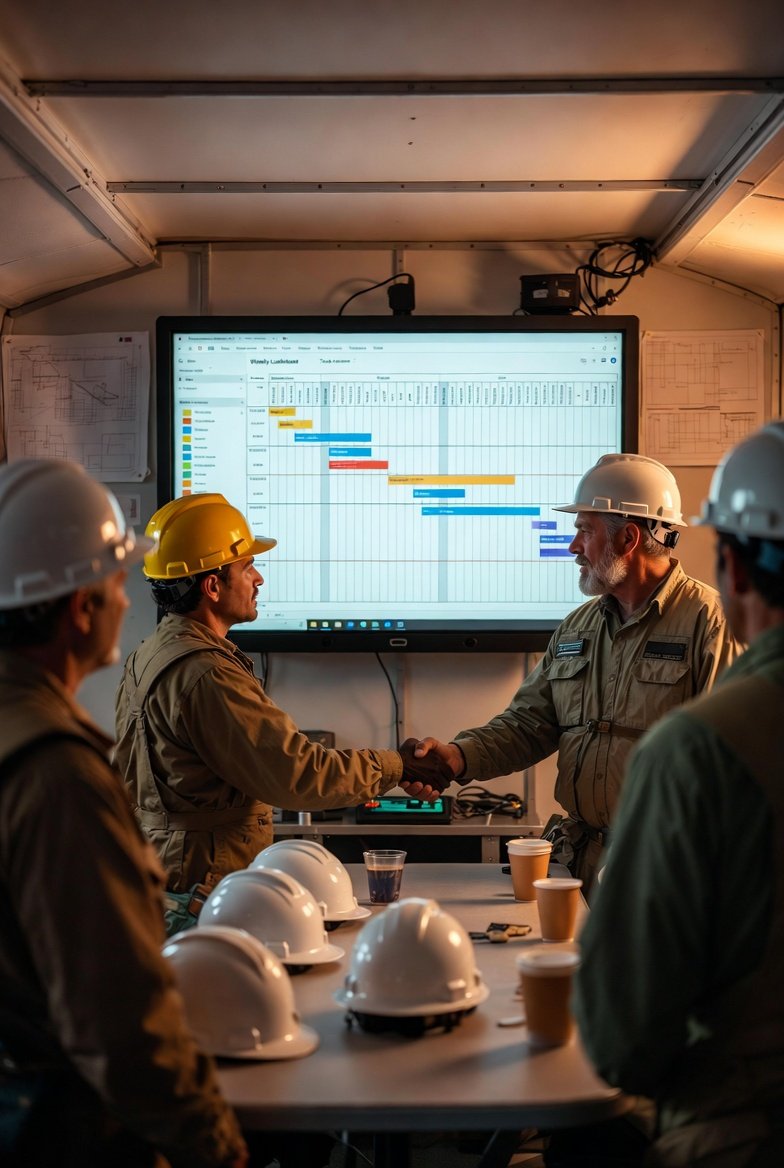
The single most effective thing a superintendent can do to kill conflict is publish who works where, in what order, for the next three or four weeks — and make every affected trade look at it in the same room. A weekly work plan built by location, not just by task, forces the space conflicts to surface on paper. When you lay out the third floor east wing week by week and you can literally see the framers, the electricians, and the HVAC crew all landing in the same corridor during the same five days, you've found next Tuesday's fistfight today. And today it's free to fix.
This is where location-based, visual planning earns its keep over a bar-chart CPM. A Gantt line tells you an activity spans a date range. It does not tell you that the activity and three others are all physically stacked in the same 400 square feet. Tools built for short-interval scheduling — LookAheadWall among them — let you plan by area and see the collisions, which is exactly the view you need for this. But the tool is secondary. The discipline is what matters: plan by location, walk it with the trades, resolve the overlap out loud.
Sequence the trades, don't just list them
Space is one axis; order is the other. For any given room or zone, somebody has to go first, and the sequence isn't negotiable if you don't want rework. A few rules of thumb worth putting on the wall:
- In-wall rough-in — plumbing, electrical, low-voltage, HVAC, then blocking and backing — all finishes before insulation and before a single sheet of drywall goes up. Obvious, and yet closed-in rough-in is one of the most common rework items I see.
- Give yourself a 1–2 day buffer between rough-in completion and drywall for the rough-in inspection and any punch. If you butt those two activities against each other with zero float, one failed inspection blows the whole sequence and the drywaller shows up to a wall he can't close.
- Overhead MEP wants a coordinated sequence too — typically the biggest, least-flexible system first. Main duct and gravity waste don't bend; conduit and flex do. Hang the stiff stuff first so the flexible trades route around it, not the other way around.
- Wet trades before dry finishes in any given room. Don't let the flooring or the painter in until the overhead water is proven.
When the sequence lives in a shared plan instead of in your head, arguments about who's first stop being arguments. The plan already answered it, and everyone agreed to the plan when it was built.
Handle the shared resources like reservations, not a free-for-all
Equipment and access conflicts are pure logistics, and logistics respond well to a calendar. If you've got one hoist and four trades that need it, treat the hoist like an operating room: it gets booked in blocks, in the look-ahead, weeks out. The framers get Monday and Tuesday mornings for material; drywall gets Wednesday; the mechanical crew gets Thursday for equipment sets. Put it in the weekly work plan where everyone can see it.
The value isn't the schedule itself — it's that the competition surfaces early, in a meeting, where you can horse-trade. "I need the crane Thursday for the RTUs." "So do I, for steel." That conversation is a two-minute negotiation on Wednesday of the prior week. The same conversation at 7 a.m. on the actual Thursday, with both crews standing there on the clock, is a lost morning and a grudge. Same for staging and laydown: assign zones in the plan. Unassigned staging is where material gets buried, moved, damaged, and blamed.
Pull information forward so nobody starts blind
A crew that stops mid-task because of an unanswered question is expensive twice — once for the idle labor and once for the resentment. The look-ahead is your early-warning system for information gaps, if you use it that way.
Tie every upcoming activity to its dependencies and read backward. If the activity is three weeks out and it depends on an RFI that's still open, or a submittal that hasn't been approved, that constraint is now visible with three weeks of runway instead of surfacing the morning the crew mobilizes. This is the constraint log doing its real job. Walk the look-ahead every week and ask one question of each near-term activity: what has to be true for this to start on time, and is it true yet? Anything that isn't true is a constraint with an owner and a need-by date. Chase those, and the field stops discovering surprises.
Owner and designer decisions deserve the same treatment. If a finish selection or a color choice is holding up work three weeks out, that decision belongs on the look-ahead as a dated constraint pointed at the owner. "I needed that answer weeks ago" is a much weaker complaint when you can show you asked for it weeks ago, with the deadline attached.
The paper is what saves the relationship
Here's the part crews underrate. A published, shared look-ahead isn't just coordination — it's a quiet record of who committed to what and when. You're not building a case file to go to war; you're building the thing that prevents the war.
When the drywall sub says framing was supposed to be done last week, you pull up the plan the whole team agreed to and everyone's looking at the same dates. Nine times out of ten the disagreement evaporates, because the facts are no longer in dispute — only the memory was. On the tenth time, when it really does become a schedule claim, you've got a clean history of the planned sequence, the constraints that were flagged, who owned them, and when they cleared. That trail resolves disputes that would otherwise fester into claims. It's not about proving someone wrong; it's that clear records take the heat out of a fight before it starts.
The Last Planner mindset: reliable promises, no blame
A lot of what makes look-ahead scheduling reduce conflict comes straight out of Last Planner thinking, and it's worth stating plainly. Two ideas do most of the work.
First, only commit to what you can reliably deliver. The temptation in a coordination meeting is to say yes to every date to avoid looking like the holdup. That's how you build a schedule made of lies, and a schedule made of lies generates conflict every single week when the promises break. Better to let a foreman say "I can't commit to Thursday, the material won't land until Friday" in the meeting than to have him blow the date silently and take the whole downstream sequence with him. Measure it if you can — track how many of last week's commitments actually got done. That number is your honesty gauge.
Second, run the post-mortems blame-free. When a commitment misses, the useful question is "why did it slip, and how do we keep it from slipping again," not "whose fault is this." The minute your coordination meeting turns into a trial, everyone lawyers up — foremen stop volunteering real dates and start protecting themselves. A crew that isn't afraid of the meeting tells you the truth, and the truth is what lets you plan around problems instead of getting ambushed by them.
Bring the subs and the owner inside the tent
"I didn't know" is the single most common excuse on a jobsite, and it's usually true. The fix is to make the schedule impossible to not-know. When every sub can see the same weekly work plan you can, on their phone, updated when it changes, "nobody told me" stops being a valid complaint — and, just as importantly, stops being a valid excuse. A crew-facing mobile view that pushes the current week's plan to foremen closes that gap; it's exactly why the companion app exists.
Let the trades put input into the plan, too, not just receive it. A schedule handed down from on high gets resisted on principle. A schedule the foremen helped build gets defended, because it's theirs. That participation is worth more to your conflict rate than any amount of top-down enforcement.
The owner relationship benefits from the same transparency. Show them the look-ahead, let them see progress, and — critically — show them the schedule impact when they make a change. When an owner can see that their late finish selection just pushed three activities and cost a week before they sign off on it, you get fewer surprised, angry conversations later. Consequences understood in advance are rarely disputed after the fact.
How to tell it's working
You don't need a dashboard to feel this, but a few signals tell you the planning is actually reducing friction:
- Fewer trade clashes and stop-work moments in the field — the daily reports get boring, which is good.
- Your commitment-completion rate climbs week over week as crews get honest about what they can deliver.
- Coordination meetings shift tone: less rehashing last week's failures, more solving next week's problems.
- Fewer issues escalate to formal disputes or claims, because they got caught and resolved on paper first.
None of this is magic, and no software makes it happen by itself. The tool gives you the shared, location-based view and the paper trail; the discipline of walking the plan every week with the trades is what actually moves the needle. Do it consistently — not in bursts when things get hot — and trust compounds. Subs start showing up expecting a real plan, and a crew that trusts the plan is a crew that isn't looking for someone to blame.
The most productive jobs I've run weren't the ones without problems. They were the ones where the problems got surfaced early, in a room, while there was still time and it was still cheap — instead of in a hallway, on the clock, with two crews and a superintendent trying to figure out who's going to eat the day. That's the whole game. Move the fight upstream, and the field gets quiet.