
Walk onto any jobsite that's been running a while and ask a drywall foreman what he thinks of the schedule. If he laughs, you already know the story. Somewhere along the line he learned that the schedule is a document that lives in the trailer and has nothing to do with the work in front of him. He plans his own week off gut and phone calls, ignores the pretty Gantt chart on the wall, and treats every date on it as a suggestion at best.
That's the real problem a three-week lookahead has to solve. It isn't a software problem or a formatting problem. It's a trust problem. And trust in the field isn't given because you printed something in color and hung it by the gang box. It's earned, one accurate week at a time, and it can be lost in an afternoon.
Why the Field Stopped Believing Schedules
Field crews don't distrust schedules because they're cynical. They distrust them because they've been right to. Most have watched the same movie play out on job after job.
The classic version: a beautiful CPM schedule gets built in an office by someone who has never hung a door, based on durations pulled from a database and sequences that assume every crew shows up at full manpower with all materials on site. It's baselined, printed, celebrated. By week three it bears no resemblance to the job. The concrete pour slipped, the elevator submittal is still in review, and the whole downstream logic has quietly detached from reality. Nobody re-plans it. It just becomes wallpaper.
The other version is more insidious: the aggressive schedule that's wrong on purpose. Everyone in the trailer knows the finish date is a fantasy, but it's there to apply pressure. Crews feel that. When you hand a foreman a plan you don't believe yourself, he can smell it, and every future plan you hand him is discounted the same way.
So the trust deficit is real and it's rational. Any lookahead process that ignores this is going to fail no matter how good the tooling is. The whole point of the exercise is to rebuild something that got broken long before you showed up.
Why Three Weeks Is the Right Window
There's a reason short-interval planning settled on roughly three weeks, and it's not arbitrary. Three weeks sits in the sweet spot between two kinds of uselessness.
Go too long — a six-week or eight-week lookahead handed to a crew leader as their working plan — and you're back to fantasy. Nobody can commit to what a specific crew does on a Tuesday five weeks out with any honesty. It reads as noise, and noise gets ignored. A longer horizon is useful for the super to see material lead times and constraint runway, but it's the wrong document to put in a foreman's hand as a commitment.
Go too short — a one-week plan only — and there's no runway to actually clear the path. You find out Friday that Monday's work is blocked because the inspection didn't happen and the material's on a truck somewhere. Three weeks gives you enough lead to see the wall coming and steer around it: week three to flag the constraint, week two to resolve it, week one to execute clean.
Psychologically, three weeks is also just comprehensible. A crew leader can hold three weeks in his head and check it against what actually happened. He remembers what you said last Monday. When the plan you committed to keeps coming true, that memory is what builds belief — not a slide, not a dashboard, the lived experience of the plan being right.
Trust Is Built in Week One and Verified Weekly
Here's the mechanic that most people miss. A three-week lookahead is really three different promises with three different confidence levels, and crews grade you on the closest one.
- Week one is a commitment. These activities should be constraint-free, sequenced, manned, and materialed. If you're putting something in week one that you can't actually execute, you're spending trust you haven't earned.
- Week two is a plan. It's mostly firm, but you're still clearing a constraint or two and firming up crew sizes.
- Week three is a forecast. It's allowed to move. Everyone understands it's the rough shape of things, not a blood oath.
The crew judges the whole system by whether week one keeps coming true. This is why Percent Plan Complete matters — not as a corporate metric, but as the honest scorecard the field can see. If you commit to ten activities this week and eight get done, that's a 80% PPC, and everybody knows it. Track it, post it, and don't hide the misses. A crew watching PPC climb from 55% to 70% to 80% over a couple months is a crew slowly deciding the schedule might be real after all.
The weekly rhythm is the engine. Same day, same time, every week, the plan updates and the last week gets scored. That fast feedback loop is what makes a lookahead credible in a way an annual review or a monthly report never can be. Crews see the plan being wrong, see it get fixed, and learn that being wrong leads to a change instead of a shrug.
Put the Foreman's Hands on the Plan
The single fastest way to build trust is to stop imposing the schedule and start building it with the people who do the work. A plan a foreman helped write is a plan he defends. A plan handed to him is a plan he tolerates.
There's a hard practical reason for this beyond ownership: the foreman is usually right about durations and sequences and you usually aren't. He knows the taper won't touch a wall until it's been floated and the corner bead's been checked. He knows his three-man crew hangs a certain amount of board a day, not the database number. He knows the electrician still has to land the panel before the drywaller closes that wall, and if you sequence over the top of that, you're going to be cutting holes back into finished rock. Pull that knowledge into the plan and the plan gets more accurate, which makes it come true more often, which builds trust. It's a virtuous loop, and it starts with asking.
There's also a commitment effect worth naming. When a foreman stands in a Monday planning huddle and says out loud, in front of his peers, "I'll have the second floor ready to hang by Thursday," he's far more likely to make it happen than if the same date got assigned to him on paper. Public commitment is one of the oldest levers in the book, and short-interval planning runs on it. Software like LookAheadWall makes that commitment visible and shareable, but the commitment itself is a human thing that happens in the room.
Show the Constraints Honestly
Crews trust a schedule that admits what's blocking it far more than one that pretends everything's fine. This feels backwards to a lot of managers who want the plan to look clean, but honesty about obstacles is a trust-builder, not a weakness.
When your lookahead openly flags that the curtain wall submittal is still in review, or the slab in Area C needs seven days to cure before layout, or the switchgear is three weeks out — the field reads that as respect. You're treating them like adults who can handle the truth. Compare that to the plan that shows the work starting on a date everyone knows is impossible because the material isn't on site. That second plan doesn't just fail; it insults the crew's intelligence and torches your credibility.
Constraint tracking works best when it's visible and someone owns each item. Material, information, prerequisite work, permits, inspections, equipment, manpower — every blocked activity should trace back to a constraint with a name and a needed-by date. And critically, accountability has to point both ways. When the crew sees that constraints assigned to the office — the PM chasing an RFI, the super scheduling an inspection — get resolved on time too, not just the ones assigned to them, that's when they believe the system is fair. A lookahead where only the trades get held accountable dies fast.
Buffers, Sequences, and the Details That Make It Real
A lookahead earns trust by being technically right about how trades actually flow, not just by being updated on time. A few things separate a plan the field respects from one it quietly rewrites in its head:
- Build in the buffers real work needs. Frame-to-rough-in usually wants a day or two of slack for cleanup, layout, and inspection sign-off before the walls close. Don't butt trades nose-to-tail on paper and call it efficient — it just means the first slip cascades.
- Respect the inspection gates. Rough-in doesn't get covered until it's signed off. If you schedule insulation over an un-inspected wall, either the inspection gets skipped (a problem you'll pay for later) or the whole thing stops and the crew watches you lose credibility in real time.
- Honor the real handoffs. MEP overhead before the drywall ceiling. Fire-stopping and above-ceiling inspection before the grid goes in. Waterproofing and cure before you build over it. Every one of these is a place a paper schedule can lie and a field crew can't.
- Sequence by location, not just by trade. Crews think in areas — this floor, this wing, this unit. A lookahead that flows work location by location matches how the job actually moves, and that alone makes it more believable to the people executing it.
Get these right and the plan starts predicting reality. Get them wrong and it doesn't matter how consistent your meeting cadence is — the crew has already decided the schedule doesn't know the job.
Mobile Access and the End of Secondhand Information
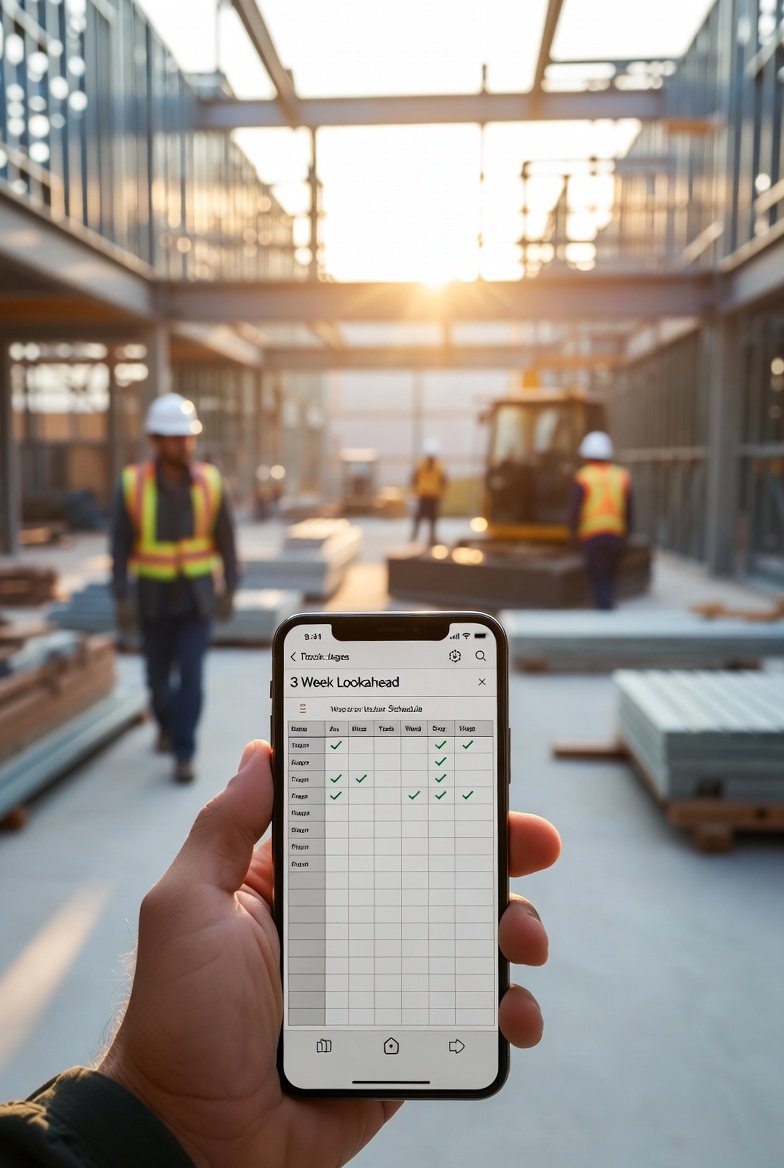
A lot of distrust comes from crews working off stale information. The foreman's looking at a printout from last Tuesday while the plan changed Thursday. When a crew leader can pull the current plan up on his phone and see exactly what changed and why, the schedule stops being a rumor and starts being a fact. The mobile companion is genuinely part of the trust equation here — the plan on the phone is the plan, always current, and the foreman can push his own progress back into it instead of just receiving edicts from the trailer.
How to Build Trust From a Standing Start
Rolling this out on a job where the field has been burned before takes some discipline. A few hard-won rules:
- Start conservative. Under-promise the first few weeks. It's far better to blow past a modest plan than to miss an ambitious one. Early wins buy you the credibility to get bolder later.
- Own the misses out loud. When week one comes up short, say so in the huddle, dig into why, and show the change that results. A crew that watches you handle a miss honestly will forgive the miss.
- Never punish the reporter. The moment a variance turns into a blame session, people stop telling you about problems and start hiding them until they explode. Trust dies in blame cultures. Treat every miss as information, not an indictment.
- Don't abandon the process when it gets busy. The temptation, the second the job gets tight, is to skip the huddle and go back to top-down orders. That's exactly when the field is watching to see if you meant it. Consistency under pressure is the whole game.
The Payoff
When a crew genuinely believes the plan, their behavior changes in ways that show up in the numbers. They stage materials on Friday for Monday's work because they trust Monday's work is real. They come in prepared instead of standing around waiting to find out what's actually happening. They solve small problems themselves to protect the plan instead of shrugging and assuming it'll change anyway. And they'll accept accountability for what they committed to, because the commitment was theirs and it was realistic.
That's the quiet transformation a good three-week lookahead delivers. It stops being a document nobody reads and becomes the actual operating plan of the job — the thing the field checks first, defends, and works to keep true. You don't get there with better software alone, though good short-interval scheduling tools make the whole thing easier to run and share. You get there by being consistently, honestly right about the near-term work, week after week, until the field decides to believe you. That belief is worth more than any Gantt chart, and once you've earned it, protect it like the schedule depends on it. It does.