
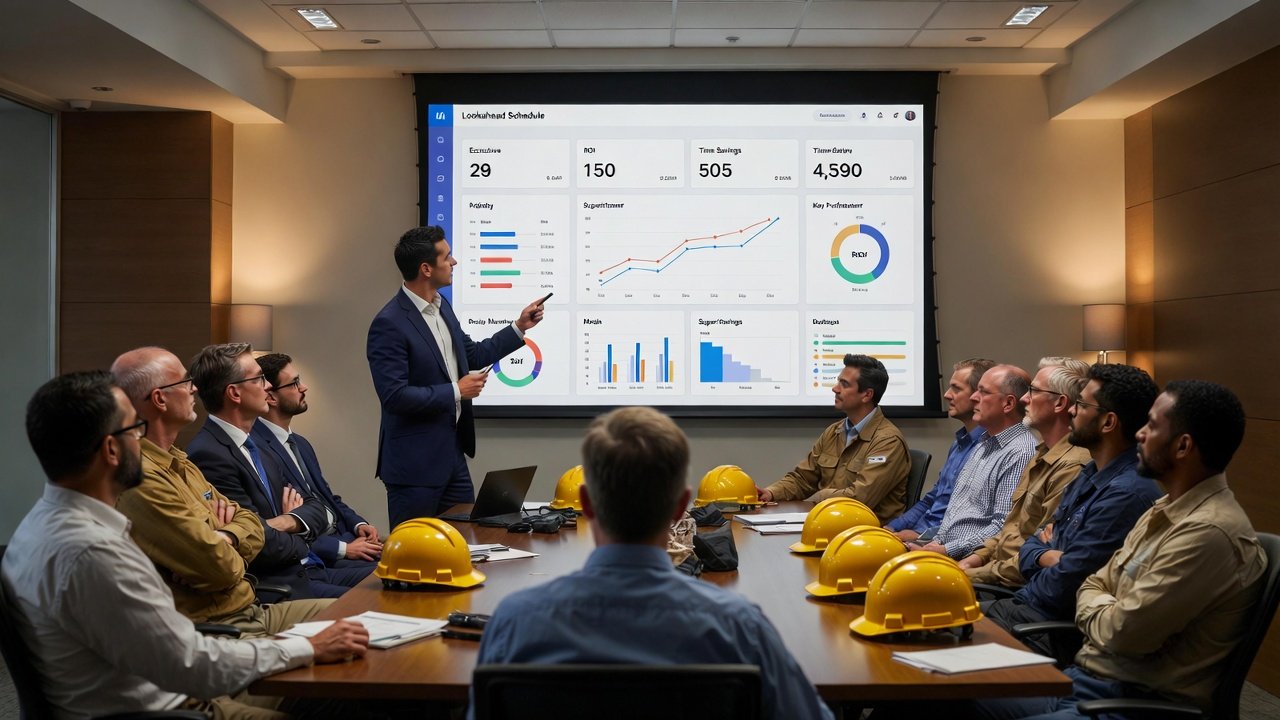
I've watched more good scheduling tools die on the vine than fail on their merits. The software worked fine. The problem was that nobody in the field trusted it, the PM only opened it the day before the owner meeting, and the subs never saw it at all. Six weeks in, everybody quietly went back to the whiteboard and the group text, and the license sat there billing monthly for a product nobody used.
Getting a look-ahead tool adopted is not a purchasing decision. It's a change-management problem wearing a software costume. The purchase is the easy part — one signature. The hard part is convincing a superintendent with 25 years on the tools that a screen is going to make his Monday better, not add another thing he has to feed. If you don't win that person, you've bought a very expensive read-only calendar.
Here's how to actually get it adopted, from someone who has botched it and gotten it right.
Know why people are digging in
Resistance in construction is rarely stupidity or stubbornness, even when it looks like it. It's almost always one of these, and each one needs a different answer:
- "This is one more thing to feed." The single most common and most legitimate objection. Field leaders are already drowning in daily reports, timecards, safety forms, RFIs, and the phone. If your rollout adds twenty minutes of data entry a day and gives nothing back that same day, they're right to resist. The tool has to pay them back on the same shift they invest in it.
- "We tried something like this before." Somebody got burned by a bloated P6 rollout or a mobile app that didn't work past the gate where there's no signal. That scar tissue is real. Don't dismiss it — acknowledge the last failure and be specific about why this is different.
- "You're telling me how to run my job." A veteran super hears "new scheduling software" as a challenge to the map he carries in his head. If the pitch sounds like the office is going to watch him through a dashboard, you've lost him before you start.
- "It won't work where I work." No signal in the stairwell, gloves on, dust everywhere, a cracked phone screen. If the app is clumsy in those conditions, no amount of executive enthusiasm saves it.
Notice that only one of those is about the software. The rest are about trust, workload, and respect. Solve those and the software almost sells itself.
Win the superintendent first, not the executive
Most adoption playbooks tell you to secure executive sponsorship first. You need it — somebody has to fund it and clear the runway — but executive mandate alone produces the worst outcome there is: malicious compliance. The field fills in the boxes to satisfy the office, the data is garbage, and everyone concludes the tool doesn't work.
The person who actually decides whether a look-ahead lives or dies is the superintendent running the job. So start there. Find the one respected super on your best crew — the one other supers listen to at the toolbox talk — and make him a partner in the pilot, not a test subject. Let him poke holes. Let him tell you the three-week view is more useful than the six-week view because past three weeks it's all guesses anyway (he's right). When that guy tells his peers "yeah, I actually use this now," you've done more than any ROI slide ever will.
The pitch to the super is never about visibility for the office. It's about his Monday morning. Show him that a clean weekly work plan means fewer 6 a.m. phone calls asking where the crew goes, fewer trades showing up to a face that isn't ready, and a paper trail when a sub claims he was never told. That's the language that lands: fewer surprises, fewer arguments, less firefighting.
Make the executive case in dollars and risk, not features
When you do go up the chain, leave the feature list at the door. Executives don't care about drag-and-drop trade flows. They care about three things: labor burn, schedule risk, and claims exposure.
Frame it concretely. A short-interval schedule that catches a missing predecessor two weeks out instead of the morning of prevents a crew standing around at loaded rate. On a mid-size commercial job, one avoided idle crew-day of a ten-man drywall outfit is real money — run the number for your own trades and it gets attention fast. Reliable look-ahead planning also produces something legal loves: a dated, shared record of what was promised and when, which is worth its weight the day a delay claim shows up.
Don't oversell the ROI, though. If you promise a 30% schedule improvement, you'll be held to it and you'll lose credibility when reality comes in at a more honest number. Promise better predictability and fewer collisions, measure it, and let the results speak.
Run a real pilot, and design it to win
A pilot isn't a trial where you hope for the best. It's a stacked deck you build on purpose to generate a success story the rest of the company can't argue with. Structure it deliberately:
- Pick the right job, not the hardest one. You want a project with an engaged super, a couple of cooperative subs, and reasonable complexity. Do not prove the concept on the fire-drill job with the impossible owner. Prove it where it can win, then scale to the hard ones.
- Start with a three-week window. Two weeks is too short to sequence trades meaningfully; six is fiction. Three weeks is the sweet spot for a rolling look-ahead — near enough to be real, far enough to fix problems before they hit the field.
- Go view-only for the subs at first. Do not open week one by demanding your electrician log in and update tasks. Give trade partners read access so they can see what's coming and plan their crews and materials. Add their input later, once they've felt the benefit. Burden-first kills sub adoption every time.
- Pick one honest metric. Percent Plan Complete (PPC) — the share of the week's committed tasks that actually got done — is the cleanest. Track it rigorously and don't fudge it. A pilot that starts at 55% PPC and climbs to 75% over six weeks is a story that sells itself. A pilot with no baseline is just an opinion.
- Give it eight weeks minimum. The first two weeks always look worse, not better, because you're surfacing coordination problems that were previously invisible. If leadership pulls the plug at week three, they're killing it right before the payoff.
One caution from experience: whoever owns updating the plan during the pilot needs protected time to do it. If you bolt "keep the look-ahead current" onto a super who's already at capacity, it becomes the thing that slips when the day gets ugly — and a stale look-ahead is worse than none, because people stop trusting it after they get burned once.
Have honest answers ready for the objections
You will hear the same five objections on every job. Weak answers sound like sales. Here's how to respond like someone who's actually stood in the mud:
- "We don't have time for this." The honest answer: bad planning already costs you more time than good planning takes — you're just paying it in reschedules, no-shows, and rework instead of up front. But acknowledge the real version of this objection, which is that you're asking them to spend the time now to save it later, and later feels theoretical when today is on fire. So make the payback fast and visible.
- "We've built for thirty years without it." True, and also not the point. The question isn't whether the old way works — it's whether it works well enough when schedules are compressed, subs are stretched across four jobs, and the owner wants a two-week look-ahead every Friday. Survival isn't the same as margin.
- "Our projects are too unique." Every super believes his job is special, and in the details he's right. But the sequencing logic — this trade can't start until that one's done and inspected — is the same on a hospital as it is on a strip mall. The plan adapts; the discipline doesn't change.
- "It's too expensive." Put the license cost next to the cost of one blown pour, one idle crew-day, or one delay claim. It stops being expensive in a hurry. If it doesn't, you may genuinely not need it — and that's a fair conclusion.
- "My guys won't use it." That's a training and design problem, not a reason to skip the tool. But take it seriously: if the app is hard to use with gloves on or dies without signal, they're right and you need a different tool.
Match the message to who's listening
The same tool sells five different ways depending on who's in the room, and using the wrong pitch on the wrong person wastes both your credibility and their patience:
- Executives want risk reduction and predictable delivery. Talk margin and claims exposure.
- Project managers want fewer fires and a clean record for the owner meeting. Show them the look-ahead as the thing they screen-share on Friday that makes them look organized.
- Superintendents want fewer surprises and less arguing with subs. Talk about their Monday.
- Foremen and crews want to know one thing: where do I go and is the work ready when I get there. Keep their view dead simple. They should never see the full six-week plan — just today, tomorrow, and what they need staged.
- Subcontractors want lead time to plan crews and materials, and fair, consistent direction instead of a 6 a.m. text moving them. Give them visibility and you turn coordination from a fight into a rhythm.
The rollout doesn't end at go-live
The most dangerous moment isn't launch — it's week six, when the novelty wears off and the tool has to survive on genuine usefulness alone. This is where most adoptions quietly die. A few things keep it alive:
Celebrate the first real save out loud. The first time the look-ahead catches a sequencing conflict two weeks early and prevents a crew from mobilizing to a wall that isn't framed, make sure the whole company hears about it. That one concrete story does more for adoption than a quarter of dashboards.
Respond to feedback fast, and visibly. When a foreman says the mobile view is cluttered and you clean it up the next week, you've just proved that using the thing is worth his breath. Ignore that same feedback and you've taught him the office doesn't listen — and he'll stop.
Keep publishing the PPC trend. Not to police anybody, but because a line that's climbing is the quietest, most durable argument for keeping the tool. Numbers going the right direction end debates that opinions can't.
A platform like LookAheadWall earns its keep here precisely because it's built for the field — a visual, location-based weekly plan the super can actually read, trade-flow links that make the sequencing dependencies obvious, and a companion app so the crew leader sees today's assignment without hunting through a spreadsheet. But the tool is only ever the easy half. The other half is trust, and you build that the same way you build a schedule: one honest commitment at a time, delivered when you said you would.
The bottom line
Adoption doesn't come from a mandate or a slick demo. It comes from the superintendent telling another superintendent that the thing actually made his week easier. Win that person, make the tool pay off on the same shift someone invests in it, run a pilot you designed to succeed, and answer the hard objections like a human who's stood on a job instead of a rep reading a script. Do that, and the software adopts itself. Skip it, and you've bought the most expensive whiteboard in the company.