
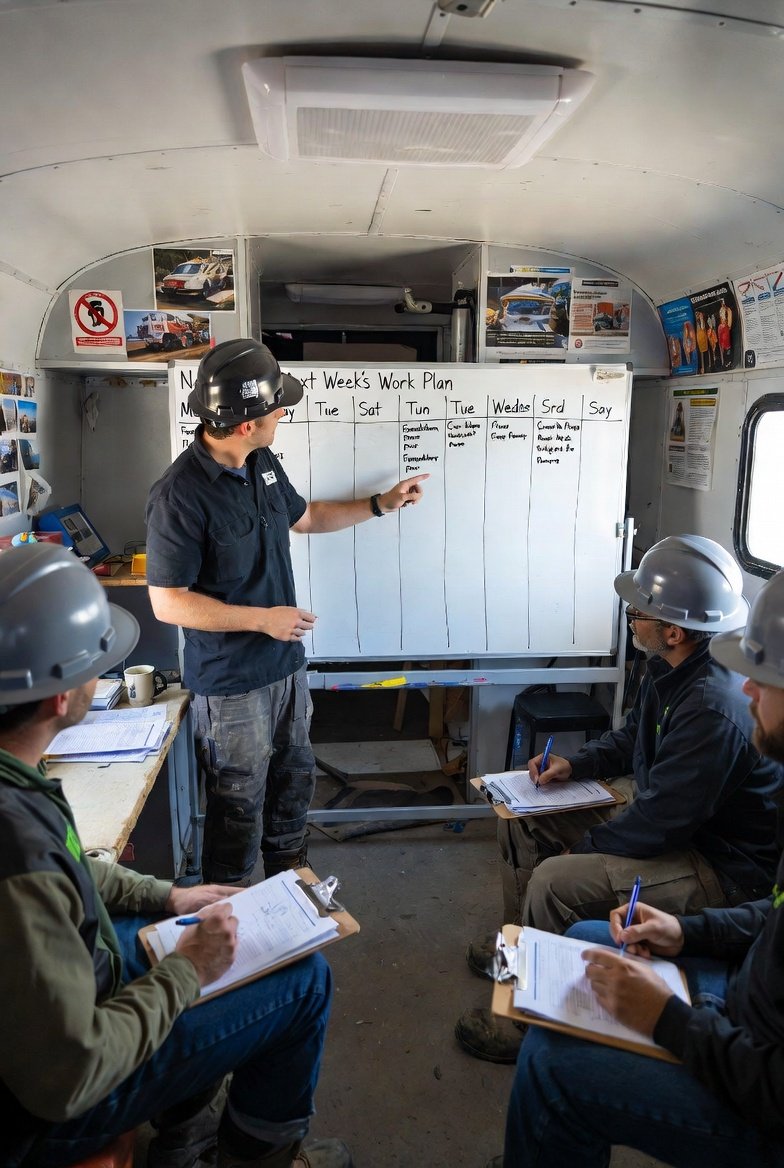
Here's a scene every superintendent knows. It's Friday afternoon, the trailer is full, and you go around the table asking each foreman what they'll finish next week. Everybody nods, everybody commits, everybody sounds confident. Then Monday hits and the drywall crew can't start because the electrical rough-in failed inspection, the framer's out a man, and the material you swore was coming Tuesday is now "end of the week." By Wednesday the plan is fiction and you're back to running the job off your gut and your phone.
The weekly work plan is supposed to prevent exactly that. Done right, it's the tightest, most reliable planning tool you have — a commitment of what will actually get done in the next seven days, made by the people doing the work, screened for the things that could stop it. Done wrong, it's a status meeting that wastes an hour and predicts nothing. The difference isn't the form or the software. It's how the superintendent runs it. Below is what actually separates the two.
Only Plan Work That's Actually Ready
This is the whole game, and it's where most weekly plans fall apart. A task belongs on the plan only if it can genuinely be done next week — which means every constraint on it is already cleared. Before anything makes the list, walk it against the usual blockers:
- Prerequisite work complete — the wall is framed and inspected before you schedule insulation.
- Materials on site or confirmed for delivery — not "ordered," physically here or with a hard delivery date and a tracking number.
- Design and RFIs answered — no open questions that could change the scope mid-week.
- Prior inspection signed off — you don't cover work that hasn't passed.
- Access, equipment, and manpower available — the lift is scheduled, the crew is actually staffed.
If a task fails any of these, it doesn't go on the weekly plan. It goes on the lookahead as a constraint to resolve. The instinct — especially when you're behind — is to load the plan with everything you wish would happen. Resist it. A plan full of hopeful tasks trains your crews to treat the plan as a wish list, and once they do that, they stop believing any of it. A short list of genuinely-ready work that actually gets done is worth more than a full page of optimism.
Let the Lookahead Do the Heavy Lifting
The weekly plan and the six-week lookahead are two halves of the same system, and the lookahead is where you win. Its entire job is to spot constraints far enough out that you can clear them before the work is due. A long-lead material that needs eight weeks has to surface on the lookahead at least eight weeks out, or it's already late by the time it hits your weekly plan.
Every week, before you ever sit down to build the plan, run the lookahead and screen the tasks coming into the window. For each one, ask what could stop it and who owns fixing that. Submittal not approved? PM owns it, needs a date. Inspection required Thursday? Somebody schedules it now, not Wednesday night. This constraint-screening is the difference between a superintendent who's ahead of the job and one who's chasing it. A rolling lookahead you actually maintain — whether on a whiteboard or in look-ahead scheduling software like LookAheadWall — is what feeds a weekly plan you can trust. Garbage lookahead, garbage weekly plan.
Make the Commitment Real — and Let the Foreman Own It
A commitment made by a foreman he believes he can hit is worth ten commitments you handed him across the table. So don't dictate the weekly plan. Facilitate it. Bring the ready work and the sequence, then let each foreman tell you what his crew will complete and by when. Your job is to pressure-test it: "You've got two guys and 4,000 feet of conduit — is that really a Thursday finish?" If he's overreaching, help him right-size it. If he's sandbagging, push. But the number is his.
The reason this matters is accountability. When the foreman set the target himself, Friday's conversation about whether he hit it is honest and blame-free. When you set it for him, every miss becomes an argument about whether the target was fair. Ownership up front buys you honest reflection at the back end.
Sequence the Trades So They Don't Collide
Most weekly-plan failures aren't one crew being slow — they're two crews needing the same space, or one starting before another finished. Location-based thinking prevents it: instead of listing tasks by trade, think in terms of who's working in which area, in what order, on which days. In a given room the flow runs overhead rough-in, then in-wall rough-in, inspection, insulation, then close the walls. Stack those correctly and each trade hands off clean. Stack them wrong and your drywallers are standing around while the electrician finishes, which you're paying for either way.
A few buffers worth building in from experience:
- Frame to rough-in: leave a day or two for cleanup and framing inspection before the trades pile in.
- Rough-in to cover: never schedule insulation or drywall the same day as the rough-in inspection. Inspections fail, and re-work behind closed drywall is the most expensive mistake on the board.
- Wet trades to finishes: give mud, self-leveler, and concrete real cure time. Rushing it shows up in the finish work, and the finish crew gets blamed for your schedule.
Get the trade-flow sequence onto the plan visually — by area, not just by task — and half your coordination conflicts disappear before Monday. This is exactly what visual, location-based planning tools are built to show you: the collision you'd otherwise only discover when two foremen call you at 7 a.m.
Review Last Week Honestly — Track PPC, Kill the Blame
At the start of every weekly meeting, before you plan anything new, score last week. The number that matters is Percent Plan Complete: of the tasks you committed to, how many finished 100 percent by the date promised? Not "mostly done," not "80 percent there" — done. PPC is brutally binary on purpose. A task that's 90 percent complete didn't hand off to the next trade, so for planning it counts as zero.
Most healthy jobs run PPC in the 65 to 85 percent range. If you're consistently above 85, your commitments may be too soft and you're leaving productivity on the table. If you're stuck below 60, the plan isn't reliable and everyone downstream is guessing.
But the PPC number is only half of it. For every missed task, capture why — and this is where superintendents make or break the meeting. The reason a task missed is data, not a verdict on a person. Log the cause: late material, failed inspection, missing manpower, prerequisite not done, weather, design change. The moment reason-for-variance becomes about who screwed up, your foremen start committing to soft, easy targets to avoid getting burned, and your PPC becomes meaningless. Keep it clinical. After a month or two those variance reasons will show you the same three or four root causes over and over, and fixing those is where real schedule reliability comes from.
Run the Meeting Tight
The weekly planning meeting should be 30 to 45 minutes, start on time, same day, same place, every week. Consistency is what makes people prepare for it. A meeting that drifts to whenever-you-get-to-it is a meeting nobody preps for. Keep a standing agenda: score last week's PPC, review variances, screen the incoming lookahead for constraints, then make next week's commitments by area.
Guard the meeting against turning into a problem-solving session. When two trades hit a real conflict, note it and take it offline with just those parties — don't hold ten people hostage while two of them hash out a detail. And put the plan on a screen everybody can see. When the schedule is visible and gets updated live as commitments are made, the room stays engaged and there's no argument later about what was agreed to.
Work the Constraints Between Meetings
The plan doesn't run itself Tuesday through Thursday. Every constraint you flagged needs an owner and a due date, and somebody — usually you — has to chase them mid-week. The material confirmed for Wednesday should get a call Tuesday. The Thursday inspection should be on the books Monday. A constraint with no name attached to it is a constraint nobody's clearing.
This is also where the mobile side earns its keep. Your foremen are in the field, not the trailer, and a plan they can pull up and update from their phone — the way LookAheadWall's companion app lets crew leaders do — keeps the plan honest through the week instead of going stale by Tuesday. The plan should reflect the job as it stands, not as it stood Friday.
The Mistakes That Sink Superintendents
- Planning work that isn't ready. The number one killer. Constraints not cleared, so the plan collapses by mid-week and everyone stops trusting it.
- Making variance about blame. Kills honesty, drives soft commitments, and turns your PPC into theater.
- Dictating instead of facilitating. A plan the foremen didn't build is a plan they don't own — and won't defend when it gets hard.
- Skipping the lookahead. Constraints surface too late to fix, so you're firefighting instead of scheduling.
- Inconsistency. Meetings that slip, plans that don't get updated, follow-through that's hit-or-miss. The system only works if it's a discipline, not a mood.
What Good Looks Like
You'll know the weekly plan is working when the signs stack up: PPC holds steady in a healthy range and trends up over the weeks. Foremen show up prepared and argue for their own numbers instead of nodding along. Constraints get raised and cleared before they become fires. And the biggest tell — Monday morning feels boring, because the crews already know what they're doing and where, and they can just go do it.
None of this comes from a template or a piece of software on its own. It comes from a superintendent who protects the process: only ready work goes on the plan, the foremen own their commitments, the review is honest, and the follow-through is relentless. Good look-ahead and short-interval scheduling tools make all of that easier to see and share — but the discipline is yours. Run it that way for a few months and the weekly plan stops being another meeting to endure and becomes the thing the whole job runs on.