
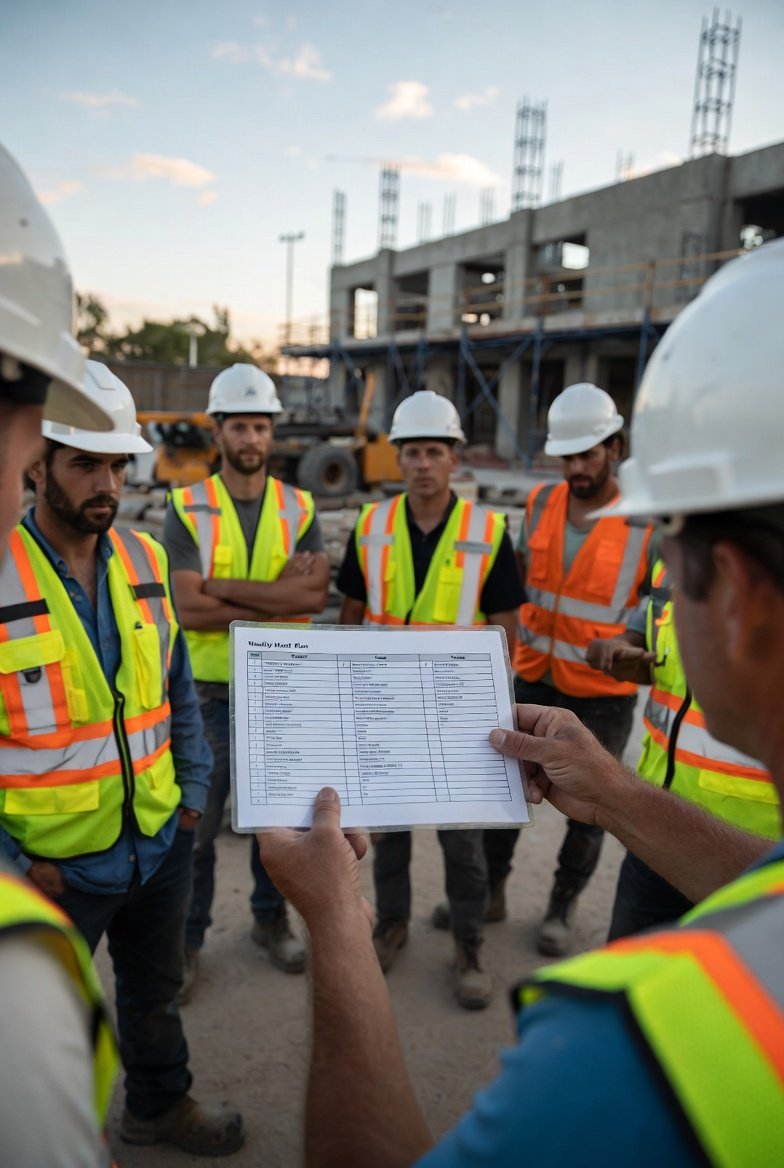
Every Monday morning on a lot of jobsites, the same thing happens. The super hands out a weekly plan, the foremen nod, and by Wednesday half of it is fiction. Nobody says anything. The plan just quietly dies, and everyone goes back to running the job off the drawings, the phone, and gut feel. If that sounds familiar, the problem usually isn't the crews. It's the plan.
A weekly work plan that crews don't follow isn't a plan — it's a wish list with a date on it. After twenty-odd years of building these things and watching them succeed and fail, I've come to believe that whether a plan gets followed is decided before the crew ever sees it. It's decided by how you build it, who you build it with, and whether the work you're asking for is actually ready to be done. Here's how to build one crews will trust.
Understand why the last plan got ignored
Before you fix anything, be honest about why crews tune out. In my experience it comes down to a short list:
- You planned work that wasn't ready. The single biggest killer. You told the drywall crew to hang Building C corridor, but the electrician hadn't finished rough-in and the inspector hadn't signed off. The crew shows up, can't work, and learns that your plan doesn't reflect reality.
- The production rate was fantasy. You penciled in 4,000 square feet of overhead deck per day because that's what the estimate assumed. The crew that's actually on your job does 2,800 on a good day. Now every plan built on the estimate's numbers is set up to fail.
- Nobody asked the foreman. A plan written in the trailer and handed down without a conversation carries no weight, because the person who has to execute it never agreed to it.
- The last three plans blew up. Trust is cumulative. Once crews watch a plan miss badly a few weeks running, they stop reading the next one. Why would they? It's been wrong every time.
Notice that none of these are the crew's fault. They're planning failures. Fix the planning and the following takes care of itself.
Only plan work that's actually ready
This is the discipline that separates a real weekly work plan from a to-do list. Before an activity earns a spot on the week, it should clear a readiness check. I run through what most people in lean construction circles call the seven flows, but you don't need the jargon — you need to actually ask the questions:
- Are the prior trades done? Not "supposed to be done." Walk it or get a straight answer. Predecessor complete, inspected where required, and signed off.
- Is the material on site and staged? Not on a truck, not "coming Thursday." On site, in the right area, in the right quantity.
- Are the crew and the right skills available? The exact headcount and trade you're counting on, not a number you hope shows up.
- Are tools and equipment lined up? The lift, the pump, the specialty tooling — reserved, not fought over Monday at 6:45.
- Is the information there? Approved drawings, no open RFI blocking the work, latest revision in the crew's hands.
- Is the area physically accessible and safe? Not blocked by a material drop, not sharing tight space with another trade, not waiting on a shoring or overhead-protection detail.
If an activity can't clear all of those, it doesn't go on this week's plan. It goes on the look-ahead as a constraint to knock down. That's the whole point of a rolling look-ahead schedule — you're looking three to six weeks out specifically so you can find and clear these constraints before the week they'd bite you. A weekly work plan is where you commit only to work that's already been made ready. Mix those two up and you're back to wish lists.
Build the plan with your foremen, not for them
A commitment somebody else made for you isn't a commitment. It's an assignment, and people slip assignments without guilt. The move that changes everything is simple and a lot of supers resist it: sit down with your foremen and build the plan together.
I like a short weekly planning meeting — thirty to forty-five minutes, foremen from every active trade, everybody looking at the same look-ahead. You go area by area and ask each foreman what they can commit to next week. Not what you need them to do — what they'll commit to, knowing their crew, their material situation, and the conditions in their area. When a foreman says "I can get the north wing done but the south wing is waiting on the plumber," that's gold. You just found a constraint and a realistic scope in one sentence.
The magic word is commit. When a foreman says out loud, in front of his peers, "yes, my crew will complete grid A through F rough-in by Thursday," that commitment behaves completely differently than a line item you typed. He owns it. He'll fight to make it. And if it slips, he'll tell you why, because he's invested in it being right.
Use production rates from this crew, on this job
Estimating production rates from the estimate is a trap. The estimate was a bid built months ago to win the job; it wasn't a promise about what your specific crew does in your specific conditions. Once the job is running, throw the estimate's rates out for planning purposes and start tracking what actually happens.
You don't need a spreadsheet with fifty columns. You need to know, roughly: how many linear feet of wall this framing crew frames in a day, how many fixtures this plumber sets, how many square feet this painter rolls. Two or three weeks of watching gives you a working number. Then adjust for the reality in front of you — congested area with three trades stacked in it runs slower than an open floor; winter conditions slow everyone; a crew that just added two green apprentices isn't at full rate yet. Plan to the real number and your plans start hitting. Plan to the optimistic number and you're teaching your crews that the plan is always wrong.
Make every activity specific enough to execute
"Drywall — Building C" is not a plannable activity. It's a category. A crew can't tell whether they hit it or missed it, which means you can't measure the plan and they can't take pride in finishing. Every line on the plan should answer three questions cold:
- What, exactly? "Hang and fire-tape 5/8 Type X, corridor walls" — not just "drywall."
- Where, exactly? "Level 2, grid lines 4 through 9, east corridor." Location-based planning matters here — when your plan is tied to real areas of the building, two trades can look at it and instantly see whether they're about to collide. This is where a visual, location-based tool earns its keep; in LookAheadWall the plan is laid out by area and week, so a handoff between trades is something you can actually see coming instead of discovering when both crews show up in the same hallway.
- Done means what? Define the finish line. "Hung, taped, ready for inspection" is a different commitment than "hung." Say which one you mean.
Load the week honestly — leave room for the job to breathe
There's a temptation to pack every crew to 100 percent, or worse, to 110 percent because "they'll rise to it." They won't. They'll fall short, and the shortfall becomes the story of the week. I'd rather see a plan loaded to about 80 to 85 percent of theoretical capacity, with the slack left deliberately.
That slack isn't laziness — it's where the punch items, the surprise RFI, the truck that came late, and the inspector who wanted one more thing all get absorbed. Think in terms of what the crew can actually pull through, not how much you can push at them. A plan the crew beats by Thursday builds more momentum than a plan they're behind on by Tuesday. And the frame-to-rough-in handoff in particular usually wants a day or two of buffer baked in for cleanup, layout, and inspection — don't butt those activities up against each other on paper and expect the field to make it work.
Communicate it so it survives contact with the field
A plan that lives in the trailer is already dead. Once you've built it with the foremen, it has to get to the crews, and it has to be somewhere they can see it all week.
- Brief it face to face. The foreman should walk his crew through the week Monday morning — what they're doing, where, and what "done" looks like. Two minutes at the daily huddle.
- Post it where work happens. A printed plan in the gang box or on the job trailer wall beats one buried in email. Better yet, put it on their phones — the whole reason field-accessible scheduling exists is so the foreman standing in the corridor can pull up the week without walking back to the trailer.
- Answer the questions on the spot. When a foreman asks "what about the material for the south wing," that's not an interruption, that's the plan getting stress-tested before it goes live. Answer it now, not Thursday.
Reinforce daily and fix problems before they metastasize
A weekly plan isn't a set-and-forget document. It's a commitment you check against every single day. The daily huddle — five minutes, whole team, standing up — is where you compare yesterday's promise to yesterday's actual and adjust today accordingly. Did the electrician finish so the drywaller can start? Did the material show? Is anybody blocked right now?
When something's going sideways, the whole value of catching it early is that you can still do something about it. A crew that's blocked Monday morning is a problem you can solve by Monday afternoon — reassign them to ready work, chase the missing material, escalate the RFI. The same crew still blocked Wednesday because nobody raised it is two lost days you'll never get back. Build the expectation that raising a blocker fast is exactly what you want, not complaining. The foreman who tells you Monday that the south wing isn't ready just saved you a wasted week.
Coordinate the trade handoffs — that's where jobs actually stall
Most weekly plans fail at the seams between trades, not inside any one trade's work. The framer finishes but leaves the wall dirty for the electrician. Two crews need the same corridor the same day. The drywaller hangs before the inspector signs the rough-in, and now the wall's got to come back open. These trade-flow handoffs are where a look-ahead earns its money.
When you sequence trade flows explicitly — this trade finishes here, then that trade starts here, with a defined buffer between — you can see the collisions and the gaps before they happen. Mapping those sequences across the building and across the weeks is exactly the kind of coordination that visual look-ahead scheduling is built for, and it's the difference between a plan that flows and a plan that jams up every time two subs meet at a doorway.
Close the loop: measure what missed and learn from it
At the end of the week, do a quick honest count: of everything you committed to, how much actually got done? That percentage — a lot of people call it Percent Plan Complete — is the single best gauge of whether your planning is getting more honest over time. But the number alone doesn't help you. The reasons do.
For everything that missed, ask why in one word or two: material late, prior trade not done, weather, crew short, RFI open, plan too aggressive. Track those reasons for a few weeks and a pattern jumps out — maybe it's always material, maybe it's always one trade's predecessors, maybe your production rates are still too rosy. That's your improvement list. Fix the top reason, watch the number climb, move to the next. This is how planning discipline compounds: not from any one clever plan, but from steadily removing the things that keep breaking your plans.
The bottom line
Crews follow plans they believe in, and they believe in plans that keep coming true. Everything above is really in service of that one thing — making the plan credible. Plan only ready work. Build it with the foremen who have to run it. Use production rates from this crew on this job. Say exactly what, where, and done. Leave room to breathe, check it daily, and be honest about what missed.
Do that for a month and something shifts. The plan stops being a piece of paper the super waves around and starts being the thing the whole crew runs the week by. Software helps — it keeps the look-ahead visible, the constraints tracked, and the plan in the foreman's pocket instead of on the trailer wall — but the discipline is yours to build. Get the discipline right and the crews come along, because for the first time in a while, the plan is telling them the truth.