
The look-ahead schedule is where you think. The daily huddle is where you fight. If those two things aren't wired together, you end up with a beautiful three-week plan taped to the trailer wall that nobody looks at, and a morning stand-up that turns into a gripe session about parking and porta-johns. I've watched both fail on the same job, in the same week, run by the same super. The fix wasn't more meetings. It was making the plan and the huddle talk to each other.
Here's how the connection actually works when it's working, and how to tell when it's quietly broken.
Two tools, two jobs, one loop
The rolling look-ahead is a planning tool. You sit down once a week, pull the three or four weeks in front of you, and you knock down constraints before they turn into stopped work. Are the materials on site? Is the design question answered? Did the inspector sign off on the last phase so the next trade can start? That's look-ahead work. It's slow, deliberate, and it happens away from the noise.
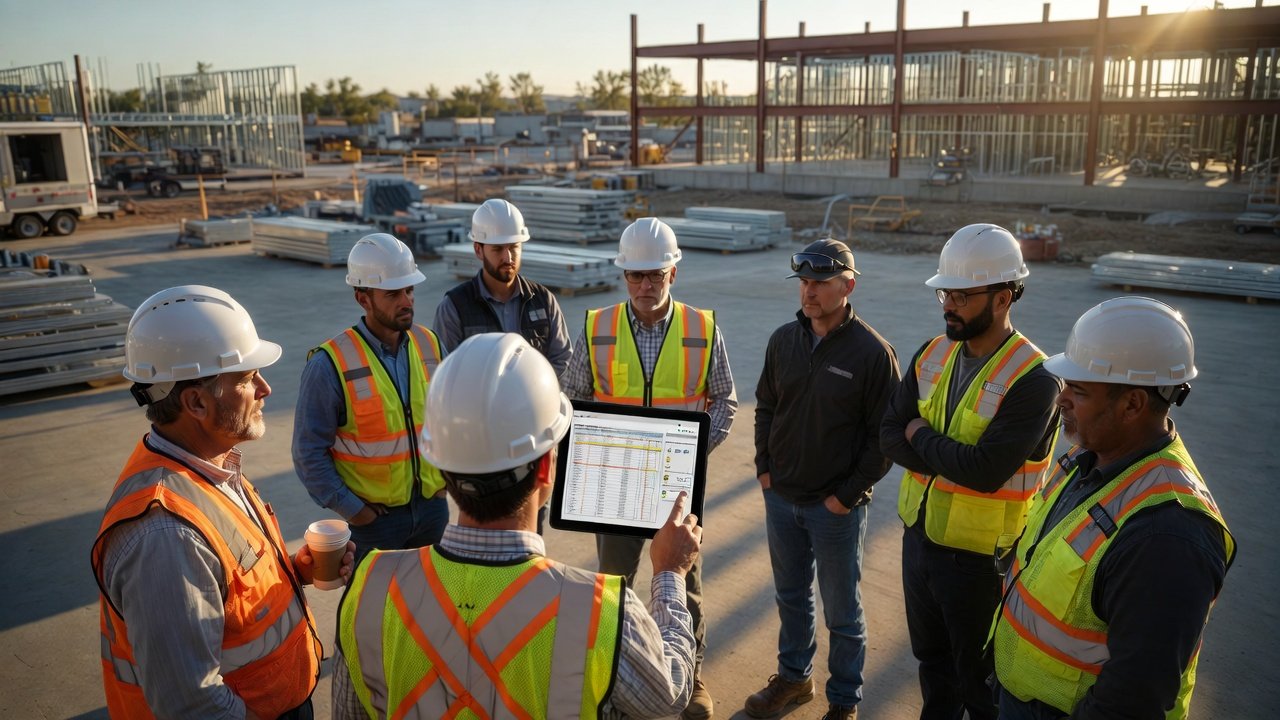
The daily huddle is an execution tool. Ten minutes, everyone standing, first thing in the morning. Its only job is to take the small slice of the plan that lands today and make sure the crews don't collide. Who's in which area, what hands off to whom, what changed since yesterday. It is not a planning meeting. If you're planning in the huddle, you've already lost — you're doing on the sidewalk at 6:45 what should've been done in the trailer last Thursday.
The relationship is a loop. The look-ahead pushes work down into the huddle. The huddle pushes reality back up into the look-ahead. Break either direction and the whole thing goes stale.
What the huddle should pull straight off the plan
A good morning huddle isn't freeform. It's reading the first week of your look-ahead out loud and confirming it against what the field actually sees. When you walk into that circle, the plan should already have answered:
- Location. Where is each crew today? Not "the drywall guys are hanging" — Building B, third floor, north wing, units 301 to 308. Location-based planning is the whole game once you have more than two trades moving. Two crews scheduled into the same corridor is a fistfight you can prevent the night before.
- Handoffs. What finishes today that lets somebody start tomorrow? Framing wraps unit 305 this afternoon, so the electricians are in there first thing Wednesday. Name it out loud so the electrician's foreman is nodding before he leaves the circle.
- Constraints that should already be dead. If your look-ahead did its job, nothing on today's list is waiting on material, an RFI, or an inspection. The huddle is where you verify that, not where you discover it.
- Today's inspections. If the framing inspection is at 10 and it fails, half your afternoon plan evaporates. Everyone should know it's on the calendar so they're not blindsided at 10:15.
If your crews are seeing this on a phone in the field — location, their specific activities, what's ahead of and behind them — the huddle gets faster and the arguments get shorter, because nobody's relying on memory. That's the honest case for putting the plan on a mobile screen: it's not about dashboards, it's about the foreman being able to point at his own row.
The specifics that keep the plan honest
Platitudes don't help you at 6:45. Numbers do. A few rules of thumb I hold crews to, and put right into the look-ahead as buffers:
- Frame to rough-in: leave a 1–2 day gap. Not because the work needs it, but because you need time for cleanup, punch, and the framing inspection to clear. Butt those two activities up against each other with zero float and the first bad inspection blows your whole sequence.
- Don't schedule the finish trade to chase the rough trade by a day in the same room. Give it breathing room. Insulation and drywall stepping on a not-quite-signed-off rough-in is how you end up cutting open a wall you just closed.
- Megger the runs and pressure-test the lines before anyone closes a wall. Put "test complete" as its own constraint on the drywall activity, not a footnote. A wall you have to reopen costs you a day and your credibility.
- Concrete cure, inspection sign-off, and delivery lead times are constraints, not activities. They don't show up as bars people are "working," so they get forgotten. Track them in the look-ahead explicitly or they ambush you.
The point of all of this is that the look-ahead is where you build in the buffers, and the huddle is where you find out whether the buffer held. When you keep butting activities against each other with no slack, every huddle turns into damage control.
Pushing reality back up the ladder
The direction people forget is the one going up. Crews are great at hearing today's plan. They're terrible at reporting back what actually happened, and without that, the look-ahead drifts away from the jobsite until it's fiction.
Make end-of-day progress a non-negotiable. Did the activity finish, or is it 70 percent? Did something slip? The moment a foreman marks framing on 305 as "not done — waiting on a beam," that's information the whole downstream sequence needs. If your short-interval schedule doesn't get that update until the next weekly meeting, the electrician still shows up Wednesday to an empty room. This is exactly the kind of thing look-ahead software earns its keep on — a status change one foreman makes on his phone ripples to everyone the activity touches, instead of dying in a notebook.
The discipline I care about isn't the tool. It's the habit: nobody leaves the site until their rows are updated. Do that and your Monday look-ahead meeting starts from truth instead of guesswork.
Minor variance vs. the kind that changes the plan
Not every hiccup is a schedule change, and one of the fastest ways to make people ignore your look-ahead is to rev it for every little thing. Learn the difference:
- Minor variance — handle it in the huddle, leave the plan alone. Rain pushes the pour two hours; the crew shifts to interior work and picks the pour back up after lunch. That's a field decision. Don't touch the rolling schedule.
- Real variance — the plan has to change. An activity won't finish this week, or a constraint you thought was dead came back. Now you've got a downstream problem. Decide fast whether it waits for the weekly update or needs an immediate adjustment and a phone call to whoever's affected. If it touches another sub, that call happens today, not Monday.
The judgment call — "is this a today problem or a plan problem?" — is the superintendent's real job in this whole loop. Nobody else can make it.
The weekly rhythm that ties it together
Zoom out and the cadence is simple, and it only works if all three pieces happen:
- Weekly look-ahead meeting. Pull constraints off the next three to four weeks, confirm this week's commitments, get the subs to actually commit — not "we'll try," but "yes, we'll have that corridor done Thursday." Commitments you can hold people to.
- Daily huddles. Break the week's commitments into today, coordinate the collisions, surface the surprises. Five to ten minutes, standing, same time every morning.
- End-of-week look-back. What did we commit to, and what percent did we actually hit? Track that number. When a trade keeps promising and missing, the number tells you before the schedule does. That look-back is the single most useful habit most crews skip, and it feeds straight into next week's planning meeting.
That percent-planned-complete figure is worth more than most people realize. A crew running at 50 percent isn't lazy — they're getting handed work that isn't really ready, which means your constraint clearing upstream is weak. The number points at the real problem instead of the loudest one.
How to tell it's quietly broken
The connection fails silently. Watch for these, because by the time they're obvious you've already lost a week:
- The huddle never mentions the look-ahead. If the morning stand-up and the weekly plan feel like two different jobs, you've got two planning tracks and neither one is trusted.
- The plan says one thing, the crews do another. When the schedule and the field have visibly diverged and nobody's alarmed, the plan is already dead — people are just being polite about it.
- Progress never flows up. You're finding out on Monday what stalled on Wednesday. Every one of those is a downstream trade that showed up to nothing.
- "Cleared" constraints that weren't. The look-ahead shows a constraint resolved, but the crew hits the field and the material's still not there. That gap between the plan and the loading dock is where trust goes to die.
Wiring it together
None of this is complicated, which is exactly why it gets skipped. Start the huddle by reading today off the look-ahead. End the day by updating what actually happened. Once a week, calibrate the two against each other and count your hits. And teach the crews why — that the two minutes they spend updating their rows is what keeps the next trade from showing up to a locked room.
Do that, and the look-ahead stops being wall art and the huddle stops being a complaint box. The plan stays honest because the field keeps feeding it, and the field stays coordinated because it can see the plan. That's the whole relationship — a weekly brain and a daily heartbeat, each one useless without the other, and genuinely powerful together.