
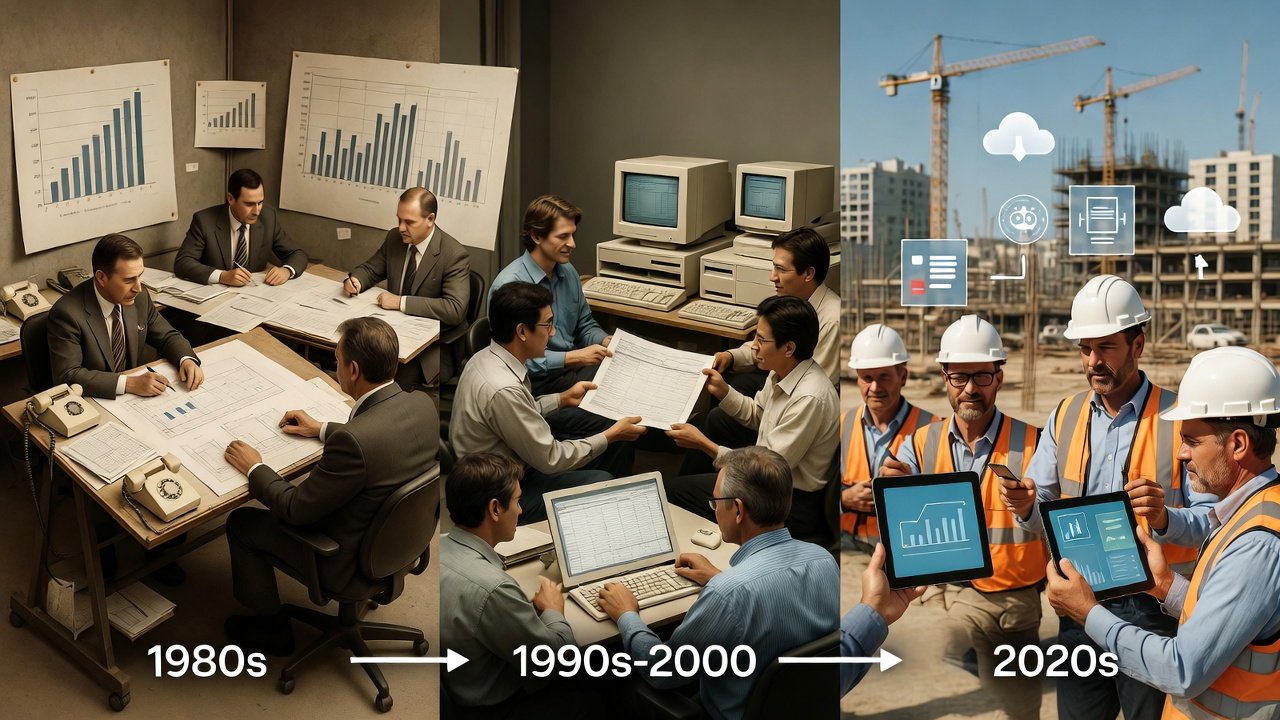
The idea behind a look-ahead has not changed in forty years. Good superintendents have always been thinking three weeks out, chewing on what's coming, worrying about the crane pick that hasn't been scheduled and the switchgear that's still sitting on a boat somewhere. What has changed is everything around that instinct: how we capture it, who gets to see it, how fast it moves, and how honestly it reflects what's actually happening on the deck. If you've been running work for a while, you've lived through most of this evolution firsthand. If you're newer, understanding how we got here explains a lot about why the tools work the way they do, and where the real gains still are.
It started in the super's head, and partly still does
The oldest version of the look-ahead lived in one person's skull. A veteran super would walk the job on Friday afternoon, already knowing that the plumber was going to need the slab poured by Wednesday, that the inspector was booked out three days, and that the mason wasn't going to be ready no matter what he swore in the OAC meeting. That knowledge was real and often very good. Its problem was that it wasn't shared, wasn't written down, and died the day that super retired or got hit by a bus.
I bring this up not for nostalgia but because it's the thing every later tool has been trying to reproduce and scale. The whiteboard in the trailer, the typed three-week schedule, the spreadsheet, the cloud platform, every one of them is an attempt to get what lived in one experienced head into a form that a whole team can act on. Keep that in mind, because it's the yardstick. A tool is only worth adopting if it captures more of that judgment and loses less of it in the handoff.
Paper, whiteboards, and the trailer wall
The first shared look-aheads were physical. A handwritten or typed schedule taped to the trailer wall. A whiteboard gridded out by week that everybody stood around in the Monday coordination meeting. These worked better than people give them credit for, mostly because they forced the whole team into the same room, looking at the same thing, arguing it out loud. That face-to-face negotiation is worth a lot, and it's the part we've spent twenty years trying not to lose.
What killed the paper era wasn't that it didn't work. It's that it didn't travel and didn't remember. The whiteboard got erased Monday afternoon and nobody could reconstruct what was promised. The subcontractor who missed the meeting got a version secondhand, three days stale. And there was zero record. When the schedule slipped and everyone wanted to know why, you had nothing but memory and blame. No trail of what was actually committed to versus what got done.
The spreadsheet, and the version chaos it brought
Excel felt like a revolution and in some ways it was. Suddenly you could produce a clean three- or four-week look-ahead in an afternoon, sort it, reformat it, and email it to fifteen subs before lunch. Distribution went from a bottleneck to trivial. That was real progress and a lot of jobs still run this way today.
But the spreadsheet quietly created the single worst problem in scheduling, and it's worth naming because it still bites people: nobody knew which version was current. The plumber was working off the copy you emailed Tuesday. The PM had edited a different copy Wednesday. The owner was looking at last week's. You'd get to the Monday meeting and spend the first twenty minutes just establishing whose schedule was real. Every emailed spreadsheet is a fork, and forks multiply. On top of that, constraints in a spreadsheet are just text in a cell. You can write "waiting on RFI 214" but nothing tracks whether it got answered, nothing nudges you, and nothing stops you from scheduling the work anyway.
Where the master-schedule tools fit, and where they didn't
Primavera P6 and Microsoft Project came from a different world. They were built for the CPM master schedule, the thousand-line beast with logic ties and float and a baseline the contract hangs on. Those are essential documents. But trying to run a weekly look-ahead in P6 is like using a chainsaw to trim a bonsai. The tool is too heavy, the field can't touch it, and the update cadence is monthly at best.
What most good teams landed on was a two-layer approach that still holds up: the master schedule owns the contract logic and the milestones, and a lighter, faster look-ahead owns the next two to six weeks of actual field commitments. The look-ahead pulls its targets from the master but lives at field speed. The mistake I still see is teams trying to make one document do both jobs. It can't. The master is too slow to be a look-ahead and the look-ahead is too shallow to be a master. Keep them separate and let them talk.
Mobile put the schedule in the foreman's pocket
The phone changed the geography of scheduling. For the first time the person actually running the crew could see the current plan standing in the mud, without waiting for a printout. That sounds small. It's not. The whole value of a look-ahead is that the people doing the work believe it and commit to it, and you can't get commitment from someone who's looking at a schedule three days out of date.
Mobile also closed the gap between what happened and what got recorded. Progress captured in the field, a photo of the completed pour, a note that the inspector red-tagged the west stair, all of it lands in the plan the same day instead of getting reconstructed from memory Friday afternoon. A companion app aimed at crew leaders, the way LookAheadWall handles it, is really about that one thing: getting the frontline supervisor into the planning loop instead of treating them as the last to know.
The cloud finally killed the version problem
Cloud platforms solved the spreadsheet's original sin. One schedule, one place, everyone looking at the same live document. The PM in the trailer and the super on the fifth floor and the electrical foreman in his truck all see the same thing, and a change any one of them makes shows up for everyone. No more forks. No more twenty minutes of "whose version is this."
The quieter win is history. A cloud system remembers what was planned three weeks ago even after reality steamrolled it. That matters more than people expect, because it turns your look-ahead into a record you can learn from. Which brings us to the part of this evolution that actually changed how the work gets planned, not just how it gets stored.
The real shift was Lean, not the software
Here's the thing most "evolution of scheduling" pieces get wrong. They treat this as a story about technology. The bigger change was a change in method, and it came out of Lean construction and the Last Planner System in the 1990s. Software just made it practical.
Three ideas are worth knowing cold, because they're what separate a look-ahead that works from a pretty chart that gets ignored:
- Make-ready and constraint screening. Before an activity enters the near-term window, you strip it of constraints, design, materials, prerequisite work, equipment, permits, inspections, manpower. If it isn't clear of constraints, it doesn't get promoted into the committable window. This is the discipline that separates a plan from a wish. You are not allowed to schedule work that can't actually be done.
- Pull planning. You build the sequence backward from a milestone with the trades in the room, each one saying what they need from the crew before them. It's the opposite of the GC dictating dates. The handoffs get negotiated by the people responsible for them, so they're realistic and people own them.
- PPC and variance analysis. Percent Plan Complete is simply what fraction of the tasks you committed to this week actually got done. Track it. A healthy team runs somewhere around 70 to 85 percent, and honestly the number matters less than the reasons. Every miss gets a reason code, and the reasons are gold. When "waiting on inspection" shows up nine weeks running, you don't have a scheduling problem, you have a process problem, and now you can see it.
Software like a modern look-ahead platform earns its keep here. It enforces the constraint screening you'd skip when you're busy, it makes the pull-planned trade-flow sequence visible so a slip in one trade shows its downstream damage immediately, and it does the PPC arithmetic so you actually track it instead of meaning to.
What data-driven planning actually gives you
Once you've got a few projects' worth of honest history, real patterns show up. Which activities always run long against their estimate. Which constraint types recur every single job. Which trade handoff, framing to rough-in, drywall to paint, is where your schedule reliably bleeds. That last one is worth a specific note: the transitions between trades are where look-aheads die, not the trade work itself. Frame-to-rough-in usually wants a day or two of buffer for cleanup, punch, and inspection before the next crew crowds in, and the teams that build that buffer in deliberately stop eating the delay by accident.
Be skeptical of the "AI will predict your durations" pitch, at least for now. The prediction is only as good as the honesty of the data feeding it, and most field data is optimistic by nature. Where the analytics genuinely help today is simpler: flagging that an activity has an open constraint two weeks out, showing you a trade that's been missing commitments, surfacing the recurring reason codes. That's not sci-fi, it's just bookkeeping you'd never keep by hand, and it's enough to change how you run a job.
Subs went from being told to being asked
The oldest model was pure dictation. The GC built the schedule and handed it down, and the subs treated it as fiction because they had no hand in making it. The single biggest cultural change in scheduling is that the trades now help build the near-term plan instead of just receiving it. When the drywall foreman commits to a date in the pull plan with his own mouth, in front of the trade ahead of and behind him, that date means something. When it's a date the GC picked and typed, it means nothing.
Shared live access is what makes this real day to day. The subs see the same current look-ahead you do, they see how their piece connects to the flow, and they can raise a flag before a slip cascades instead of after. The technology matters, but it's serving the relationship, not replacing it, and that's the part worth remembering.
What hasn't changed, and won't
For all the tooling, the fundamentals are stubborn:
- Judgment still wins. No software knows that this particular mason is slow out of the gate but finishes strong, or that this inspector needs a day's notice or he gets prickly. The tool holds the plan. You still have to know the job.
- Relationships aren't in the software. A shared schedule doesn't get you a favor from a sub when you're in a bind. Twenty years of treating people straight does that.
- The plan has to tell the truth. A look-ahead that shows what should be happening instead of what is happening is worse than no schedule, because people learn to ignore it. Update it to match the deck, even when the deck is ugly.
- Discipline beats features. There is no platform that survives a team that updates it whenever they feel like it. The weekly cadence, honestly kept, is the whole game. The best tool run sloppily loses to a whiteboard run religiously.
The lesson under all of it
If there's one takeaway from watching this evolve, it's that technology enables but process delivers. Every wave, spreadsheets, mobile, cloud, Lean, opened a door. The teams that got results were the ones who changed how they worked, not just what they logged into. The whiteboard super who runs a rigorous make-ready screen every Monday will beat the crew with the slickest platform and no discipline, every time.
So when you're weighing tools, past the demo dazzle, ask the boring questions. Can the foreman actually use it standing in the mud, or does it need a laptop and a training class? Does it track constraints and make me clear them, or does it just let me type wishes into cells? Does it keep the history so I can learn from the misses? Does it show the trade-flow so a slip's downstream damage is obvious? Those are the questions that separate a real planning tool from a prettier place to store a schedule that nobody believes. The next wave, whatever it turns out to be, will be worth adopting for exactly the same reason every wave before it was: not because it's new, but because it captures more of what the good super always knew, and loses less of it on the way to the crew.