
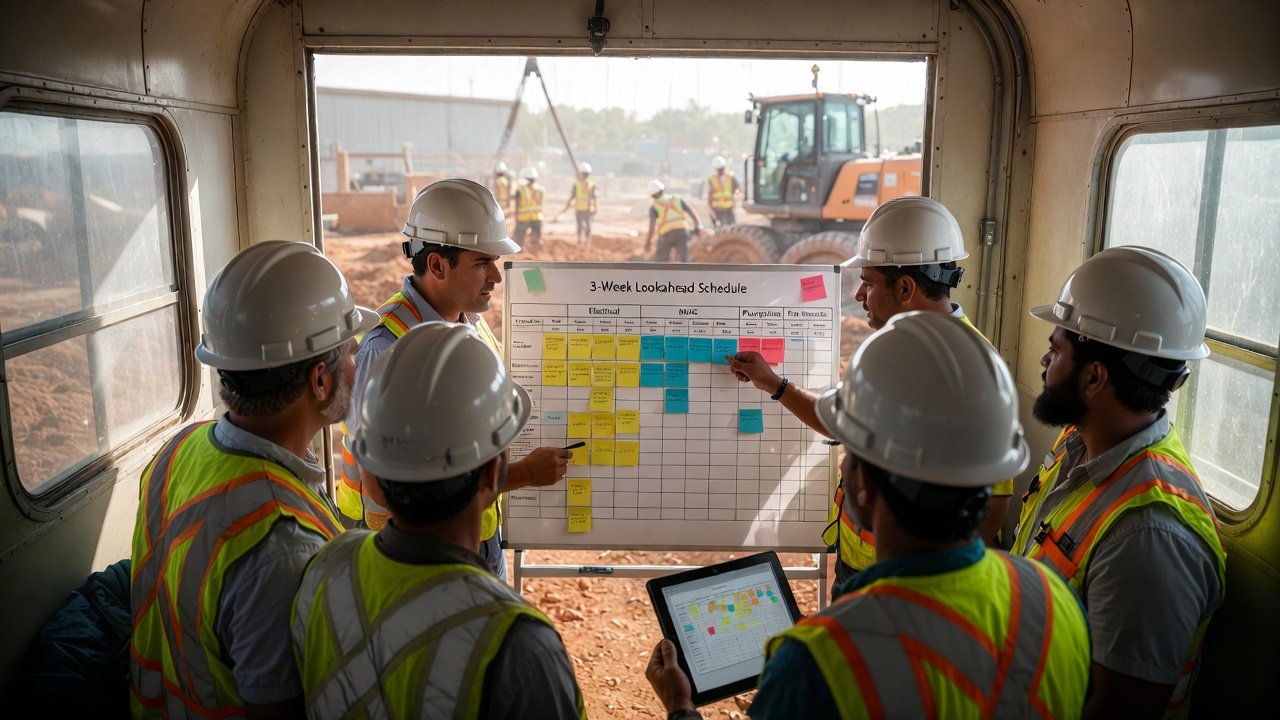
Every superintendent has stood in a corridor watching two crews stare at each other. The sprinkler fitters are up in the lift running main. The sheet metal crew showed up the same morning to hang trunk duct in the exact same ceiling. Neither foreman knew the other was coming. One of them is going home, and the one who stays is going to hang his hangers around the other guy's work and hope it fits. That is a coordination failure, and it almost never happens because someone is incompetent. It happens because nobody looked three weeks ahead and saw the collision coming while there was still time to move it.
That is the whole argument for a three-week lookahead. It is not paperwork. It is the window where trade conflicts are cheap to fix, because they are still on paper instead of in the ceiling.
Why Three Weeks Is the Sweet Spot
A master schedule tells you the building should be dried in by October. It does not tell you that the electrician and the plumber both want the same wall on Tuesday. That level of detail lives in the short-interval window, and three weeks is usually the right size for it.
Go shorter, and you are firefighting. A one-week window catches conflicts the Friday before, when the sub has already committed his crew somewhere else and can't move. Go much longer, and the plan is fiction. Nobody can tell you honestly what their crew is doing in week six, so a six-week detailed plan is just guessing dressed up as a schedule.
Three weeks gives you three distinct jobs, and it helps to think of them as three separate zones of attention:
- Week one is execution. The work is committed, the constraints are cleared, and the only surprises should be weather and no-shows. If you are still resolving conflicts in week one, your process failed upstream.
- Week two is final coordination. This is where you nail down handoffs, confirm inspections, and lock in who is in which room. Anything unresolved here is your priority for the week.
- Week three is constraint hunting. You are looking for the collisions, the missing submittals, the material that hasn't shipped, the RFI that's been sitting on the architect's desk. You have time to fix these because they are two weeks out.
Work slides from week three toward week one as it gets cleaner. If an activity can't move from week three to week two because a constraint won't clear, that's your signal to attack the constraint now, not to wish it away.
Coordinate by Location, Not Just by Activity
Here is the single biggest change that fixes trade coordination: stop scheduling only what and start scheduling where. Most schedule conflicts are spatial. Two crews want the same physical space at the same time. If your lookahead only lists tasks in a column, you will never see that collision. If it maps work to locations — Level 3 north wing, Corridor C, mechanical room 214 — the conflict jumps off the page because two bars sit on top of each other in the same place.
This is exactly why location-based, visual planning tools matter. A wall that shows each crew placed on a floor plan or a zone grid turns an invisible scheduling problem into something a foreman can point at in a meeting and say "that's not going to work." LookAheadWall was built around that idea — you're placing crews in space and time, not just filling rows — and it's the difference between catching a clash three weeks out and discovering it when both crews show up.
A few spatial strategies that actually hold up in the field:
- Zone and flow. Break the floor into zones and run trades through them in a train. Electrician clears zone 1 and moves to zone 2 as the plumber moves into zone 1 behind him. Nobody stacks up. This is trade flow, and it only works if everyone can see the parade order.
- Overhead first, then walls, then floors. Whoever works highest and hardest-to-reach goes first. Duct and main runs before branch conduit, branch before low walls. Sequence it wrong and you're building scaffolds around finished work.
- Vertical separation on multi-story. Put different trades on different floors the same week when you can. It's the cheapest conflict resolution there is — just don't let two floors' worth of crews funnel into one hoist or one stair at shift change.
The MEP Ceiling: Where Coordination Lives or Dies
If you've run interiors, you know the ceiling above a corridor is a knife fight. Ductwork, sprinkler main, cable tray, conduit, and plumbing all want the same eighteen inches. Coordination drawings are supposed to settle who owns what elevation, but the schedule has to enforce the sequence those drawings assume.
Practical rules that save you grief:
- Sequence the ceiling by elevation, top down: big-and-rigid first (duct and gravity plumbing that can't move), then sprinkler, then conduit and cable that can weave around everything else. Let the flexible trades follow the rigid ones.
- Never schedule wall closure — drywall one side, insulation, board — until every in-wall trade is roughed and inspected. One late low-voltage drop and you're cutting open finished board. Put the rough-in inspection on the lookahead as its own line, with the trade's name on it.
- Build a real buffer between rough-in and cover. Frame-to-rough-in usually wants a day or two of slack for cleanup, punch, and the inspector's schedule — because the inspector shows up when he shows up, not when your Gantt says he should.
- Megger the runs and pressure-test the pipe before you close the wall, not after. Finding a bad run behind finished drywall is the most expensive coordination failure there is, and it's entirely preventable.
The Weekly Coordination Meeting That Actually Works
A lookahead is only as good as the meeting that drives it. A bad coordination meeting is a status update where everyone reports last week's problems and nobody prevents next week's. A good one is short, forward-looking, and built on commitments.
Run it like this. Get the trade foremen — the actual last planners who will direct crews, not the estimator who bid the job — in one room or on one call, looking at the same lookahead. Walk week two and week three location by location. At each spot, ask two questions: who's working here, and what has to be true before they can. That second question surfaces constraints — a missing submittal, a predecessor that isn't done, access that's blocked — and each one gets an owner and a date.
Then make people promise. "Can you have the north corridor roughed and inspected by Thursday?" A foreman who says yes has made a reliable promise, and the trade behind him can plan on it. A foreman who says "probably" just told you about a risk while you still have time to do something about it. Write the commitments down. Next week, check whether they held. When they didn't, ask why — not to assign blame, but because the reason ("inspector was backed up," "material shipped late") is the constraint you need to attack on the next job.
That promise-and-review loop is the heart of the Last Planner System, and you don't need to run the whole formal method to benefit from it. Tracking Percent Plan Complete by trade — what fraction of each crew's weekly promises actually got done — will tell you inside a month which handoffs are solid and which relationship is quietly wrecking your schedule.
The Constraints That Aren't Physical
Not every collision is two crews in a hallway. Half of them are information. A trade can be standing by, crew ready, and still be blocked because an RFI hasn't come back or a shop drawing isn't approved. These belong on the lookahead too, tied to the activity they gate.
If electrical rough-in in room 214 depends on an RFI about panel location, that dependency should be visible three weeks out, with a name and a due date, so the answer arrives before the crew does. The most common version of this failure: work is "ready" in every physical sense, but the paperwork that authorizes it is sitting in someone's inbox. Catching that at three weeks is a phone call. Catching it the morning the crew shows up is a lost day and an idle crew you're still paying.
The Failures You Can Name, You Can Prevent
After enough years you hear the same excuses, and every one maps to a coordination gap you can close in the lookahead:
- "We didn't know they'd be there." Everybody works off one shared plan and sits in one meeting. If a trade isn't on the lookahead, it doesn't exist to the schedule — so put every crew on it, not just the big ones.
- "They weren't ready for us." Verify handoffs, don't assume them. The predecessor's completion — and its inspection — is an explicit line item, checked off before the following trade is released.
- "We couldn't get access." Access is a constraint like any other. Track who has the floor, when the hoist is free, where the crane picks are.
- "Nobody told us it changed." When the plan moves, the notification has to reach the affected foremen the same day. A shared, mobile-accessible schedule does this automatically; a PDF emailed once and never updated does not.
Get the Plan Into the Field
A beautifully coordinated schedule that lives on the superintendent's laptop is worthless. The crew leaders standing in the building need it in their hands. That's the practical case for mobile access — a foreman checking his zones and his handoffs from the field, seeing a change the moment you make it, rather than working off a printout from last Tuesday. LookAheadWall's companion app exists for exactly that reason: the person directing the crew sees the same current plan you do.
Keep the field version honest and simple. Show location, show sequence, show what's committed for the next few days. When a crew finishes early or falls behind, that update should ripple to the trades depending on it, because a handoff that moved is worth nothing if the next crew doesn't hear about it.
The Part No Software Fixes
The best-coordinated jobs I've run had good tools, but they also had a culture where foremen actually talked to each other. A schedule can show two trades they'll collide; it can't make them care. The crews that coordinate well treat each other's work as real — the fitter who leaves a little room for the electrician's conduit gets it back when he needs a favor, and everybody's job goes faster.
So run the meeting on problem-solving, not blame. The lookahead's job is to show what needs to happen and when, not to build a case against whoever slipped. When the plan and the people both point the same direction — forward, at the next three weeks — coordination stops being the thing you survive and starts being the thing you're actually good at. That's the whole point of looking ahead: you fix the collision while it's still just two lines on a wall, not two crews in a corridor.