
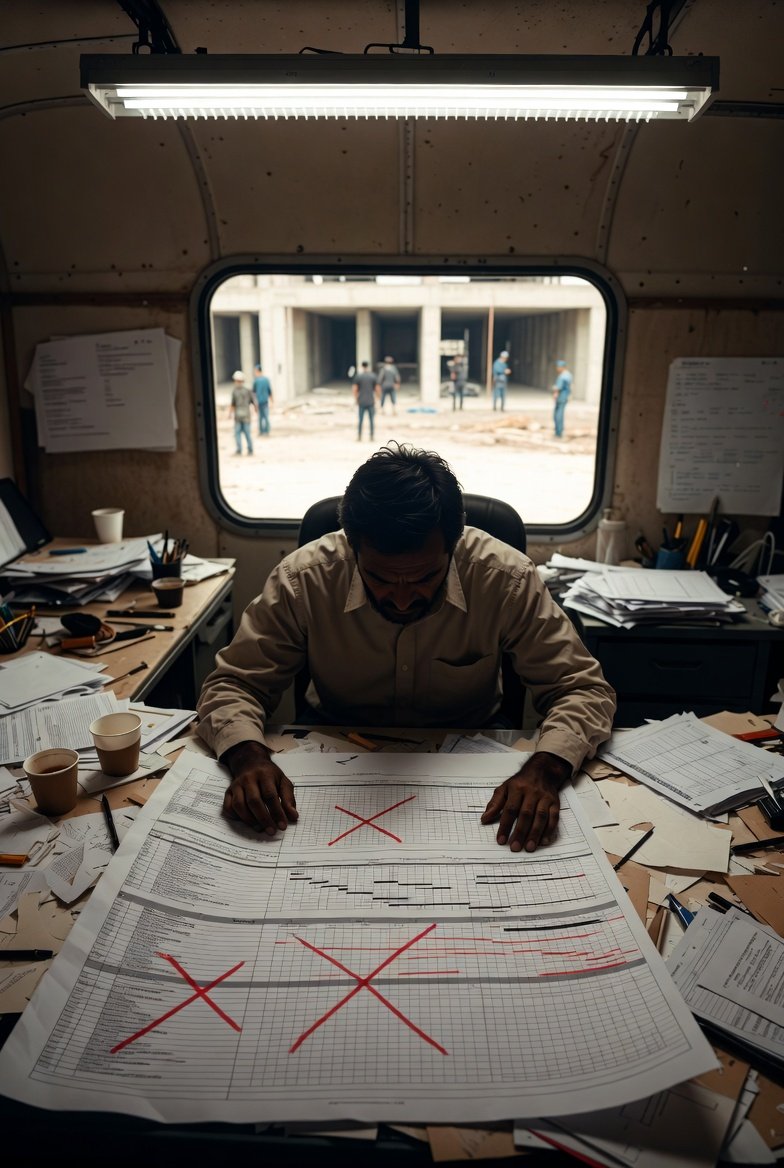
The first lookahead I ever built was garbage, and I didn't know it until Friday. I'd spent a Sunday afternoon dragging bars around, felt pretty good about myself Monday morning, and by Thursday the whole thing had come apart. Drywall was standing in a room the inspector hadn't signed off on. My painters were on site with nowhere to go. And I was on the phone lying to a PM about why we were a day behind on a job we'd barely started.
That's the thing nobody tells you about your first short-interval schedule: the format is easy, the discipline is hard. You can learn the mechanics of a three- or four-week lookahead in an afternoon. Learning to build one that survives contact with the field takes a season. Below are the mistakes I made, and the ones I've watched a hundred superintendents make since. None of them are exotic. All of them are avoidable.
Treating the lookahead as a zoomed-in master schedule
This is the original sin, and almost everyone commits it. You've got a beautiful CPM master schedule from the office. You figure the lookahead is just the next three weeks of that, blown up bigger. So you copy the bars over, change nothing, and call it planning.
The problem is that the master schedule is a promise about targets and logic. It says "electrical rough-in, level 3, weeks 14–16." It does not know that the electrician's material didn't clear the port, that the framing inspector red-tagged half the level, or that the plumber is two days behind on his top-out and hasn't cleared the walls. The master schedule is what should happen. The lookahead is about what actually can.
Build it from the field up, not the office down. Start with the question "what work is genuinely ready to go?" and sequence from there against real constraints and real crew availability. The master schedule gives you the guardrails and the milestones you can't miss. The lookahead is where you deal with the truth on the ground. Good scheduling tools let you keep the master schedule visible for context while you build the near-term plan independently — that's the relationship you want, not a copy-paste.
Activities too vague to actually work from
"Install HVAC." Okay. Which floor? Which zone? Trunk line or terminal units? Is that a two-day task or a two-week one? A foreman can't staff it, you can't measure it, and when it's 60% done at week's end nobody can agree whether that's on track.
The rule I use: an activity should be a chunk of work one crew can finish in one to three days. Not "electrical rough-in" but "electrical rough-in, units 101–104." Not "paint" but "prime and first coat, corridor B, level 2." When it's that granular, three things happen — the foreman knows exactly what he's committing to, you can see at a glance whether it got done, and the constraints jump out at you because you're forced to think about that specific piece of work.
The outer weeks of a four- or six-week lookahead can stay coarser; you don't need unit-by-unit detail four weeks out. But as work rolls into the front of the window, the detail has to sharpen. By the time an activity hits the commitment week, it should be specific enough that a stranger could read it and know what "done" looks like.
Listing work without checking whether it can happen
This is the one that burned me on that first schedule. A list of activities is not a plan. It's a wish list until you've run every line through the constraints.
Before a task earns a spot in the front of your lookahead, walk it through the checklist:
- Predecessor work complete? Not "scheduled to be" — actually done and, where it matters, inspected.
- Materials on site? Not ordered. On site, or with a delivery date you'd bet money on.
- Access and area? Is the space handed over, clean enough, and free of the trade ahead of you?
- Information? Approved shop drawings, an answered RFI, a signed change order — whatever this specific task needs to proceed without guessing.
- Manpower? Does the sub actually have the bodies, or is his crew across town on another job?
Only work that clears all of those belongs in your commitment week. Everything else lives out in weeks two and three where you still have time to break the constraint before it becomes a Monday-morning problem. That gap between "identified" and "ready" is the entire point of a lookahead — it's your runway to fix things before they cost you.
Planning alone at your desk
You are not the person who knows how long it takes to hang and finish drywall on a floor with fourteen soffits and a curved wall. The foreman doing it is. When you build the plan by yourself, every duration is a guess and half your sequences are wrong in ways you won't discover until the crew is standing in it.
Pull the trade foremen in. Ask them how long it really takes, what has to come before what, and what they see coming that you don't. The good ones will tell you things that save your week — "we can't set those units until the roofer's done above us or we'll be re-doing them." A lookahead built with the trades instead of handed down to them gets you two things: a schedule that reflects reality, and a crew that owns it because they helped make it. This is the whole idea behind the Last Planner approach — the people who do the work make the commitments.
Overloading the commitment week
Optimism is a professional hazard in this trade. You want the job moving, so you pack week one with everything you'd love to see happen. Then Wednesday hits, a delivery slips, an inspection gets pushed, and suddenly you're at 60% complete and the crews have quietly stopped believing the schedule.
Plan to what crews can actually do, including the interruptions you know are coming — the punch walk, the safety meeting, the guy who calls in. It is far better to finish 95% of a lean, honest plan than 70% of a heroic one. The number I care about is Percent Plan Complete: of the tasks you committed to, how many got fully done. Track it. If you're routinely blowing past your commitments, your week-one load is too heavy and your crews know it even if you don't. A conservative plan that hits builds trust; an aggressive one that misses every week trains everyone to ignore you.
Leaving the subs out of it
If your subcontractors never see the lookahead, you don't have a coordination tool — you have a diary. You think the plumber's clearing walls Tuesday so drywall can load Wednesday. The plumber thinks he's got until Friday. Nobody's wrong on purpose; you just never got in the same room.
Share the plan, and better yet, build it in the weekly coordination meeting with the subs at the table. Fifteen minutes of "here's what I need from you next week, here's what you need from me" prevents the collisions that eat whole days. This is exactly where scheduling software that lets subs view the current plan on their phones earns its keep — a crew leader can pull up next week's work for his trade without waiting on a marked-up PDF. That's the practical reason a mobile companion matters: the plan is only coordination if the people executing it can actually see it.
Identifying constraints and then abandoning them
Writing down "unit 201 drywall needs inspection before paint" feels like progress. It isn't, if nobody owns getting that inspection scheduled, confirming it happened, and clearing the flag. A constraint with no owner and no date is just a note about a problem you're going to have anyway.
Every constraint gets three things: a name attached to it, a need-by date, and a follow-up. Your weekly meeting should spend as much time on constraint status as on the schedule itself — "where's the inspection, where's the material, where's the RFI answer." The lookahead's real job isn't to display work; it's to surface the roadblocks early enough to clear them. If you're not chasing constraints between meetings, you're just documenting failures a week ahead of time.
Not connecting the planning levels
A lookahead floating in space is a trap. Disconnect it from the master schedule and you can hum along hitting your weekly commitments while quietly blowing a milestone that costs you liquidated damages. Disconnect it from daily crew assignments and it stays theoretical — a nice document nobody actually works from.
The lookahead is the bridge. Up top it ties to the master schedule milestones so you always know whether this week's smooth execution is actually keeping you on the big dates. Down below it feeds the weekly work plan and the daily assignments, so a bar on the schedule becomes "Miguel's crew, corridor B, Tuesday." When those levels are linked, a slip in the field shows up as a threat to a milestone immediately, while you can still do something about it.
Tracking misses without capturing why
Knowing you finished 60% of the plan tells you almost nothing. Knowing why the other 40% missed tells you everything. Was it a constraint you should've caught two weeks earlier? A trade that didn't show? A duration you lowballed? Two crews that collided in the same room?
When a task doesn't complete, log the reason before you move on. Over a month those reasons form a pattern, and the pattern is your improvement plan. If half your misses trace back to late material, that's a procurement conversation, not a crew-productivity problem — and without the reason codes you'd never know the difference. Blaming crews for a coordination failure is how you lose good crews.
Believing the software will do the work for you
I'll say the unpopular thing: buying a scheduling app does not fix your planning. A great tool used without discipline loses to a whiteboard used with it. I've seen crews run a tight, honest three-week lookahead off a wall in the jobsite trailer and outperform outfits with expensive software nobody updated past week two.
Get the process right first. Who's in the meeting? When does it happen — same time, same day, every week, no exceptions? How do constraints get identified, assigned, and chased? What happens when the plan misses? Once that rhythm is real, the right software makes it faster and shareable — rolling the plan forward, keeping the subs in the loop, tracking your PPC and reason codes automatically. Tools like LookAheadWall are built to support that discipline, but they can't manufacture it. The habit comes first; the software amplifies it.
Quitting before the curve turns
Here's the last one, and it's the reason a lot of good efforts die. The first month of short-interval planning is rough. Your PPC will probably start somewhere around 50–60% because your crews are still learning to make commitments they can actually keep. Some old-timer will grumble that he built jobs for thirty years without any of this. It is very tempting to declare it a failure and go back to running the job out of your head.
Don't. That low early PPC isn't the process failing — it's the process telling you the truth about how loose your planning used to be. Give it eight weeks before you judge it. Celebrate the small wins, keep the focus on learning instead of blame, and watch the number climb as the team gets honest about what a real commitment means. The superintendents who push through that curve end up wondering how they ever ran a job without it.
Building the habit
None of this is complicated. It's just a set of disciplines that compound. Start simpler than you think you need to — a modest three-week window done consistently beats an elaborate six-week plan you abandon. Update it on the same schedule every week. Get the foremen and subs in the room. Chase every constraint to a name and a date. And when the plan misses, ask why and write it down.
Your first lookahead will probably be a little rough, like mine was. That's fine. The point was never a perfect schedule — it's the weekly habit of looking a few weeks down the road, seeing the collisions before they happen, and clearing them while you still have time. Get that rhythm going and the rest follows.