
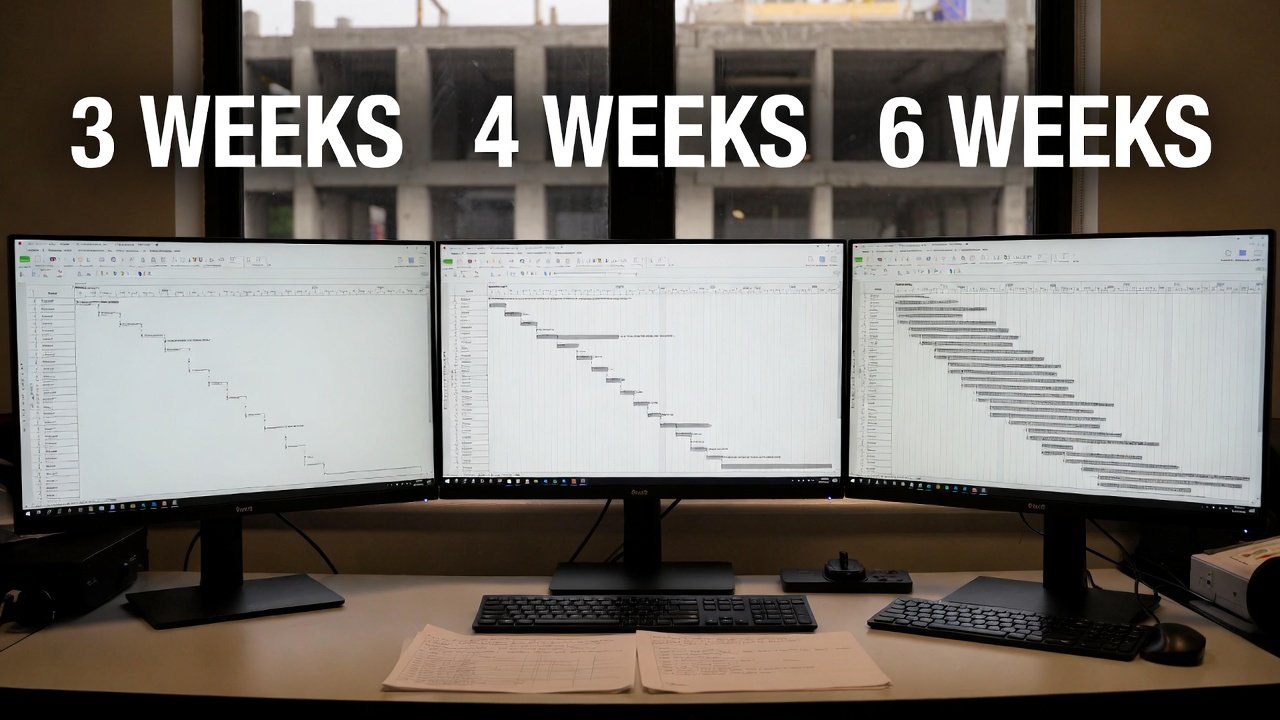
Ask ten superintendents how far out their lookahead runs and you'll get four answers: three weeks, four weeks, six weeks, and "however far I can trust it." That last one is closer to the truth than the number on the printout. Your horizon isn't a preference or a house style — it's a bet about how far into the future you can actually see clearly enough to do something about what you find. Pick it wrong and you either drown in detail that never survives contact with the job, or you get blindsided by a lead time you should have caught a month ago.
Here's how to choose the horizon that matches your job, your subs, and your procurement — and how to run it once you have.
What the horizon actually buys you
The point of a lookahead isn't to predict the future. It's to surface constraints early enough to clear them before they stop work. Every week you extend the horizon is another week of warning on a constraint — a submittal that hasn't come back, a crane that isn't booked, an inspection that needs 48 hours notice, a material with a six-week lead. But every week you extend also adds activities you have to maintain, re-sequence, and re-plan as reality shifts under them.
So the horizon is a trade between warning time and wasted planning. Too short and constraints ambush you. Too long and you spend Thursday afternoons detailing work that gets torn up before it's ever released. The right answer is the point where the warning is still worth the maintenance, and that point moves depending on what's driving your schedule.
The three-week lookahead
Three weeks is the workhorse. For a lot of jobs it's plenty, and there's a reason it's the default for lean and Last Planner shops: what you plan for week three usually still resembles what happens in week three. The predictions hold up. You're not burning labor detailing fantasy.
It fits when your lead times are short and your notice-to-sub is short. Tenant improvements, renovations, most residential, interiors work where the long pole is a couple weeks of casework or a lighting package that's already ordered — three weeks catches it. Crews that can mobilize on two weeks' notice fit inside a three-week window comfortably.
Where three weeks bites you is procurement and coordination that need a longer runway. If you've got custom millwork at ten weeks, switchgear at sixteen, or an air handler that ships in eight, three weeks is useless for those items — by the time they enter the window, the order needed to be placed a month ago. Three weeks also gets tight on multi-party coordination: an RFI that has to route through the architect, the engineer, and the owner rarely closes in fifteen working days. So run three weeks when the rhythm of your work is fast and short-cycle, and back it up with a separate procurement log for anything with a real lead time. The lookahead handles the near work; the log handles the long poles the lookahead can't see.
The four-week lookahead
Four weeks is the honest middle, and if I had to pick one horizon for a general contractor's first lookahead, this is it. The extra week buys you two things that matter.
First, it lands on a monthly rhythm. Pay apps, owner reporting, and most sub billing run monthly, and a four-week window means the schedule and the money are looking at roughly the same stretch of work. That alignment saves arguments.
Second, it gives subs a full four weeks of notice, which is what most trade partners actually need to commit a crew rather than promise one. Three weeks gets you "we'll try." Four weeks gets you a name and a headcount. If you've ever had a drywall crew show up half-staffed because you gave them thirteen days instead of a month, you know exactly what that week is worth.
Four weeks covers materials in the three-to-five-week band, which is a lot of ordinary construction — doors and frames, standard fixtures, most rebar and embeds. It's the right call for commercial shell-and-core, office and retail buildouts, schools, and institutional work with moderate complexity. What it still won't cover is genuinely long-lead equipment, and that's fine — nothing short of a very long horizon covers that, and you shouldn't try to solve procurement with schedule length. You solve it with a submittal and procurement log that runs its own timeline.
The six-week lookahead
Six weeks is a specialist tool, not a default. It exists because some jobs have coordination and mobilization needs that genuinely take that long to work, and running short on those jobs means you find out too late.
Healthcare with dense MEP overhead, data centers, industrial work with rigging and heavy equipment moves, anything where a single activity depends on three approvals and a factory witness test — those benefit from six weeks of visibility because the make-ready work itself takes weeks. Booking a crane pick, sequencing an overhead MEP corridor so the mechanical, plumbing, electrical, and fire trades don't fight over the same ceiling space, staging an equipment set that needs the wall left open — that coordination wants a month-plus of lead, and six weeks gives you room to run it.
But be honest about the cost. Six weeks is roughly double the maintenance of three. Twice the activities to keep current, twice the constraints to chase, and the outer weeks are the least reliable — work you detail for week six frequently gets re-sequenced before it's released. The failure mode I see most often with six-week lookaheads is a beautiful outer two weeks that nobody actually updates, so it rots. A six-week window that's stale past week four is worse than an honest four-week window, because it looks like planning while lying to everyone reading it.
The real deciders
Forget the sector defaults for a second. Four things should actually set your horizon:
- Your longest live lead time — sort of. The instinct is "make the horizon cover your longest lead item." Resist it. If you've got sixteen-week switchgear, you are not running a sixteen-week lookahead. Long-lead procurement belongs in a submittal/buyout log, not the weekly lookahead. Size the horizon to the lead times you can realistically act on weekly — usually four to six weeks — and let the procurement log carry the rest.
- Sub notice requirements. Call your three or four most critical trades and ask how much notice they need to commit a full crew. Your horizon should be at least that long. If your steel erector needs four weeks and you're running three, you're structurally set up to get shorted on manpower.
- Change frequency. Volatile scope — heavy owner changes, unresolved design, a job still catching RFIs daily — argues for a shorter horizon, not a longer one. There's no point detailing week six when week two keeps getting rewritten. Stabilize the design, then extend.
- Team discipline. The horizon you can maintain beats the horizon you wish you ran. A crisp three-week lookahead updated every single week delivers more than a six-week lookahead touched twice a month. Start shorter than you think you need and earn the right to extend.
How the weeks should feel different
Whatever length you pick, the weeks inside it shouldn't all carry the same weight. A good lookahead reads like a funnel — loose and screening at the far end, locked and committed at the near end. Here's the maturity I look for week by week:
- Week 1 — committed. Constraints cleared. Crew named, materials on site, predecessors done, inspections lined up. This is what flows into the weekly work plan. If it's not clean, it doesn't belong in week one.
- Week 2 — nearly ready. Material en route with a confirmed date, crew committed, last coordination happening. Any open constraint here should have a name and a due date on it.
- Week 3 — constraints identified, owners assigned. You know what could stop this work and who's clearing it. Resolution is underway, not finished.
- Weeks 4–6 — screening. First pass on constraints. Long-lead flags raised, major coordination identified, but detail is deliberately coarse. Don't over-plan out here; it won't survive.
The discipline that makes this work is the make-ready pass: every week, you walk the future weeks and ask one question per activity — what has to be true before this can start, and who's making it true? That question, asked out loud in a weekly pull-planning meeting with the trades in the room, is where a lookahead earns its keep. The horizon length just sets how far ahead you ask it. Good lookahead software — LookAheadWall included — helps here by carrying each unresolved constraint forward week to week so nothing quietly falls off the list, but the tool doesn't do the asking. You do.
Run a hybrid — most good jobs already do
The either/or framing is a little false. The strongest setup I've run is a tight, fully-detailed inner window with a coarse outer window layered on top: three weeks of real, crew-and-material detail, plus a rough look at weeks four through six showing only the majors — the sets, the ties, the phase changes, the long-lead deliveries landing. You get advance warning on the big stuff without paying to maintain full detail on work that's going to move anyway.
You can also vary by activity. Critical-path and high-coordination work earns the six-week look; routine, repetitive, low-risk work rides the three-week window. And expect the horizon to breathe across the job — heavy in early procurement and structure, then tightening up as you get into fast-cycle finishes where a three-week window is all the visibility the work needs or rewards.
A field test for whether you got it right
Don't agonize over the choice up front. Pick three or four weeks, run it hard for a month, then check two things:
If constraints keep ambushing you — material showing up unordered, subs surprised, inspections missed for lack of notice — your window's too short or your make-ready pass is too shallow. Extend a week, or tighten the pass. If the outer weeks sit empty or never change from update to update, you're carrying horizon you're not using — pull it in and put that hour back into the near weeks where it pays off.
The number on the printout was never the point. A three-week lookahead you actually update every Thursday, with the trades in the room clearing constraints on next week's work, will out-deliver a six-week masterpiece that nobody trusts. Match the horizon to what's really driving your schedule, keep the procurement log running alongside it for the long poles, and hold the discipline of the weekly pass. That's the whole game — the rest is just how many columns you print.