
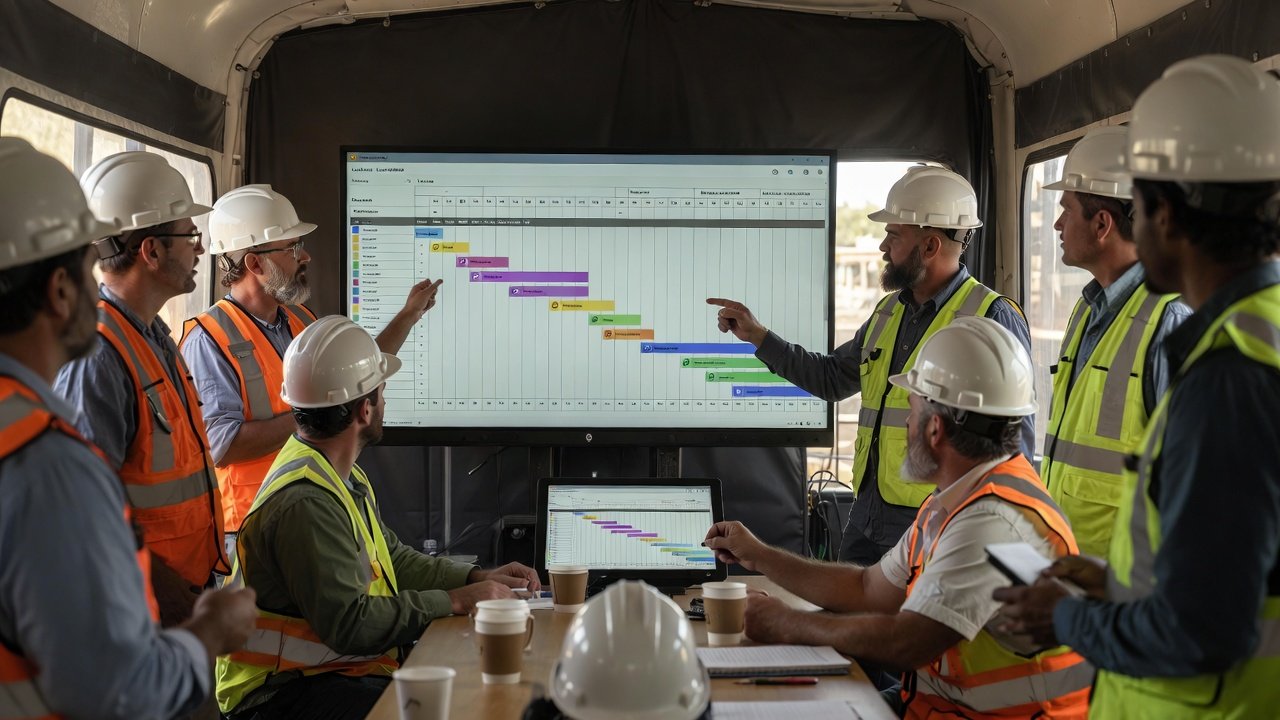
The Best Schedule on the Job Is the One People Actually Believe
I've watched superintendents build gorgeous three-week look-aheads in the trailer, print them on the big plotter, tape them to the wall, and then stand there baffled when the drywall crew shows up three days early to a room that's still open. The schedule wasn't wrong. Nobody believed it.
That's the part the software brochures skip. Durations, dependencies, and float are the easy half. The hard half is human: whether a foreman trusts the plan enough to stage his material around it, whether he'll tell you on Tuesday that he's short two guys instead of hoping you won't notice on Friday, whether the plumber and the electrician will actually sequence around each other in that mechanical room or just both show up and start swinging. Good look-ahead scheduling works because it changes behavior, not because it changes the spreadsheet. Here's what's actually happening under the hood, and how to use it.
Ownership: The Difference Between Being Told and Being Asked
There's a real, measurable shift that happens when a trade foreman helps build the plan instead of receiving it. Hand a plumbing foreman a date and he'll treat it as your problem. Ask him "what can you realistically get done in the mechanical rooms next week, and what has to be true for that to happen?" and he starts treating the answer as his promise.
The mechanism is simple: people defend plans they helped create and quietly resent plans imposed on them. So in your weekly work plan meeting, stop reading dates to the room. Ask each foreman what he's committing to for the coming week and write down his number, not yours. It'll feel slower the first two weeks. Then the plan starts predicting reality, because the people doing the work set the pace.
A word of warning here, because I've seen this go sideways: collaborative planning is not a democracy where the schedule bends to whoever complains loudest. Your job is to hold the milestones and the sequence. Their job is to tell you honestly what fits inside them. When those two things collide, that's the conversation you needed to have three weeks early instead of the fight you'd otherwise have on the day.
Why Three to Four Weeks Is the Honest Horizon
The three-week and four-week window everyone uses isn't arbitrary tradition. It matches how far out people can actually think about specifics. Ask a foreman what he's doing next Tuesday and you'll get a real answer with real constraints. Ask him what he's doing on a Tuesday nine weeks from now and you'll get a shrug dressed up as a commitment.
That's the sweet spot short-interval scheduling lives in: close enough that the work is concrete and constraints are visible, far enough that you still have time to fix them. Week one should be firm — vetted, staged, ready. Weeks two and three are you clearing the path: chasing submittals, confirming material delivery dates, making sure the inspection gets called. Anything past about six weeks belongs on the master schedule, not the look-ahead. Push the look-ahead out to six or eight weeks of daily detail and you're not planning, you're doing astrology, and the crews will figure that out fast and stop reading it.
Keep the near term detailed and the far term deliberately fuzzy. That's not sloppiness — it's honesty about what you actually know, and honest plans get followed.
Make-Ready: Ask "What Has to Be True," Not "When"
The single most valuable habit in look-ahead planning is flipping the question. Traditional scheduling asks "when does this happen?" Effective planning asks "what needs to be true for this to happen — and is it true yet?"
That's the make-ready process, and it's where look-aheads earn their keep. Before an activity is allowed into your firm week, walk it against the constraint list:
- Prerequisite work — is the work in front of it actually complete, or just "basically done" (which means not done)?
- Materials — on site, or promised by a supplier who's already slipped twice?
- Information — is there an open RFI or an unapproved submittal hiding under this task?
- Labor and equipment — right headcount, right skills, and is the lift or the pump actually available that day?
- Permits and inspections — is the inspection called, and does your inspector need 48 hours notice?
- Space and access — can two trades physically work that area at once without one standing on the other's head?
Any activity with an open constraint does not belong in the committed week. It stays in the backlog until the constraint clears. This is the discipline that separates crews who hit 45% of their plan from crews who hit 85%. It also quietly moves your whole team from reactive to proactive, because you stop explaining why work didn't happen and start guaranteeing it can. Software that forces you to name and clear constraints before an activity goes firm — LookAheadWall's trade-flow and weekly-plan views are built around exactly this — mostly just keeps you honest about a habit you should be running anyway.
Commitments Made Out Loud Get Kept
There's a reason to run the plan review as a meeting with everyone in the room rather than an email blast. A commitment a foreman makes in front of his peers carries weight a date in a spreadsheet never will. When the electrical foreman says out loud that rough-in in the east wing is done by Wednesday so drywall can load Thursday, he's not giving you information — he's making a promise to the guy sitting across the table who's now planning his week around it.
That social pressure is real and it's useful, as long as you keep it about clarity and not about shame. The point isn't to put anyone on the spot. It's that when everyone can see who's waiting on whom, abstract dependencies become concrete obligations between people who have to look each other in the eye next week. A schedule that only lives on the GC's laptop can't do that. A shared plan the subs can actually see — on the wall, on their phones, in the app the crew leads carry — turns the sequence into something the whole team owns.
Track Reliability, Not Blame
Start measuring how often committed work actually gets completed — the Last Planner crowd calls it Percent Plan Complete, and even a rough version of it changes behavior. Count the tasks committed for the week, count how many finished, and there's your number.
Here's the part most people get wrong: when that number is low, the problem is almost never lazy workers. Low completion means the planning broke down — someone committed to work with an open constraint, a prerequisite slipped, two trades got stacked in the same room. The moment you use these numbers to single out a foreman in front of the group, two things happen. The number goes up, and it becomes a lie. People start committing to only the safe, obvious stuff and padding everything, and you lose the early warning that made the metric worth tracking.
So run the variance review as a "why" session, not a courtroom. Every missed commitment gets one question: what got in the way? Do that consistently and patterns surface — this supplier is always late, that inspection always needs more lead time, this foreman is chronically optimistic by about a day. That accumulated knowledge is what makes each week's plan tighter than the last. The data is only valuable if people aren't afraid of it.
Psychological Safety Is Not Soft — It's the Whole Game
Everything above collapses if the people on your job are afraid to tell you the truth. A foreman who thinks bad news gets him chewed out will make cheerful, unrealistic commitments and sit on emerging problems until they detonate. And a problem you hear about on the day is a crisis; the same problem heard about two weeks out is just a scheduling adjustment.
You set that tone, and you set it in how you react to the first piece of bad news you get. Respond to "we're not going to make Wednesday" with problem-solving — can we re-sequence, can we add a crew, can we start the next area — and you'll get the next warning early too. Respond by lighting the guy up in front of the room, and you just bought yourself a project's worth of pleasant surprises that aren't. Admit your own planning misses out loud when they happen; nothing gives a foreman permission to be honest faster than watching the super do it first.
Respect the Guy Who Actually Does the Work
Nobody on the planet knows better than the framing foreman how long those specified shear walls are going to take, or than the plumber how much extra coordination the prefab racks need. When you build the look-ahead with those people instead of handing them dates, you're pulling in knowledge that exists nowhere else — not in the estimate, not in the master schedule, not in your head.
And the payoff runs deeper than an accurate week. Foremen who feel heard flag problems earlier, talk more, and go to the mat for a plan they helped write. That's the entire return on collaborative planning: not a prettier chart, but a crew that treats the schedule as theirs.
Make It a Habit, Then Get Out of the Way
None of this works as a one-time gesture. The value comes from the weekly rhythm — same meeting, same day, same questions — until thinking in constraints and commitments stops feeling like a process and starts feeling like how the job is run. It takes a few weeks to stick. The first couple of meetings will feel clunky and you'll be tempted to go back to reading dates off a printout. Don't.
The tools help, and they should — a shared look-ahead your subs can actually open, a mobile view your crew leads carry, trade-flow sequencing that makes the hand-offs impossible to miss. But be clear about what's doing the work. The software removes friction so the habit is easy to keep. The habit is what delivers the job. Build the plan with the people doing the work, ask what has to be true before you commit anything, make the promises out loud, track whether they held without turning it into a witch hunt, and keep everyone safe enough to tell you the truth. Do that, and you're not just scheduling activities. You're running a crew that believes the plan — and a plan people believe is the only kind that finishes on time.