
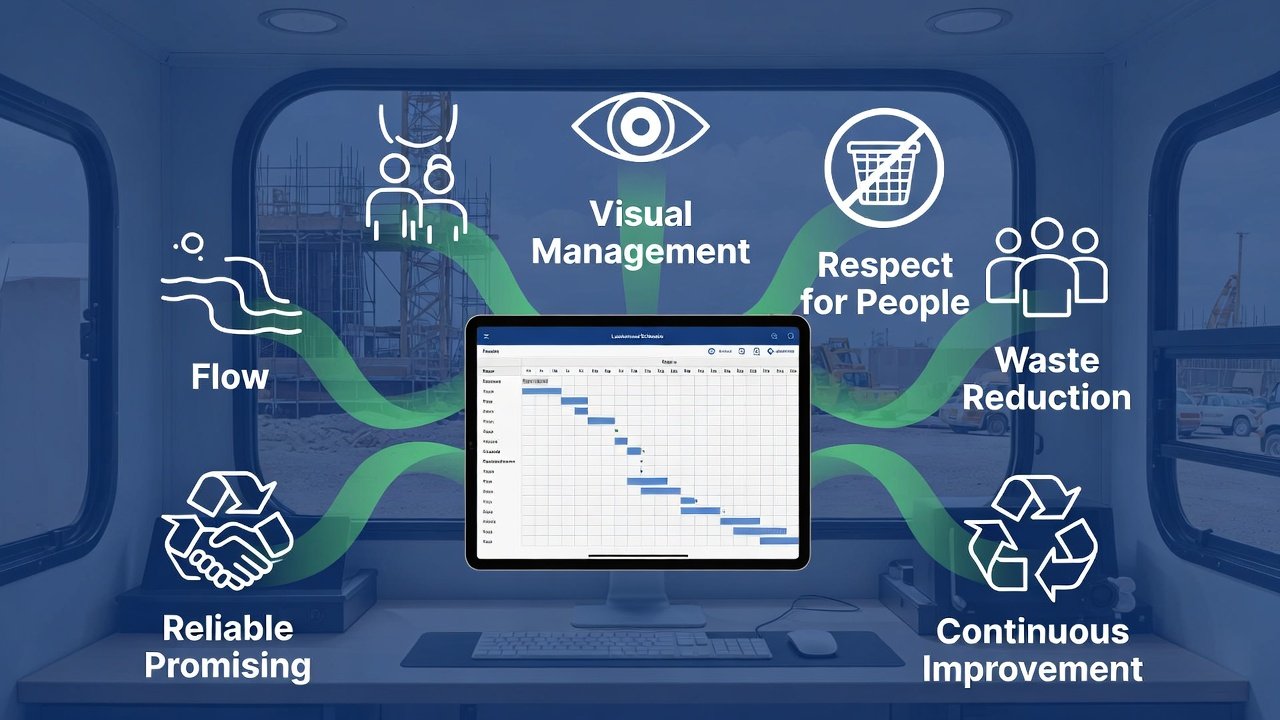
Lean isn't a binder on the shelf — it's how you plan the next three weeks
Most guys hear "lean construction" and picture a consultant with a slide deck talking about Toyota. Fair enough. But strip away the vocabulary and lean is just a disciplined answer to the question every superintendent already asks on Monday morning: what can we actually get done this week, and what's going to stop us? The lookahead schedule is where that question gets answered. If you're running a rolling three- to six-week lookahead and holding a real weekly work plan meeting, you're already doing lean whether anyone put that word on it or not.
The connection isn't marketing. The Last Planner System — the framework behind modern lookahead planning — was built as lean construction from the ground up by Glenn Ballard and Greg Howell in the '90s. Pull planning, make-ready, weekly commitments, Percent Plan Complete: those aren't separate ideas bolted onto scheduling. They are the lookahead, done right. So let's talk about what that looks like on a live job instead of in the abstract.
Waste on a jobsite is mostly waiting, and the lookahead is where you kill it
Lean talks about seven or eight kinds of waste. On a construction site, the one that eats your schedule alive is waiting. A crew shows up ready to work and the deck isn't poured, or the RFI hasn't come back, or the material's still on a truck in Ontario. That's a fully manned crew standing around at loaded labor rates, and it's the most expensive thing that happens on a jobsite that nobody puts on a cost report.
Here's the thing about waiting: you almost always could have seen it coming two or three weeks out. That's the entire point of the make-ready window. When an activity enters your lookahead — say, three weeks before it's supposed to start — you screen it against the usual constraints:
- Material — is it ordered, is the lead time real, do you have a confirmed delivery date and not a salesman's "should be fine"?
- Information — approved submittal, current drawing, closed RFI, agreed-on detail?
- Prerequisite work — is the predecessor trade actually going to be complete, or complete-except-for-the-punch-that-blocks-you?
- Labor and equipment — right crew size, right lift or pump available that week and not double-booked on the other tower?
- Access, permits, inspections — is the area released, is the inspector scheduled, is the safety plan in place for that scope?
An activity doesn't earn a spot on the weekly work plan until every one of those is clear. That's the difference between a schedule and a wish. A bar chart says drywall starts the 14th. Make-ready asks whether the framing inspection will pass, whether the board is on site, and whether the electrician actually finished his rough-in and got it signed off — and if any answer is no, that activity stays out of the commitment window until somebody owns the fix. You've converted a future crew-standing-around problem into a phone call you make today.
Pull planning: build the sequence backward, then let the lookahead protect it
The instinct on most jobs is to push — start at today and shove work forward as fast as each trade can go. Lean pulls instead. You put the milestone on the wall (say, "Level 3 ready for MEP rough-in, October 6"), get the foremen who own that scope in a room, and work backward. The drywall guy says he needs the deck poured and cured. The plumber says he needs the sleeves set before the pour. The layout guy says he needs approved coordinated drawings before he touches anything. Each trade pulls the work it needs from the trade ahead of it, and you build the real sequence out of what the people doing the work actually say, not what the office guessed.
Pull planning is a great afternoon with sticky notes. The problem is Tuesday. Reality moves, a pour slips, a submittal bounces — and that beautiful wall of sticky notes is now fiction. This is exactly where the lookahead earns its keep: it's the living document that carries the pulled sequence forward and re-screens it every single week. The phase pull plan sets the logic once; the rolling lookahead keeps it honest as conditions change. Tools like LookAheadWall exist for precisely this handoff — you build the trade-flow sequence visually, by location, and it stays connected week to week instead of dying on the conference-room wall the day after the pull session.
Reliable promising is the whole game
If I had to teach a new super one lean idea, it'd be this: a commitment is a promise, and the value of your weekly work plan is exactly the reliability of the promises in it. A schedule full of activities nobody truly committed to is worthless — worse than worthless, because everyone downstream is planning around promises that were never real.
So the weekly work plan meeting isn't a status update. It's a commitment ceremony. Each foreman looks at the make-ready-clean activities for the coming week and says out loud, in front of the other trades, "yes, my crew will complete these specific tasks by Friday." Not "we'll make progress." Not "we'll try." Specific work, specific quantity, specific done-by date. And critically, a foreman is allowed to say no. If the plumber knows he's short two men Thursday, the right move is to not commit to Thursday's work — because a promise everyone knows is fake corrupts the whole plan. Reliable promising means you'd rather commit to less and hit it than commit to everything and blow half of it.
The payoff compounds. When the drywall foreman can trust that the framing and rough-in commitments in front of his scope are real, he can staff and stage with confidence. When those promises are garbage, he pads, he holds crew back, he no-shows to avoid getting stuck — and now his unreliability is feeding the guy behind him. Reliable promising is how you break that chain. It's also, not coincidentally, how you keep subs wanting to work for you.
Percent Plan Complete: the one number that tells you if your planning is real
Here's where lean gives you a scoreboard most jobs never keep. Percent Plan Complete is dead simple: of the tasks you committed to this week, what fraction did you actually finish? Committed to 40, completed 34, that's 85% PPC. That's it.
What makes PPC powerful is what it measures. It's not "are we on the master schedule" — it's "is our planning trustworthy." A crew can be wildly busy and productive and still run 50% PPC, which tells you your planning is broken even when your production looks fine. Most jobs live around 50–60% PPC when they start tracking, and honestly that's typical. Get a disciplined team consistently into the 80s and the job feels completely different — fewer fire drills, fewer surprised trades, fewer Fridays that fall apart.
But the number alone changes nothing. The gold is in the misses. Every task that didn't complete gets a reason for variance, and you keep it short and honest — material late, prerequisite not done, RFI open, weather, crew pulled to another job, bad estimate. Log those reasons for a few weeks and the pattern jumps out. When you see the same root cause three weeks running — say, submittals always coming back late from one office — you've found a process to fix, not a person to blame. That's continuous improvement with teeth: the weekly cycle turns each miss into next week's fix instead of just another late line item.
The people closest to the work do the planning
The other half of lean that construction constantly forgets: the foreman knows things the office doesn't. He knows his crew hangs board faster on open floors and bogs down in the tight corridors. He knows the real cure time in November versus July. He knows which inspector wants what. "Last Planner" is literally named for him — the last person who plans before work happens, the one whose commitment is the one that counts.
A weekly work plan that a superintendent hands down as a finished document gets nodded at and ignored. One that the trades build together — arguing out durations and sequences and hand-offs in the room — gets owned, because it's theirs. That's not soft stuff. Plans built by the people who execute them are more accurate and more likely to actually happen. When your scheduling tool gives every foreman visibility into the sequence around his scope and a real seat in building it, you get both.
Make the status visible or it festers
Lean shops run on visual management — you should be able to walk up to a board and see what's ready, what's blocked, and why, in about five seconds. Construction schedules usually do the opposite: they bury status in a 400-line bar chart that three people can read and nobody looks at. A good lookahead flips that. Location-based, color-coded, constraints flagged on the face of it — you can see at a glance that the third floor east is ready to go and the west is jammed waiting on an inspection. When the problem is visible, somebody fixes it. When it's hidden in a report, it sits there quietly turning into next month's crisis.
The practical version, for anyone allergic to the word "lean"
You don't have to buy into any philosophy to get the benefit. Strip the vocabulary and it comes down to a handful of habits that pay off on any job:
- Screen work for constraints two to three weeks out, and don't commit to anything that isn't make-ready.
- Build your sequences by pulling backward from milestones with the foremen who own the work.
- Make specific, real commitments each week — and protect the right to say no.
- Track Percent Plan Complete and, more importantly, the reasons for every miss.
- Fix the recurring root causes instead of re-fighting the same fire, and keep the whole thing visible.
Do those things and you're running lean, label or not. The rolling lookahead is where all of it lands — the make-ready screening, the pulled sequence, the weekly commitments, the PPC scoreboard, the variance you learn from. Lean gives you the why; the lookahead is the how you run every Monday. Get that loop turning and the job stops feeling like you're reacting to chaos and starts feeling like you're a week or two ahead of it. That's the whole point.