
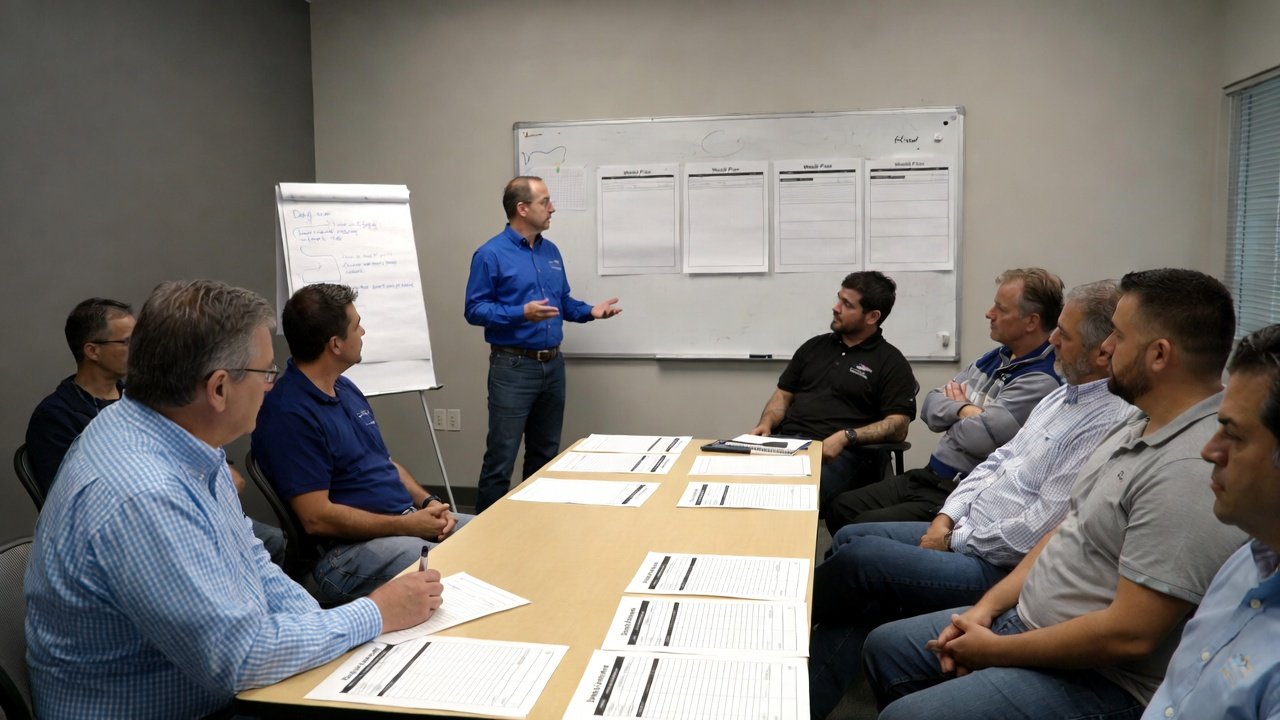
Most crews already do weekly planning. It just happens in the truck at 6:15 on Monday, in somebody's head, and it lasts until the first inspection fails or a delivery shows up a day late. Building a real weekly work plan process from scratch isn't about inventing planning where none exists. It's about dragging what's already in the foreman's head onto a wall where everyone can see it, argue with it, and be held to it.
I've stood up this process on jobs where the whole idea got eye-rolls in week one. The trick is not to arrive with a binder and a system. Nobody adopts a system. They adopt a habit that makes their Friday less miserable. Here's how to build that habit in a way that actually sticks.
Understand what you're really building
A weekly work plan answers one question for every crew on site: what will you actually finish this week, and is it truly ready to be worked? That second half is where most schedules fall apart. It's easy to write "hang drywall, Level 2" on a plan. It's another thing to know the electrical rough is signed off, the insulation inspection passed, and the board is on the deck and not still on a truck in Fontana.
So you're building two things at once: a short list of honest weekly commitments, and a habit of checking whether work is ready before anyone commits to it. Get those two running and the rest is refinement.
Weeks 1 through 4: get the meeting and the commitments right
Don't roll out constraint logs, make-ready lookaheads, and variance analysis on day one. You'll drown the crew and the whole thing dies. Start with the smallest version that produces value.
Set a fixed meeting and defend it
Pick a day and time and never move it. Thursday afternoon or Friday morning both work well, because you want next week's plan locked before the weekend, not scrambled together Monday at dawn. Forty-five minutes, standing, in the trailer or in front of a board. Superintendent runs it, foremen attend, and the key trade leads for the coming week are in the room or on the phone. If a foreman sends a laborer who can't commit on his behalf, the meeting is worthless. The people who make the commitments have to be the ones in the chairs.
Make every foreman commit out loud
Go around the room. Each foreman says what his crew will complete in the coming week, stated as finished, inspectable work, not effort. "Complete rough plumbing on the north wing, levels 1 and 2, ready for inspection Thursday" is a commitment. "Work on plumbing" is not. Write it where everyone can see it. A whiteboard works. A shared visual plan works better because it survives the meeting and everyone can pull it up midweek. This is the whole point of a proper weekly work plan tool, whether that's a wall of magnets or something like LookAheadWall where the plan lives by location and stays visible to the subs all week.
Keep it to work you genuinely believe will finish. A foreman who commits to five days of work knowing three will slip is training the whole room to treat the plan as fiction. Better to commit to what's real and beat it.
Review last week before you plan next week
By week two you add the most important habit in the entire system: before anyone commits to next week, you review what actually got done against what was promised. For each commitment, it either completed or it didn't. Count the ones that hit. That's your Percent Plan Complete, and it is the single number that tells you whether your planning is honest.
A new crew often lands around 50 percent. That's normal and it's not a scolding session. The number isn't a report card on the foreman; it's a thermometer for the plan. The valuable part is the next question.
Weeks 5 through 8: start looking ahead and naming what's in the way
Add a two-to-three week lookahead
Once the weekly commitment rhythm is steady, pull the horizon back. In the same meeting, walk the next two or three weeks of work at a coarser grain. You're not committing to it yet. You're surfacing it early enough to do something about the things that aren't ready. A rolling look-ahead is just organized worry: it forces the question "what's coming, and what will bite us when it arrives?" while there's still time to fix it.
Ask the make-ready question on everything upcoming
For every activity in that look-ahead window, ask: what has to be true before a crew can start this cleanly? Those preconditions are constraints. The usual suspects on any job:
- Predecessor work complete and inspected (you can't hang board over an open electrical rough)
- Materials on site, or with a confirmed delivery date that beats the start
- Design questions closed: RFIs answered, submittals approved, no pending change to the scope
- Inspections and sign-offs scheduled, with the inspector actually booked
- Access and prerequisites: power, temporary heat, a dry slab, a crane window, the deck cleared of the last trade's junk
- Manpower confirmed by the sub, not assumed
Write each constraint down, name the one person who owns clearing it, and put a need-by date on it. A constraint without an owner and a date is just a complaint. The discipline is boring and it is exactly what separates crews that hit 85 percent from crews stuck at 55.
Weeks 9 through 16: only commit to ready work
Now you close the loop. The rule becomes: an activity does not go onto the weekly work plan until its constraints are cleared. This is the hinge the whole system turns on. If plumbing rough isn't inspected and drywall's constraint is "electrical and plumbing signed off," drywall does not get committed for next week. It stays in the look-ahead as work you're still making ready.
This feels like it slows you down. It doesn't. What actually slows you down is a crew mobilizing to a work area that isn't ready, standing around for two hours, then demobilizing to somewhere else and losing the afternoon to the move. Committing only ready work is how you stop paying crews to discover the work isn't ready.
A practical rule of thumb on sequencing: leave a buffer between trades that hand off to each other. Frame-to-rough-in usually wants a day or two so the area can be cleaned and inspected before the next trade shows up. Don't schedule mud and tape to start the same morning the last electrical device goes in. Those tight handoffs look efficient on paper and blow up the first time an inspection slips half a day.
Bring the subs in as owners, not spectators
Around this same stretch, stop planning the subs' work for them and start planning it with them. The trade foreman who's actually going to run the crew makes his own commitment in the meeting. It's a different level of buy-in when a sub says "I'll have the north wing roughed by Thursday" in front of his peers versus when the GC writes it on a schedule and hopes.
This is also where trade-flow sequencing earns its keep. When you can see the handoffs laid out by location, drywall following framing following rough-in through each area, everyone in the room sees whose finish is somebody else's start. The mechanical foreman understands that his one-day slip is the drywall crew's lost week. That shared picture does more for coordination than any amount of nagging. A location-based plan that shows trade flows, on a wall or in software built for it, makes those dependencies impossible to ignore.
Weeks 17 and beyond: learn from the misses
By now you have months of PPC numbers and a pile of missed commitments. Turn them into learning. For every activity that didn't complete, record why in plain categories: prerequisite work not done, materials late, weather, design change, manpower short, equipment down, or the classic "we overcommitted." Don't overthink the taxonomy; six or seven buckets is plenty.
Then read the pattern, not the individual miss. If a third of your misses trace to late materials, your problem isn't planning discipline, it's procurement and your make-ready horizon is too short to catch long-lead items. If misses cluster on one sub, that's a conversation to have directly. If they cluster on a specific work area, go look at whether that area has an access or sequencing problem nobody's naming. The variance reasons are where the real superintendent work lives. PPC tells you that you're missing; the reasons tell you what to fix.
The mistakes that kill a new process
- Too much, too fast. Full constraint logs and variance analysis in week one buries a crew that hasn't even mastered honest weekly commitments. Sequence the rollout the way you sequence the work.
- Padding commitments. Foremen who commit soft, then always "beat" the plan, hollow out the whole exercise. You want honest commitments and an honest PPC, even when it's ugly.
- Moving the meeting. The first time you skip or reschedule because you're busy, you've told everyone it's optional. It isn't.
- Treating PPC as a scorecard. The minute foremen think a low number gets them chewed out, they'll game it. It's a diagnostic, and you have to protect it as one.
- Committing to unready work. The single most common relapse. Discipline on this one rule drives most of the improvement.
What good looks like, and how long it takes
Give it a real timeline. Month one, you'll have a steady meeting and honest commitments, and a PPC that's probably mediocre and that's fine. Months two and three, the look-ahead and constraint thinking take hold and you start clearing problems before they land on you. Months four through six, make-ready is routine and the subs are committing their own work. From there it's refinement forever.
You'll know it's working before the PPC even climbs. Attendance holds without anyone chasing people down. Foremen start walking into the meeting with their own constraints already logged instead of waiting to be asked. The 6:15 truck scramble goes quiet because Friday already answered Monday's questions. The number rises after that, usually into the 80s once make-ready is honest, but the culture shift shows up first.
None of this requires software to start. A whiteboard and a disciplined superintendent will get you a long way. What software buys you is that the plan survives the meeting, the subs can see their work all week without walking to the trailer, and the trade flows and constraints don't live in one person's memory. Whether that's LookAheadWall or a wall of sticky notes, the tool serves the habit. Build the habit first. Start with an honest weekly commitment and one number, and let the rest grow from there.