
On any commercial or multi-family job, you're not really building a building. You're building a schedule that fifteen different companies have to agree to live inside, and most of them have never met each other. The GC signs the prime contract and takes the risk, but the actual work belongs to subs — framers, MEP trades, drywall, flooring, glaziers, paint. Your weekly work plan is the document where all of that either comes together or quietly falls apart.
I've watched superintendents treat the weekly plan as a broadcast — print it, tape it to the trailer window, and expect the trades to fall in line. That's not coordination, that's a wish list. Real coordination is a negotiation you run every week, and the plan is the record of what everyone actually committed to. Here's how the good ones do it.
The plan is a set of promises, not a set of orders
The single biggest shift that separates a working weekly plan from a decorative one is who makes the commitment. If you fill in the plan yourself — "drywall hangs 3rd floor Monday, tapes Wednesday" — you've made a promise on someone else's behalf. When it slips, and it will, the sub shrugs because it was never their number.
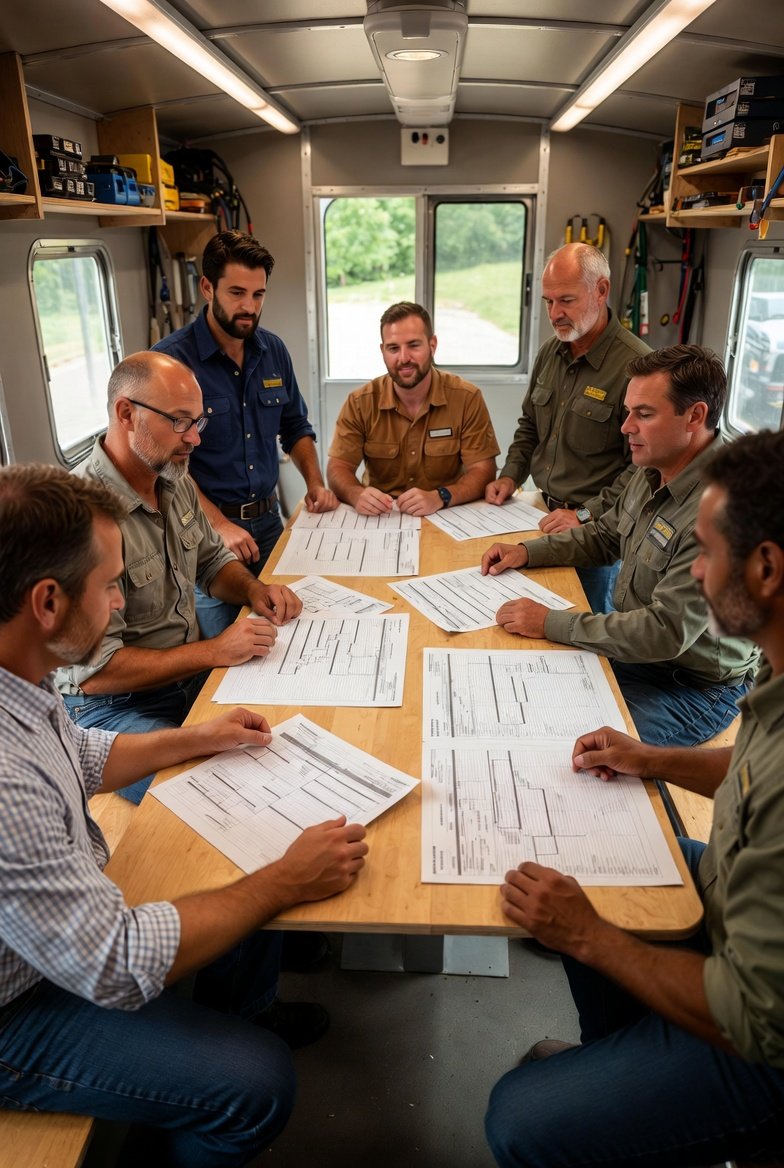
Flip it. In your weekly coordination meeting, the drywall foreman tells you what he'll finish and by when, out loud, in front of the other trades. Now it's his word, and the electrician sitting across the table heard him give it. That social weight does more for reliability than any email chain. A weekly work plan built from the crews' own commitments — the core idea behind short-interval scheduling and the Last Planner approach — consistently outperforms a plan handed down from the trailer, because the people doing the work own the numbers.
The rule of thumb: don't put a task on the board that a specific foreman hasn't verbally agreed to. If nobody will commit to it, it's not ready, and pretending otherwise just buys you a variance next Friday.
Make work ready before you plan it
Most missed commitments aren't the sub's fault. They're yours — or the project's — because the work was never actually ready to be done. Before any task earns a slot in the week, walk it against the constraints that reliably kill trades:
- Predecessor complete and accepted — not "mostly done," accepted. Rock is hung and inspected before tape shows up. Rough-in is signed off before you close the wall.
- Material on site and staged — not "on order," physically here, in or near the zone, counted.
- Information in hand — the RFI is answered, the ASI is in the field set, the shop drawing is approved. Framing to a detail that's still "under review" is how you build it twice.
- Access and space — the area is clear, the lift is available, the trade ahead has actually vacated.
- Manpower confirmed — the foreman has the bodies, not the bodies he hopes to have if the other job releases them.
A task that fails any one of these isn't a plan item, it's a constraint you need to knock down first. The discipline of screening work for readiness a few weeks out — the whole point of a rolling look-ahead — is what keeps your weekly plan from filling up with wishful thinking. If you're doing that screening on paper or in a spreadsheet, you'll lose track; a proper look-ahead tool like LookAheadWall exists precisely so constraints get flagged before they hit the week, not after.
Sequence trades by flow, not by trade
Amateurs schedule by trade — "this is electrical week." Superintendents schedule by flow: a defined path of work moving through the building, with each trade following the one ahead by a set distance. Think of it as a train. Layout leads, then top-out and in-wall rough (electrical, plumbing, low-voltage, HVAC), then inspection, then insulation, then board, then tape and finish. Each car follows the one ahead at a steady interval, zone by zone.
The distance between cars is your buffer, and getting it right is most of the job. Too tight and one slow trade rear-ends the whole train. Too loose and you've stretched the schedule for no reason. A few intervals worth internalizing on a typical multi-family or commercial interior:
- Frame to in-wall rough: give the rough-in trades a zone or two of clear framing to work into, so they're never chasing the framers around a corner.
- Rough-in complete to cover/insulate: build in a 1–2 day buffer for cleanup, the inspection, and correction of anything the inspector flags. Never schedule board the same day as the rough inspection — one red tag and you're opening walls.
- Board hung to tape: a day is usually enough, but confirm the hangers are truly done in the zone, screws set, before tapers mobilize.
- Finish trades (paint, flooring, trim, final MEP): these stack tightest and fight hardest over the same rooms. Sequence them room-by-room, not floor-by-floor, or they'll be on top of each other.
When you connect these sequences visually — literally drawing the hand-off from one trade to the next across zones and days — everyone can see where the train is tight and where it has slack. That trade-flow view is one of the things location-based look-ahead software does far better than a Gantt bar, because a Gantt chart tells you when but hides where, and on a job with shared space, where is everything.
Control the stacking of trades
The fastest way to torch productivity is to jam too many trades into one space at once. Two crews in a room can work. Four crews tripping over each other's ladders, arguing over the same outlet box, breathing each other's dust — that's negative productivity. Work gets damaged, tempers flare, and everyone's slower than if you'd let them go one at a time.
Set a stacking limit per zone and defend it. When the plan tries to put three finish trades in the same unit on Tuesday, that's your cue to spread them across the week or across units. This is exactly why zone-based planning beats a flat task list: you can see the pile-up before it happens instead of discovering it when two foremen are yelling in the same doorway.
Run the weekly meeting like it matters — because it does
The weekly coordination meeting is where the plan gets built, and a loose one is worse than none. Keep it short, keep it standing, and run the same rhythm every time:
- Score last week first. Go task by task: did we complete what we committed to? Percent Plan Complete (PPC) — completed commitments divided by total commitments — is your honesty number. If you're consistently over 85%, your planning is realistic. If you're living at 50%, you're either over-committing or your work isn't getting made ready.
- Chase the reasons for the misses. Every incomplete task gets a reason: prerequisite work late, material short, RFI open, weather, crew pulled to another job, changed scope. The point isn't to assign blame; it's to spot patterns. If "material" shows up three weeks running for the same sub, you have a procurement problem, not a manpower problem.
- Build next week from commitments. Go trade by trade and let each foreman state what they'll do. Test each one against the readiness constraints out loud. If it's not ready, it doesn't go up.
- Handle conflicts on the spot. Two trades want the same zone Wednesday — settle it in the room, with a clear rule, and write down who yielded. Nobody leaves guessing.
Sub foremen will tell you the truth in a meeting they helped shape, and they'll tune you out of one where they're just being talked at. The difference is whether they get to make commitments or just receive assignments.
Track PPC by trade, and use it as a conversation, not a weapon
Break your PPC down by trade over time. One sub sitting at 60% while everyone else is at 85% isn't a scheduling problem — it's a specific company you need to sit down with. Maybe they're short-staffed because they took another job, maybe their foreman is over-promising to keep you happy, maybe they genuinely can't get material. You won't know until you show them their own number.
Used well, by-trade PPC turns a vague "you guys are always behind" into "here's twelve weeks, here's where the promises broke, let's figure out why." That's a conversation a foreman can actually act on. Kept honestly — and shared, not hoarded — it also protects the good subs, because the number backs up what everyone already suspects about the weak one.
Get the plan into the field, and confirm it landed
A commitment made Monday morning is worthless if the crew leader can't see it Thursday afternoon. The plan has to live where the work happens — on the wall in the trailer, sure, but also in the foreman's pocket. When a sequence shifts (and it will), the affected trades need to know before they mobilize a crew for work that isn't ready.
This is the practical case for a shared, mobile look-ahead: the superintendent updates the plan once, the electrical foreman sees his filtered slice of it on his phone, and — critically — you can confirm he saw it. A crew leader who shows up to a zone that got pushed lost half a day and some goodwill; a quick heads-up saves both. LookAheadWall's crew-leader app is built around exactly that hand-off, so the field isn't working off last Monday's printout.
The real product is trust
Strip away the software and the acronyms and coordinating subs comes down to one thing: reliability begets reliability. When you consistently deliver ready work — predecessors done, material staged, access clear — subs start trusting your plan enough to staff to it. When your plan is fiction, they staff defensively, hold crews back, and pad every promise, which makes your plan even more fictional. It's a loop that runs in whichever direction you start it.
So start it right. Make work ready before you plan it. Let the trades commit in their own words. Sequence by flow and defend your buffers. Score honestly every week and chase the misses. Do that for a month and you'll feel the job get quieter — fewer fire drills, fewer doorway arguments, more crews that show up because they believe the wall. That's what a weekly work plan is actually for. The board and the app are just where it lives.